Thursday, February 16, 2017

Head of U.S. Special Ops says that America’s government is in “unbelievable turmoil”

Army Gen. Raymond "Tony" Thomas didn't offer specifics but said he wants the government as "stable as possible"


Army Gen. Raymond “Tony” Thomas, the head of US Special Operations Command, bemoaned the “unbelievable turmoil” racking the United States government during a symposium in Maryland on Tuesday.
“Our government continues to be in unbelievable turmoil. I hope they sort it out soon because we’re a nation at war,” Thomas said in his speech, according to CNN. Although he didn’t specify what “turmoil” he was referring to, he clarified when later asked about his comments, saying, “As a commander, I’m concerned our government be as stable as possible.”
The Special Operations troops include Navy SEALs and the Army Green Berets, both of which have become increasingly prominent in military operations since the Sept. 11, 2001, terrorist attacks and which are equally prominent in our national folklore.
While it is unclear what Thomas was referring to, it is quite possible that he was discussing the war that has been ongoing between the so-called “deep state” and the Trump administration. Critics have accused America’s intelligence agencies of trying to promote an anti-Russian agenda and punishing both President Trump and various administration advisers with targeted leaks intended to discredit them. There are also reports that members of intelligence communities, convinced that the Trump administration has been compromised by the Russian government, has withheld information from the president in order to avoid having it leaked out.
Naturally, the most recent manifestation of the poor relationship between Trump and the intelligence community were the events leading up the resignation of former national security adviser Michael Flynn. Although Flynn initially claimed that he had not spoken with Russian ambassador Sergey Kislyak about President Barack Obama’s sanctions, intelligence leaks later revealed that he had in fact done so, prompting his resignation.

Republicans bar Hispanic lawmakers from meeting with ICE

In what House Minority Leader Nancy Pelosi called “highly unusual," Republicans booted some Hispanic Caucus members


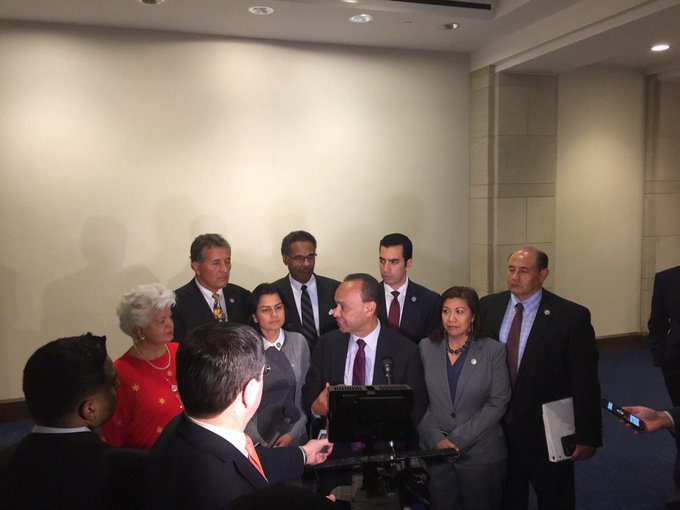
“I’m pretty shaken,” Illinois Democratic Rep. Luis Gutierrez said after he and Rep. Norma Torres, D-Calif., were asked to leave a meeting on Capitol Hill with Immigration and Customs Enforcement officials on Thursday afternoon.
“I’ve been here 25 years and I’ve never been told by the Speaker of the House that I can’t attend a meeting I’ve requested,” Guitierrez said afterward, Politico reported.
According to the lawmakers, both members of the Hispanic Congressional Caucus were barred from entering a meeting between congressional leaders and the federal agency that has ramped up its immigration enforcement following the inauguration President Donald Trump.
While eight Democrats — including Congressional Hispanic Caucus Chairwoman Michelle Lujan Grisham (D-N.M.) — were eventually allowed to attend Thursday’s meeting with ICE Acting Director Thomas Homan about deportation raids, House Minority Leader Nancy Pelosi told reporters that no invite was initially extended to members of the Hispanic Caucus. No members of the Congressional Asian Pacific American Caucus were invited either.
“Members of the CHC expressed interest in attending, and to accommodate the request, we welcomed the chair of the CHC to join on behalf of the other members,” House Speaker Paul Ryan’s spokesperson AshLee Strong told Politico. “We are confident that the CHC chair is capable of representing the views of her caucus, and this arrangement was made very clear to the CHC ahead of time.”
Ryan, who did not attend Thursday’s meeting, organized the briefing after ICE abruptly canceled a meeting with Democrats and members of the Hispanic Caucus previously scheduled for Tuesday. ICE officials said the agency canceled the initial meeting because the Hispanic Caucus attempted to invite too many people.
“Oh my God! That room is big enough. They have not filled it to capacity,” Rep. Tony Cardenas, D-Calif., who was not allowed to attend the meeting, complained to reporters outside.
According to the Huffington Post, Pelosi complained at the meeting that she had “never been in a meeting where an agency can designate who can attend.” She also called Ryan’s move “highly unusual.”
“It was the speaker’s staff that came to me, and I know her very very well, and she said she was speaking on behalf of the speaker, that there were a limited number of seats,” Gutiérrez said. When Reps. Gutierrez and Torres showed up, Judiciary Committee Chairman Bob Goodlatte, R-Va., asked them to leave, the Huffington Post reported:
Before [Torres] left, she asked ICE officials when she could get answers to questions about the raids. She said the officials did not answer; instead, Goodlatte told her that Republican leadership could get information to them.
“I was asked to leave and I was told that if we would like to have a meeting with ICE, that we need to go with the leadership of the majority party here and ask them to schedule a meeting and ask them to schedule a meeting for us with ICE,” Torres told her colleagues waiting outside the room.
“I speak English ― I don’t need a translator,” Torres told reporters afterward. “My constituents elected me to represent them here. I should be able to participate and hear firsthand what ICE is saying and what ICE is doing in my communities.”
Aside from Guitierrez and Torres beeing booted from the meeting, Reps. Grace Napolitano and Juan Vargas, both democratic representatives from California, were not even allowed in.
“I was expecting to get let in, we’re the ones who were asking for this meeting, now we’ve been barred from the meeting,” said Vargas. “I want to know what they’re doing, and now we’ve been barred from this meeting that we called for.”

I was asked to leave the meeting with  by @SpeakerRyan staff. Never before in 20 plus years has this happened.
Goodlatte defended his decision and told reporters that the arrangement was “agreed upon ahead of time.” He added that there were more Democrats than Republicans in the meeting.
Rep. Linda Sanchez, a Hispanic Caucus member who did attend the meeting, said lawmakers were told by Homan that they “can and should expect many more arrests and removals this year.”
Nearly 700 undocumented immigrants who were arrested in ICE raids across multiple states over the weekend — only 75 percent had a criminal record, according to ICE officials. One such raid, in the so-called sanctuary city of Seattle, resulted in the detention of a 23-year-old Mexican immigrant who has received protect from Obama Deferred Action Program twice.
“It was hard to not leave that meeting and believe that the Trump administration is going to target as many immigrants as possible,” Rep. Joaquin Castro (D-Texas), who attended the meeting, told reporters.

US ambassador to UN contradicts Trump's position on two-state solution

Nikki Haley said US upholds longstanding policy on Israeli-Palestine conflict, as French foreign minister finds Rex Tillerson’s proposal ‘confusing and worrying’

Go to Original
By 

The US ambassador to the United Nations has insisted that Washington “absolutely” supported a two-state solution to the Israeli-Palestine conflict, 24 hours after Donald Trump dropped US commitment to the policy.
The conflicting messages coming out of the new US administration reflected policy chaos in a week when the national security adviser was forced to resign over his contacts with Russia, and factions inside the White House continue to vie for dominance.
In Bonn, the French foreign minister, Jean-Marc Ayrault, emerged from his first meeting with the new US secretary of state, Rex Tillerson, to describe the Trump administration’s Middle East policy as “confused and worrying”.
Ayrault pointed to Trump’s remarks in a joint appearance with the Israeli prime minister, Benjamin Netanyahu, in which he explicitly abandoned the two decades-long US commitment to the creation of a Palestinian state alongside Israel as part of a final peace deal.
“I’m looking at two-state and one-state, and I like the one that both parties like. I’m very happy with the one that both parties like,” Trump said. “I can live with either one.”
After his meeting with Tillerson at the sidelines of a G20 meeting, Ayrault said: “I wanted to remind him after the meeting between Donald Trump and Netanyahu that in France’s view, there are no other options other than the perspective of a two-state solution and that the other option which Tillerson brought up was not realistic, fair or balanced.”
He did not give details about the option that Tillerson raised and the secretary of state did not take press questions, but he appears to have echoed Trump’s remarks suggesting other outcomes would be acceptable to the US.
“I found that there was a bit more precision even if I found that on the Israeli-Palestinian dossier it was very confused and worrying,” Ayrault told reporters. He also noted differences over the 2015 international nuclear deal with Iran, with the Trump administration wanting to review it “from scratch”.
Meanwhile the US ambassador to the UN, Nikki Haley, was adamant that US policy on Israeli-Palestinian issues had not changed.
“First of all, the two-state solution is what we support. Anybody that wants to say the United States does not support the two-state solution – that would be an error,” she told reporters at the UN headquarters in New York. Referring to Trump’s comments, she said: “We absolutely support the two-state solution, but we are thinking out of the box as well.”
Adding to the confusion, Trump used his meeting with Netanyahu to urge him publicly to restrain Israeli settlement building on the West Bank. But his nominee for the US ambassadorship, his former bankruptcy lawyer, David Friedman, has been a long-term supporter of expanded settlements and even annexation of the West Bank.
At his Senate confirmation hearing on Thursday, Friedman distanced himself from many of his past policy positions and comments on the Middle East, including his rejection of a two-state solution.
“If Israelis and Palestinians are able to achieve a two-state solution, I would be delighted,” he said, noting there was no “appetite among Palestinians” for a one-state solution. He added he no longer supported the annexation of the West Bank.
He repeatedly apologised for past verbal attacks on liberal American Jews, including the branding of Barack Obama and the state department as antisemitic and the description of the liberal Jewish advocacy group, J Street, as “worse than kapos” (Jews forced to act as guards in Nazi concentration camps).
“There is no excuse for my offensive comments. I deeply regret them. They don’t reflect my character,” Friedman said.
Republicans on the committee indicated they were likely to support Friedman’s nomination, all but assuring his eventual confirmation.
But the committee chairman, Senator Bob Corker, asked why he wanted the job so much if it meant “you have to recant every single strong held belief you’ve had”.
Friedman replied: “This is something I want to do because I think I can do it well and there is nothing more important to me than strengthening the bond between the US and Israel.”

Ukraine charges Russia with new cyber attacks on infrastructure

Go to Original
By Natalia Zinets

Ukraine on Wednesday accused Russian hackers of targeting its power grid, financial system and other infrastructure with a new type of virus that attacks industrial processes, the latest in a series of cyber offensives against the country.
Oleksandr Tkachuk, Ukraine's security service chief of staff, said at a press conference that the attacks were orchestrated by the Russian security service with help from private software firms and criminal hackers, and looked like they were designed by the same people who created malware known as "BlackEnergy."
Russia's Federal Security Service (FSB) could not be reached for comment. Moscow has repeatedly denied accusations from Kiev that it has been waging a "cyber war" on Ukraine since relations between the two countries collapsed following Moscow's 2014 annexation of Crimea and the outbreak of Russian-backed separatist fighting in Ukraine's Donbass region.
The allegations are the latest sign that Russia's behavior in conflict areas has not changed markedly since Donald Trump became U.S. president last month, calling for warmer relations between Washington and Moscow.

The new attacks caused some of Ukraine’s cyber defenders to cancel plans to attend this week’s RSA cyber security conference in San Francisco, according to one Western expert familiar with the situation.
If the allegations are confirmed, that could help Ukraine further its case for the United States to help coordinate a multi-national effort to counter the threat of Russian cyber warfare.
"There is a global cyber war of Russia against (the) whole world," President Petro Poroshenko told Reuters in an interview in January at the World Economic Forum in Davos.
Ukraine said Russia made 6,500 cyber attacks on it in November and December alone. Ukraine blamed hackers for knocking out part of Kiev's power grid in December, and for attacks on the defense and finance ministries and the State Treasury.
Tkachuk said at Wednesday's press conference that malicious software used in the campaign was designed to attack specific industrial processes. As an example, he said that the code included modules that sought to harm equipment inside the electric grid.
"Russian hackers and infobots become an important tool of the aggression against our country," Tkachuk said.
He said the attacks employed a mechanism dubbed "Telebots" to infect computers that control infrastructure.
Slovakian cyber-security firm ESET used the same name in December to identify the hacking group responsible for attacks on Ukraine's financial sector and energy industries.
ESET said it believed that Telebots had evolved from BlackEnergy, a hacking group that attacked Ukraine's energy industry starting in December 2015.
ESET researcher Cameron Camp said that the latest attack software sounded like a modest adaptation of an program his firm had published a report on in December.
Both campaigns were carefully targeted, opened back doors, sent out certain types of files to unknown masters, and downloaded tools that can wipe out those files.
Without directly attributing the attack to the Russians, Camp said "If it walks like a duck and talks like a duck, it's duck-like."
Separately on Wednesday, cyber security firm CyberX said that it had uncovered a separate espionage operation in Ukraine that had compromised more than 60 victims.
Victims of the malware included an energy ministry, a scientific research institute and a firm that designs remote monitoring systems for oil & gas pipelines, according to CyberX.
CyberX Chief Technology Officer Nir Giller said he was not sure who was behind the operation, but suspected it was conducting reconnaissance for launching further attacks.

Third arrest but Malaysia stays tight with North Korea

As Malaysian police detain two more suspects, the assassination of North Korea's genial former heir apparent is set to become a complex diplomatic issue for Kuala Lumpur


While police on Thursday detained a third person for the assassination of the half brother of North Korean leader Kim Jong Un in Kuala Lumpur, the Malaysia deputy prime minister stressed that the bizarre killing will not affect ties between the two countries. This assurance came despite US and South Korean government sources saying they believed Pyongyang agents carried out the killing.
“We maintain and we would like to strengthen our relationship with any foreign country that has established their embassy here,” Ahmad Zahid Hamidi told a reporter in Kuala Lumpur.
According to the deputy prime minister, Malaysia may return the body of Kim Jong Nam at Pyongyang’s request, saying that although there are “procedures to be followed,” Kuala Lumpur’s policy is “that we have to honour our bilateral relations with any foreign country.”
Yet Malaysia has not, according to sources, bowed to North Korean demands to have an autopsy on Kim Jong Nam cancelled and are carrying on with a murder investigation that saw a second female and her boyfriend detained on Thursday.
Links between Malaysia and North Korea are close and Monday’s murder will continue to be an increasingly complex and delicate issue for Kuala Lumpur as it treads a precarious line between China, the US and North Korea.
Kuala Lumpur has closer links with Kim Jong Un than most in the region with Malaysia having numerous business ties, relatively lax travel restrictions and even direct air connections with North Korea. In recent years it has become a venue for unofficial talks between Washington and Pyongyang and any credible murder investigation will only put strain on this relationship.
The second woman that has been detained – her travel documents bore the name of Siti Aishah, and listed her place of birth as Serang, Indonesia – has been remanded in custody for seven days. This woman’s boyfriend – currently unidentified – was apprehended some hours later and the pair join another woman, with Vietnamese travel documents, who was taken in by Malaysian police at Kuala Lumpur International Airport on Wednesday.
Kim Jong Nam was once North Korea’s heir apparent until he fell from grace after a peculiar incident when he traveled to Japan on a false passport to visit Disneyland in 2001. In recent years he has lived a seemingly quiet but comfortable life, mostly in the Asian gambling hub of Macau, avoiding controversy and appearing relaxed about personal safety, according to sources close to him.
Friends in Macau said Kim Jong Nam was an outwardly calm man, often casually dressed, sometimes in jeans and sandals, and carried a Louis Vuitton shoulder satchel. He had a striking dragon tattoo on his back, a source who went to the gym with Kim told Reuters.
A Facebook page under the name Kim Chol, which appears to be his, includes friends from numerous countries including France, Singapore and Switzerland and photos of Kim in various locales including Macau and Shanghai, as well as pictures of dogs. Kim Chol was the name on the passport Kim Jong Nam used to travel to Malaysia, according to authorities there.
“I miss Europe,” he posted next to a 2008 picture of himself and a man standing on a yacht. “Living Las Vegas in Asia,” he posted in 2010. His “likes” include French musician Serge Gainsbourg and two bars in Singapore, including one called Girls Bar Kimidori. He also “liked” Russian President Vladimir Putin and a Kim Jong Un impersonator calling himself Kim Jong “Um”.
Kim Jong Nam was fatally assaulted at an airport in Kuala Lumpur on Monday with what was believed to be a fast acting poison as he prepared to board a flight back to Macau.

Why Kim Jong Nam was murdered by poisoned needles

Go to OriginalBy STEPHEN BRYEN

The news today, February 14, 2017 is that the half-brother of Kim Jong Un, the Korean dictator, was murdered in Malaysia where two female assassins stabbed him with poisoned needles.
Kim Jong Nam, often described as a playboy, was the oldest son of Kim Jong-il and should have been his successor. But Kim Jong-il selected Kim Jong-Un instead.
The killing of Kim Jong Nam was a North Korean operation. As I wrote in in December, 2013, Kim Jong Nam was China’s proxy for replacing Kim Jong Un. China sees Kim Jong Un as an impediment to their goals on the Korean peninsula and as causing problems for China with the United States. China does not want to see American resources shifted to the Korean peninsula, especially the THAAD Terminal High Altitude Missile Area Defense system.
North Korea’s missile tests, in China’s view, are unnecessarily provocative and interfere with China’s policy of dominating the region by putting in place the analogue of pre-War Japan’s co-prosperity sphere, thus turning the tables on their former enemy.
A compliant North Korean leader serves China’s interests. A dangerous and reckless leader, which best describes Kim Jong Un, is a threat to China. China thus has sponsored at least two attempts to remove Kim Jong Un. One seems to have been in the works even before last week’s ballistic missile “test.” For any coup to work and avoid a nasty civil war that would invite the South Koreans and the Americans in, an acceptable successor was necessary and that would have been Kim Jong Nam.
It is noteworthy that reports last week say that Kim Jong Un purged his head of state security, General Kim Won-hong. He was the right hand man of the North Korean dictator and vital to the security of the regime. We don’t know exactly why, but Kim Jong Un felt threatened by his state security minister and liquidated him. It could be that coup planning was at an advanced stage. If so we can expect more upheaval in North Korea soon.
Below is my article of December 13, 2013. It makes clear why Kim Jong Un wanted his half brother dead.
December 13, 2013
The purge and execution of Jang Song Thaek in North Korea has touched off concern about the future of North Korea, and it has stimulated a variety of comments about what was behind Jang’s fall.
There are certain points to keep in mind in evaluating the North Korean situation.
1. The purge and execution of Jang Song Thaek was relatively quick. A few days before Jang Song Thaek was snatched by soldiers at a Politburo meeting in Pyongyang, reports leaked through sources in South Korea’s intelligence organization that two of Jang Song Thaek’s top aides had been executed. Even so, Jang went to the Politburo meeting where he was arrested, taken before a sort of military tribunal, and sentenced to death. It was only after the announcement of the execution that the official charges were announced by the North Korean mass media.
2. Jang’s arrest and immediate execution are unprecedented by the standards of modern totalitarian regimes. In modern times the two most notorious, Stalin’s Russia and China after Mao, behaved in a decidedly different manner. Typically, the subjects were arrested and held incognito for some time, in some cases as long as five years. Once matters were satisfactorily organized, state trials commenced. Many of these trials were public or semi-public in character, although other were secret trials. The accused were expected and, in many cases cooperated, in providing “confessions” of their “crimes.” Some, but not all were executed, some were sentenced to execution but received reprieves, and others were sent to labor camps and Gulags.
3. In China and Stalin’s Russia the purpose of the purges and trials was primarily the consolidation of power. The trials served the purpose of discrediting political factions and movements, creating a justification for the action of the state in making the arrests, and produced an aura of fear among those would-be opponents of the regimes. In Russia the purges of the old Bolsheviks morphed into the massive Great Purge that led to millions of deaths and a chain of prisons known as the Gulag Archipelago (the title of Aleksandr Solzhenitsyn’s famous book).
4. Confessions are the essential element of a successful show trial. In some cases, the confessions that were given were filled with coded messages, put there by the victims, to try and communicate to the global audience the real nature of their persecution. In other cases, such as Mao’s wife Jiang Qing, the effort to obtain a confession failed; more recently in the case of Bo Xilai, the “trial” was actually closed and only summaries were provided to the press (the actual court transcripts still are suppressed), because Bo, a powerful political figure, was uncooperative. He got a life sentence (his wife was previously convicted of murder and got a life sentence), but this saga is far from over.
5. In the case of Jang Song Thaek there was no confession, no open trial, no proceeding’s summaries, and no appeals. The sentence apparently was carried out immediately. In this circumstance, it more approximates what happened in the so-called trial of Nicolae and Elena Ceaușescu in Romania by a sort of revolutionary court. The couple were executed immediately on the conclusion of the proceeding, itself a shouting match. To add more insult to the affair, the condemned couple broke loose and ran around a courtyard until they were cut down by the executioners.
6. If we use the above as a guide, the execution of Jang is more like what happens in a revolution than in a power consolidation. But how can that be? How could Kim Jong Un be operating as a revolutionary? Only if his grip on power was so tenuous, and the situation so dire, that this was the only way he could survive.
7. Professor Kang Myong-do is the son in law of a former North Korean Prime Minister who is now a professor at Kyungmin University in South Korea. His explanation is one of the few that partly explains what is going on in North Korea. He says that Jang, in October, had traveled to China, probably Macao, which is a special administrative region of China and a former Portuguese colony and gambling center. He went there to take a monthly stipend to the older brother of Kim Jong Un, Kim Jong Nam. According to the Professor, this trip made Kim Jong Un very apprehensive and suspicious. It also conferred in Kim Jong Nam a much higher status than an exile who was passed over when power was transferred to Kim Jong Un. One recalls that Kim Jong Nam was poorly regarded,before this visit by Jang, and that he was passed over for succession by his father after it was exposed that he traveled to Japan under a false passport, ostensibly to go to Disneyland. In the eyes of the North Koreans, he would either have been regarded as a defector or a traitor for the unauthorized trip.
8. It is extraordinary and unusual for a very high ranking official, technically the number two guy in North Korea, to personally deliver money to Kim Jong Nam. Kim Jong Nam was a special “guest” of the Chinese government, and it does not take much to see that the visit was regarded, and probably was, a plot to get rid of Kim Jong Un. This plot can be surmised to consist of Jang, regarded as a major pro-China partisan, and Kim Jong Nam, a sort of hapless fellow but useful if the idea was to replace Kim Jong Un.
9. We recall that Jang is officially accused of treason, of “day dreaming” about “being recognized as a new regime” and of plotting a “premeditated coup against” Kim Jong Un. It is also worth noting that the official charges talk about the “discovery and purging of the Jang group….” In short, Kim Jong Un was in serious trouble and feared for his life.
10. Professor Kang says that Kim Jong Un had been trying for some time to assassinate his older bother and that some of the agents sent to kill him had been arrested by the Chinese.
11. Jang was married to the biological aunt of Kim Jong Un. There was speculation she may also have been involved in the plot, but according to the latest leaks from North Korea, she was consulted about the imminent purge of Jang and supported it. This story is almost certainly fabricated, but Jang’s execution and the threat to the aunt may have caused a great deal of panic in the larger family of the dictator. The leak was certainly designed to calm them down.
12. China’s game in all this is not clear, but it appears that China probably supported a coup d’etat and a more compliant North Korean leader in the form of Kim Jong Nam. Temporarily at least, China is the loser in the struggle. Kim Jong Un’s intelligence apparatus sniffed out the threat and Kim Jong Un liquidated it by cutting off its head. It is said, a fish rots from the head down. At least one of the heads, Jang’s, is off. Kim Jong Nam has a lot to worry about these days.
13. Where does all of this lead. Most of the experts are saying that all of Jang’s people will be purged. If this is true, there are some 20,000 who were directly dependent on Jang. If they are purged in a ruthless fashion, it could trigger heavy internal conflict. If the purge is gradual and measured, Kim Jong Un may survive for a while longer.
14. Meanwhile North Korea continues to fester and its economy continues to falter. The country is dysfunctional, and danger is always lurking when dealing with frightened and hungry people. That North Korea has nuclear weapons and rockets, and that the U.S. failed completely to make a deal with North Korea, creates a danger that goes far beyond the Korean peninsula.

US operations in Mosul take a dangerous turn

Go to Original
By SALMAN RAFI

If  nothing else, the US-led operation Fatah (victory) in the Iraqi city of Mosul has turned into everything but victory. On the other hand, “liberation” of the city is producing new conflict by reviving old ethnic and sectarian strife — a strife which, in turn, has a lot more to do with the economics of the city than mere ethnic and sectarian identities.
What had earlier been conceived by the Obama administration as a quick walk over the city has now turned into what a coalition spokesperson, Col. John Dorrian, has called an “extraordinarily dangerous” operation.
The remark has come at a time a when the presence of US Special Operations Forces in the city has been publicly acknowledged and their strength increased from 230 to 450.
Dorrian described the fight for Iraq’s second-largest city as “slow going,” saying further that it’s “going to take some time.” According to the commander of US-led anti-ISIS international coalition forces, General Stephen Townsend, Mosul would be recaptured from terrorists in the next six months, although he was earlier convinced that the target would be achieved by February 2017.
Liberation of the entire city is going to take time despite the other contradictory claim that the US-led coalition forces have killed almost 60,000 IS fighters in the past two years. 30,000 of these fighters have been killed during the on-going operation Fatah.
According to Raymond Thomas, the rise signifies the campaign’s (positive) progress in degrading the terrorist group. “I’m not into morbid body counts, but that matters,” Thomas was reported to have said at a National Defense Industrial Association conference in Maryland.
Yet, a clear victory is far from visible, making Mosul yet another instance, after Syria, where the coalition forces have been unable to achieve the stated objectives.
According to last reports, fighting in many parts of the city has completely ceased due primarily to the fact that the better part of the terrorist forces have moved to the western part of the city, spread into Iraq’s other cities such as Baghdad or simply “vanished” amid the civilian population, which in turn has become the biggest victim of the operation.
Thus, according to the statements of the UN coordinator in Iraq, Lise Grande, up to 47% of all the wounded men in Mosul were civilians, while on average this number rarely exceeds 15-20% in armed conflicts. In the last week of December, a total of 817 men were injured, while in early January, this number grew by another 683 people.
It must be noted that the way Washington has been waging the war on ISIS, with the use of “natives” as a main assault force, has already undermined its position in the region.
Largely seen in terms of the US inability or unwillingness to go deep enough in the operation, the unexpected prolongation of the operation has raised questions about the kind of objectives the US is pursuing in Iraq. Is the delay a part of the bigger plan of the US to stay militarily involved in the region?
While an answer to this question depends upon how the operation progresses in the future, what is becoming visible on the horizon is the other kind of conflict, i.e., sectarian strife brewing in the city among different militia units currently fighting the IS.
Were this fight to spread, Iraq will once again be facing the kind of situation it had to face after the withdrawal of US forces in 2008-09 – a situation that turned out to be the primary context against which ISIS emerged in the first place.
The roots lie in the hotch-potch of groups (Iraqi forces, Peshmerga, Sunni forces loyal to the government, Shia militias, units of Turkmens, Yazidi and Christians that operate as a part of the Popular Mobilization Units) the US has assembled and the tactical way they have been deployed, in a tightly compartmentalized fashion, in different parts of the city.
As such, while the Iran-backed Peshmerga fighters, who have previously been accused of atrocities against Sunni villagers, have been kept outside of Mosul in a bid to avoid ethnic violence, the KRG is determined to use their involvement in the offensive to strengthen its position with the central government in Baghdad.
Indeed, this was the message contained in an interview given at the beginning of the operation by KRG Foreign Minister Falah Mustafa Bakir. “We have a stake in Mosul,” he stated when asked about the role of the KRG after its recapture. “Mosul is important and has a direct impact on Irbil and Dohuk, and the KRG as a whole, in terms of security, economy, and social impact. Therefore, we need to be there.”
Economically, Mosul is a sufficiently large center of oil production and was one of the biggest sources of income for ISIS. Besides it, Mosul is also a transportation hub. Three major highways pass through Mosul: the Baghdad (№1) – Mosul – Syrian border – Aleppo (M4), the Baghdad (№2) – Mosul – Turkish border, and the Mosul – Kirkuk (№80). The branch of the so-called Baghdad railway also passes through the city. The city is located on the largest river in the Middle East, the Tigris River. The largest hydroelectric power station in Iraq is situated on this river (60 km from the city).
Therefore, control over resources of the city means the ability to exercise political influence on Baghdad and beyond. Therefore, the question of who will replace ISIS in the city has already started to surface and is, as one Iraqi journalist described it, likely to transform into yet another conflict with roots going well beyond Baghdad.
Hence, the question: can the US-led forces avoid this conflict or will this conflict become yet another excuse for them to prolong their stay in the city and the region?
That is to say, while ISIS might ultimately be eliminated, peace in the city may not immediately return if the question of accommodation of economic interests of diverse fighting militias is not given as much importance as the question of dismantling and destroying ISIS. Without it, Iraq may very well once again slip into the muddy-marsh of internal conflict, creating the context for another ISIS.

The US should change its approach to Iran

Go to Original
By MANISH RAI

The new US President Donald Trump’s decision to quickly slap new sanctions on Iran after it conducted a ballistic missile test clearly signals the hard turn the new administration intends to take with Tehran.
Neutralizing the Iranian threat in the Middle East has been an American aim since the 1979 Islamic Revolution. Arabs and Israelis alike will cheer Trump’s current hard line on Iran. But Iran is among the toughest foreign policy challenges United States have faced and President Trump should be careful to avoid ill-planned early actions against Iran which may turn out to be blunders.
The Trump administration is totally mistaken if it believes that a ratcheting up of pressure, coupled with closer policy alignment with Israel and Saudi Arabia, will force an Iranian retreat in the region. The Islamic Republic is too deeply entrenched in the region’s conflict zones and it will nearly impossible to impose any a quick retreat. By all credible accounts, Iran can firmly stand its ground even if it risks a major crisis in US-Iranian relations. Iran is a hardened adversary, despite its political isolation it is very much required to eradicate the Islamic State from the region. So rather than being isolated Iran should be engaged.
The US and other world powers took years to find a common ground with Iran, which prevented the country from acquiring nuclear weapons in return for removal of international sanctions. The deal, which was called Joint Comprehensive Plan of Action (JCPOA) allowed Iran to mend ties with European countries, boost its oil production and trade with other countries, thereby minimizing the pain its people had suffered due to economic sanctions. This resulted in empowering the hands of Iranian moderates who wants integration of Iran with Western economies. This progress stands threatened by President Trump’s current hostility toward Iran. Recent sanctions could strengthen hard-liners in the Iranian regime who are seeking to escalate tensions with the United States. There is a certain equation between the US and Iran. If Iran provokes and the US does not react, Iran’s deterrent power goes up because it learns it can do these provocations with no consequences. Surely Iran has carried out provocative activities like- carried out additional missile tests, stepped up its military presence in Syria and tries to provide “game-changing weapons” to Hezbollah.
This all should not be ignored by United States but it should not be dealt in the way like Trump administration is doing now. All the current measures which has been taken are counterproductive. There is an urgent need to develop some new options to deter and contain Iranian activities of concern. Some of measures which can work in current situation are following
Diplomatic engagement– The White House and State Department should look for opportunities to expand bilateral contacts, and to identify areas for cooperation. Beginning with work in multilateral settings on global and transnational problems may be more productive than an early focus on regional or bilateral issues, which will remain fraught for all parties.
Heavy US Military Presence- Heavy military presence in the region will be an essential part of the US strategy, even if deployment numbers and other quantitative metrics vary over time. The larger message to Iran, will be that the United States has vital interests in the region, an enduring commitment to regional stability, and an interest in preventing interstate conflict and intrastate destabilization.
Negotiations on ballistic missiles program — The strategy will need to delineate what aspects of Iran’s long-term commitment to developing this capability are unacceptable. Iran is unlikely to entirely roll back this program, which derives from its vulnerability to Iraqi missiles in the Iran- Iraq War. But the United States may be able to define some parameters to reduce the risks of miscalculation by Iran or its neighbors. While urging Iran to reduce the size and scope of the program, and make clear its conventional weapon only mission.
No country in the Middle East has Iran’s combination of geographic size, strategic location, large and educated population. Iran has been the most effective country at leveraging the ongoing disorder across the Middle East to expand its regional influence. Tehran has done this by providing substantial political, military and financial backing to allies and proxies in Bahrain, Iraq, Lebanon, Syria and Yemen. Iran now stands at the apex of arc of influence stretching from Tehran to the Mediterranean, from the borders of NATO to the borders of Israel and along the southern tip of the Arabian Peninsula. It commands the loyalties of tens of thousands in allied militias and proxy armies. They have been joined by thousands of members of the Islamic Revolutionary Guard Corps, Iran’s most prestigious military wing, who have acquired meaningful battlefield experience in the process. So it is nobody interest to press Iran to behave more militantly rather it should be engaged at various levels to promote the Islamic republic to play a constructive role to strengthen stability in the region.