Saturday, May 20, 2017

The Scramble for Post-ISIS Syria Has Officially Begun

A rare strike on Assad regime and its allies signals new dynamics in a long war.

Go to Original
By 


On Thursday, the United States deepened its involvement in the Syrian Civil War in ways that may only gradually become apparent. In targeting a convoy that Secretary of Defense James Mattis said included Iran-backed militiamen as well as Syrian regime forces, the U.S. apparently, for the first time since the conflict began six years ago, attacked foreign fighters allied to the Syrian government. The same incident also represented the second time the U.S. military has deliberately targeted Assad’s own forces, which the Trump administration struck last month in retaliation for the Syrian government using chemical weapons against civilians. Under Barack Obama, U.S. military operations in Syria were directed at ISIS and al-Qaeda affiliates. Now two additional factions in the multifaceted civil war are in America’s crosshairs.

The development is in part a reflection of the fact that Donald Trump, who as a presidential candidate promised to focus solely on ISIS in Syria, has as president taken a surprisingly hard line on the Assad government. But it’s also reflective of a broader dynamic: As ISIS loses strength and territory in Syria, the endgame of the civil war is drawing nearer and the various powers engaged in that struggle are shedding a common enemy. The result is a race to carve out spheres of influence—and the United States under Trump appears to be getting in on the action.

Consider the context of Thursday’s strikes. U.S. warplanes hit a pro-Assad military convoy that ignored warnings to steer clear of a base where American and British special-operations forces are training Syrian rebels to fight ISIS. In 2016, Russian aircraft twice bombed that same base. But the Obama administration, out of concern about getting drawn deeper into the Syrian conflict, did little to deter the Russians.

By striking pro-Assad forces that were encroaching on a hub for the U.S. campaign against ISIS, the Trump administration was “establishing a deterrent in Syria that we frankly didn’t have,” said Faysal Itani, a scholar of the Syrian conflict at the Atlantic Council. “We lost it over [Barack Obama’s decision in 2013 not to enforce his red line on] chemical weapons, we lost it over the fact that when we have guys on the ground who share our military agenda, we don’t protect them, and we give the impression that you can violate with impunity U.S. counterterrorism strategy.”

The strikes asserted “more conventional power politics that were not really a part of the Obama administration’s thinking” in Syria, Itani told me. They sent a message that the area around the base—al-Tanf in southeastern Syria, near the borders with Iraq and Jordan—was an “American sphere of influence and area of operations.”

The problem is that several factions in the conflict—most prominently Iran—aren’t willing to grant the Americans that plot of land. If the U.S. military did indeed strike Shiite militiamen affiliated with Iran this week, the bombing is a “very big deal,” Charles Lister, an expert on the Syrian Civil War at the Middle East Institute, told me—and not only because it could complicate cooperation between such militias and U.S. and Iraqi forces in the fight against ISIS across the border.

For days now, Lister said, Iran-backed militias have been “seeking to intimidate U.S.-backed anti-ISIS forces in southern Syria” and Iranian state media has been running reports warning of a “‘US plot’ to establish a buffer zone in southern Syria ‘to protect terrorists.’”

“Iran doesn’t want a single American in Syria and they’ve got an extensive track record of fighting Americans next door in Iraq,” Lister wrote by email. “Just as Assad and Iran look to be winning the ground war in Syria, the U.S. and its Syrian opposition partners in the south have intensified their own anti-ISIS activities, exerting more and more of an influence and presence in the south.”

“Simultaneously,” Lister added, “the U.S. is making no secret of its intent in northeastern Syria, where [the U.S. military] now operate[s] at least two airbases. All of this represents a very serious challenge to Iranian hard-won gains in Syria and the prospect for a contiguous land corridor from Tehran, to Baghdad, to Damascus, and to Beirut. That’s Iran’s ultimate dream objective in the Middle East and U.S. zones of influence in Syria’s north and south threaten that very much.”


The al-Tanf base is located in a sparsely populated desert region known as the Badia; in the map above, the base is the pink splotch in the sea of white. But it also happens to be near oil reserves, the Damascus-Baghdad highway (which Iran has used as a supply route for weapons), and the Syrian city of Deir Ezzor, where the Islamic State might make its last stand if the group is uprooted from its stronghold of Raqqa. The retreat of ISIS and peace talks in Kazakhstan, which recently produced a Russian/Iranian/Turkish plan to divide the Syrian battlefield into into “de-escalation zones,” have made the quest to control the area more urgent. Hence the mobilizing of forces and rattling of sabers there this week.

As The New York Times reports:

The crowded field of foreign participants in the Syrian conflict are all maneuvering for influence in and around de-escalation zones that Russia and Turkey have sought to establish. One of them is southern Syria, where the United States, Jordan and Israel are eager to prevent Iranian-backed groups, especially Hezbollah, from expanding a foothold. ...
The area is strategically important to the United States, which wants to stabilize Iraq where it has a long-term military and political investment, and to Russia, which wants to strengthen the Syrian government’s control of as much territory as possible.
And the area is critical to Iran, which wants secure corridors from its borders to the Mediterranean to reinforce its influence in Lebanon and maintain an ability to challenge Israel. All claim to be battling the Islamic State but have refused to collaborate.

Ahmad Majidyar, an Iran expert at the Middle East Institute, argues that the geopolitical power struggle on display in Syria this week is also playing out in Iraq, where “Iran-backed militia forces have launched a new military offensive ... to seize more territory from the Islamic State in western Mosul and control the land corridor from the strategic city of Tal Afar to the Syrian border.”

“It is too soon to say whether [Thursday]’s strikes mark a significant shift in ... U.S. policy in Syria—although it is the first time the U.S. military is providing air support to rebel groups attacked by pro-Assad forces—or the strikes were a one-time action for force protection purposes,” he wrote this week. “But one thing is clear: As the common enemy—the Islamic State—is losing ground in Iraq and Syria, the prospect of dangerous and direct confrontation between the Iran-backed militia forces and the U.S.-led coalition forces in Syria and Iraq is on the rise.”

But such risks of confrontation are the unavoidable price of committing to defeat the Islamic State in Syria, Itani said. Say the United States succeeds in removing ISIS from Raqqa and Deir Ezzor. How will it prevent the terrorist group from bouncing back? The only option is for the U.S. or its allies to hold ISIS’s former territory. And that requires staking out spheres of influence in Syria.

“I never thought it made sense to compartmentalize the ISIS problem from the geographies and the geopolitics and the military realities of the war,” Itani told me. “Now I would have understood a position that said, ‘ISIS is just not worth it. 

We’ll bomb them a bit, we’ll weaken them, we’ll cooperate with our allies, but we’re not going to degrade and destroy them and set this bar” so high. Donald Trump, however, hasn’t taken that position. He’s set the bar high.

That decision “doesn’t mean you have to go invade [Syria] with a quarter million troops,” Itani said. “But it does mean, yeah, you have to sit down and spend a lot of energy and time on the problem. It’s very consuming.” Meanwhile, just days after beating back the Syrian military and its Iran-backed allies, the American president has arrived at the first destination of his first official foreign trip: Saudi Arabia, otherwise known as Iran’s archenemy.

Facebook promised to tackle fake news. But the evidence shows it's not working

Following pressure from users, the social network introduced tools to stem the spread of false information. But the rollout has been rocky at best

Go to Original
By 


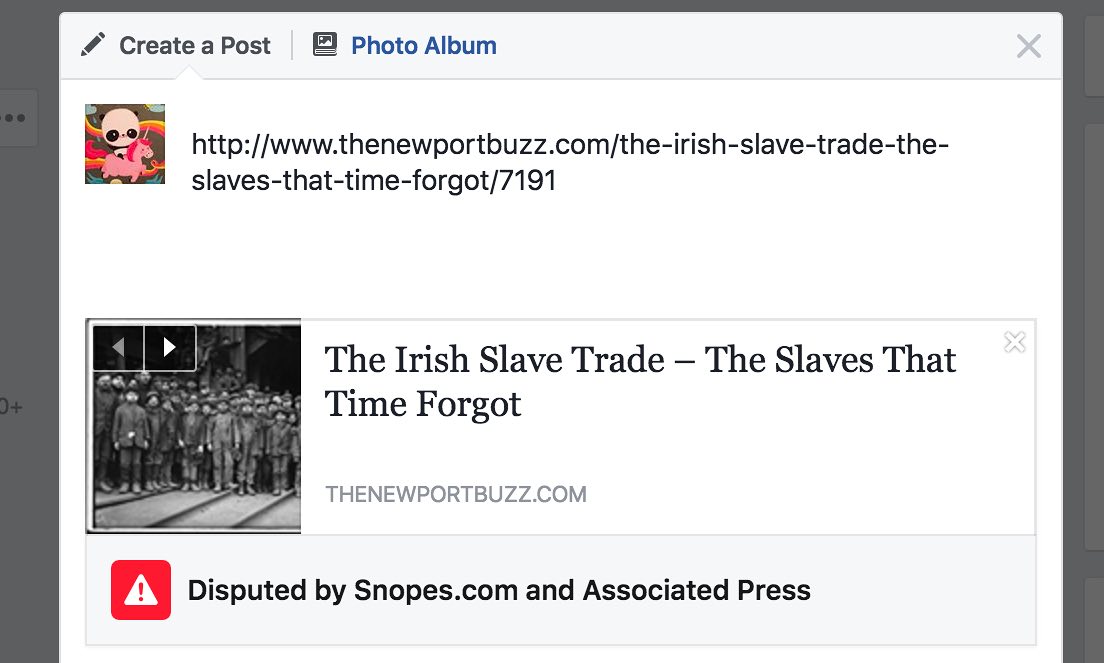
When Facebook’s new fact-checking system labeled a Newport Buzz article as possible “fake news”, warning users against sharing it, something unexpected happened. Traffic to the story skyrocketed, according to Christian Winthrop, editor of the local Rhode Island website.

“A bunch of conservative groups grabbed this and said, ‘Hey, they are trying to silence this blog – share, share share,’” said Winthrop, who published the story that falsely claimed hundreds of thousands of Irish people were brought to the US as slaves. “With Facebook trying to throttle it and say, ‘Don’t share it,’ it actually had the opposite effect.”
The spreading of Winthrop’s piece after it was debunked and branded “disputed” is one of many examples of the pitfalls of Facebook’s much-discussed initiatives to thwart misinformation on the social network by partnering with third-party fact-checkers and publicly flagging fake news. A Guardian review of false news articles and interviews with fact-checkers and writers who produce fake content suggests that Facebook’s highly promoted initiatives are regularly ineffective, and in some cases appear to be having minimal impact.
Articles formally debunked by Facebook’s fact-checking partners – including the Associated Press, Snopes, ABC News and PolitiFact – frequently remain on the site without the “disputed” tag warning users about the content. And when fake news stories do get branded as potentially false, the label often comes after the story has already gone viral and the damage has been done. Even in those cases, it’s unclear to what extent the flag actually limits the spread of propaganda.

The social network’s efforts to curb fake news followed widespread backlash about the site’s role in proliferating misinformation during the 2016 presidential election. The rocky rollout of Facebook fact-checking is as much a product of the enormity of the problem of internet propaganda as it is a reflection of what critics say is a failure by the company to take this challenge seriously.
“Fake news is flying thick and fast,” said Brooke Binkowski, the managing editor of Snopes, one of the popular fact-checking sites partnering with Facebook to review content that users flag as false. Asked if she believes Facebook’s new system is having an effect on false news through the use of tags, she added: “I honestly can’t tell.”
Last year, Facebook faced growing criticisms that it may have helped Donald Trump get elected by allowing fake election news to outperform real news, and creating filter bubbles that facilitated the increasing polarization of voters. In response, Facebook announced that it would work to stop misinformation in part by letting users report fake news articles, which independent fact-checking groups could then review.
When two or more fact-checkers debunk an article, it is supposed to get a “disputed” tag that warns users before they share the piece and is attached to the article in news feeds, a feature rolled out in March.
While some of the fact-checking groups said the collaboration has been a productive step in the right direction, a review of content suggests that the labor going into the checks may have little consequences.
ABC News, for example, has a total of 12 stories on its site that its reporters have debunked as part of its Facebook partnership. But with more than half of those stories, versions can still be shared on Facebook without the disputed tag, even though they were proven false. That includes several of the original stories that ABC bunked, such as an AngryPatriotMovement.com article about Obama planning a coup, an EmpireNews.net story that Obama built a statue of himselffor the White House, and a USANewsToday.org article about Republicans taking secret payments from Hillary Clinton.
Xana O’Neill, the managing editor of ABC News Digital, said her group has done roughly two-dozen Facebook fact checks and said she believed the process was having a positive impact. But, she added: “It’s hard to know the scope of it without the Facebook numbers.”
Facebook refused to provide data or information on the number of articles that have been tagged as disputed, how a flag impacts traffic and engagement, if there are specific websites most frequently cited and how long after publication the flags are typically added. A spokesman said “we have seen that a disputed flag does lead to a decrease in traffic and shares”, but declined to elaborate.
Robert Shooltz, who runs the site RealNewsRightNow, said it did not seem that the debunking of his content by Facebook fact-checkers was impacting traffic. Both Snopes and PolitiFact recently debunked his article that said Trump wants to bring back the military draft.
But the piece, which was published last year and recently began spreading again, does not have a disputed tag on it. It has had more than 33,000 likes, shares and comments, according to Facebook data.
“It’s had absolutely no effect. I’m happy about that,” said Shooltz, who considers his work satire, much like the Onion, and does not believe it should be targeted by Facebook fact-checking.

Another piece of his, headlined “Pope Francis: God Has Instructed Me to Revise the Ten Commandments” was also debunked by Snopes and the AP in March and does have the “disputed” tag. But he said it wasn’t clear to him if there was any serious impact on traffic and noted that the article had already experienced a spike in views prior to the debunks.
Paul Horner, another well-known fake news writer, said some of his websites have been blocked on Facebook, but that other articles have gone unchecked, including one saying Trump issued an order allowing bald eagles to be huntedand another about the president canceling Saturday Night Live. Both were published on the St George Gazette fake news site and both were debunked by Snopes.
Chris Kitze, who runs BeforeItsNews.com, said that although he allows users to post any content without fact-checking, he hasn’t noticed Facebook tagging any of his site’s articles as fake news. That includes a recent piece debunked by Snopes claiming to include leaked photos showing how Obama practiced Islam in the White House.
“A lot of people think Obama is Muslim. That’s what it plays on. Is it real? I don’t know,” he said. “The fact is a lot of people thought it was real or it reflects their sentiment.”
Aaron Sharockman, the executive director of PolitiFact, the Pulitzer Prize-winning site that is also fact-checking for Facebook, said that by the time his reporters debunk an article, it could have been up for several days to a week or more, meaning the effect of the flag may be limited.
“We don’t have a great sense of the impact we’re having,” he said, adding “We haven’t seen anything from Facebook.”
Jestin Coler, a writer who got widespread attention for the fake news he published last year, said it was hard to imagine Facebook’s effort having any impact.
“These stories are like flash grenades. They go off and explode for a day,” said Coler, who said he is no longer publishing false news. “If you’re three days late on a fact check, you already missed the boat.”
He also noted that many consumers of fake news won’t be swayed by a “disputed” tag given their distrust of the media and fact-checkers: “A far-right individual who sees it’s been disputed by Snopes, that adds fuel to the fire and entrenches them more in their belief.”
A writer with TheLastLineofDefense.org, another site that posts fake news, said the website has “definitely seen a drop in traffic since Facebook started relying on outside fact-checkers”, but did not respond to further questions.
Melissa Zimdars, assistant professor of communication and media at Merrimack College, who created a viral list of untrustworthy news sites, said it seemed Facebook was largely responding to bad press: “My initial read on it is it’s ultimately kind of a PR move. It’s cheap to do. It’s easy. It doesn’t actually require them to do anything.”
A Facebook spokesperson said the fact-checking tags were just one tool in its ongoing efforts, which include taking action against fake accounts, disrupting financial incentives of fake news creators and launching an educational tool.
“We take seriously the issue of fighting false news and are utilizing an all-of-the-above approach. There’s no silver bullet solution, which is why we’ve deployed a diverse, concerted and strategic plan.”

Jailed for a Facebook post: how US police target critics with arrest and prosecution

Felony case is part of what civil rights campaigners say is a disturbing trend of arresting users over innocuous political messages that constitute free speech

Go to Original
By 


Robert Peralta’s life was derailed by a single Facebook comment.

When the San Franciscan saw a well-known local activist had posted about being “choked” and “slammed” by a sheriff’s deputy at city hall, Peralta fired off a short response: “Wow, brother they wanna hit our general. It’s time to strike back. Let’s burn this motherfucker’s house down.”

Peralta, a 35-year-old activist and musician, didn’t think twice about the 23 January Facebook thread until two months later, when he learned that police had issued a warrant for his arrest – accusing him of threatening to kill law enforcement.
“Why waste all of the county’s money on this?” said Peralta, who turned himself in and was booked into jail, despite having no criminal record. “You’re going to take me to jail … for Facebook?”
Peralta’s felony criminal case is part of what civil rights campaigners say is a disturbing trend of police and prosecutors targeting activists for social media posts, arresting users over innocuous political messages that constitute free speech.
“For a country that purports to be guided by democracy and guided by civil rights, this is a very dangerous and very slippery slope,” said Malkia Cyril, the executive director of the Center for Media Justice. “Black activists are expressing anger, rage, hatred even about the conditions that threaten their daily lives, and they are being held liable for how they express that anger, even though they’ve committed no crime.”
Peralta’s charges have come at a time of heightened concerns about threats against law enforcement following a number of police killings – most notably a Dallas shooter who shot five officers last year. Donald Trump has also lamented a so-called “war on police”, and there has been a wave of “Blue Lives Matter” bills seeking to classify police as a protected class. Government statistics, however, suggest there is no surge in violence against police.
Critics say that digital surveillance is also plagued by racial biases, with law enforcement devoting significant resources to spying on specific activist communities, while ignoring complaints from minorities and women who face violent online abuse.
When Peralta commented on the Facebook post about alleged police violence in January – which included a photo of the officer’s arms around the activist’s neck – he said he knew nothing about the identity of the law enforcement official.
“On Facebook, you comment on so many things in minutes,” he said in a recent interview. “I didn’t even mean it.”

He later learned that an investigator had obtained a search warrant for his Facebook and was able to comb through his personal account.
Peralta thought it was a simple misunderstanding he could clear up by talking to police. But instead, prosecutors jailed him, saying the threat was “made so unequivocally, unconditionally, immediately and specifically as to convey to the person threatened a gravity of purpose and an immediate prospect of execution”.
His bail was set at $25,000.
“In jail, you just want to get out. You can’t deal with the environment,” he said. “I was not feeling like I was treated like a human.”
A friend helped Peralta post an initial $750 payment on the bail so he could be released, and eventually prosecutors agreed to dismiss the charge in exchange for Peralta giving a presentation to youth about responsible social media use.
Although he is on track to have the case wiped from his record, the prosecution has taken a serious toll on his life, Peralta said. He is still on the hook for $2,500 and is now paying monthly installments that are difficult to afford, given that he has a fixed income from disability payments. The sheriff’s office also seized his phone, which has his music on it, and won’t return it until the case is formally dismissed later this year.
“I’m still dealing with the repercussions,” he said.
A spokeswoman for the sheriff’s office noted that Peralta apologized to the deputy, adding, “It’s an excellent resolution to the case.”
Alex Bastian, spokesman for the San Francisco district attorney’s office, which prosecuted the case, noted that family members of the deputy had reported Peralta’s Facebook comment. He added in an email: “The first amendment is very sacred to us. At times, people make statements that infringe on another’s freedom to live free from fear. We are always striving to find the right balance between those two important considerations.”
Activists said Peralta’s story is not unique. After the Dallas police shootings last year, there was a spike in arrests across the country of people who criticized police on Facebook and Twitter, according to the Intercept. In March, police won a warrant to search a Facebook page of a Dakota Access pipeline protest group, leading to an ACLU challenge.
Chris Wahmhoff, a 38-year-old Michigan activist who was convicted of a felony for an oil pipeline protest action, got into trouble last year when he criticized governor Rick Snyder on Facebook amid the Flint water crisis, writing: “So when y’all are ready to march in and take his ass across the street, I have my torch, I got warm socks. I’m waitin on y’all … ”

The comment led to a probation violation charge for “threatening behavior”, even though Wahmhoff insisted that he was trying to argue for the governor’s arrest – that he be taken from his office across the street to the police department.
“I really felt we should have marched and did whatever we needed to do – non-violently – to get him in jail,” Wahmhoff said in a recent interview, adding that he felt his Facebook was targeted because of his previous protests. “They come after you if you become an activist just for the needs of control. They are going to keep pushing. It’s as simple as a bully.” The charge was later dropped.
Landon Davis, a San Francisco public defender, noted that the courts have granted citizens broad protections to criticize public officials, even if the comments are repulsive or shocking. Davis recently represented a man accused of making racist threats against a black police chief on Twitter, but ultimately convinced a judge to drop the charge on free speech grounds.
“As offensive as his statements were, if you look at the entire context, it was completely political,” said Davis, who is black.
Sometimes when police allege threats, Davis said, it seems they lack any evidence of danger and are simply pursuing charges because they were offended by the comments: “They use that as a basis to prosecute someone either they don’t agree with or don’t like … It can have a huge chilling effect on people’s expression online.” 

China 'dismantled' CIA spying operations and killed sources

Newspaper cites 10 current and former officials in report of serious intelligence breach caused either by a mole or hacking of covert communication system

Go to Original


The Chinese government “systematically dismantled” CIA spying operations in the country starting in late 2010 and killed or imprisoned at least a dozen CIAsources over the next two years, it was reported on Saturday.

The New York Times cited 10 current and former US officials, who described the intelligence breach as one of the worst in decades. They spoke on condition of anonymity.
The report said US intelligence and law enforcement agencies scrambled to stem the damage, but were bitterly divided over the cause of the breach. Some investigators were convinced there was a mole within the CIA, while others believed the Chinese had hacked the covert system the CIA used to communicate with its foreign sources. The debate remains unresolved, the paper said.
The CIA, which declined to comment to the Times, also declined to comment to the Associated Press.
The number of CIA assets lost in China rivaled those lost in the Soviet Union and Russia as a result of the betrayals by CIA officer Aldrich Ames and FBI agent Robert Hanssen, who were arrested in 1994 and 2001 respectively, the report said.
As many as 20 CIA sources were killed or imprisoned in China over a two-year period, the Times said, citing two former senior US officials.
Investigators suspected a former CIA operative of being a mole, but failed to gather enough evidence to arrest him and he is now living in another Asian country, the report said. Those who rejected the mole theory attributed the losses to sloppy American tradecraft in China.
By 2013, the FBI and CIA concluded that China no longer had the ability to identify American agents, the Times said.

Paul Ryan Tries to Deflect on Leak that Implicates Him in a Russia Cover-Up

A slip of the tongue from Majority Leader Kevin McCarthy mentions Donald Trump being on Vladimir Putin's payroll.

Go to Original
By Joan McCarter


Speaker Paul Ryan is trying out the Trump regime's favorite defense against damning news—focus on the leaker rather than on the content. In this case, it's the release of a transcript with a slip of the tongue from Majority Leader Kevin McCarthy about Donald Trump being on Vladimir Putin's payroll, a "joke" that Ryan immediately threatened all of those present to forget ever happened. Ryan is in full deflection mode trying to cover up what he and others in Republican leadership—we're looking at you, Mitch McConnell—knew about Russia's interference in the election on behalf of Trump and when they knew it.
Friday morning, Ryan told conservative radio host Hugh Hewitt that the recording was “a cause of concern” for him and other Republicans.
“I’ve never seen anything like this,” the speaker said. “There was somebody who taped a meeting a year ago where our majority leader cracked a joke and then they released the tape of that joke out just a few days ago and that’s a pretty bizarre thing to happen. So obviously that’s a cause of concern of ours.”
He's never seen anything like this? How about watching the Russians hacking the DNC, getting a briefing from the Ukrainian prime minister which detailed the attacks and the sophisticated propaganda Russia was conducting against it and other European nations, and then brushing off the suggestion that Putin was controlling the possible Republican presidential nominee? That's pretty bizarre and unimaginable. And that's exactly what happened.
But let's not let Ryan and McConnell off that easy, because that private June meeting the transcript is from isn't the first time Ryan heard about any of this stuff.
  • A full year before this meeting, in the summer of 2015, congressional leaders including McConnell and Ryan's predecessor John Boehner were briefed on Russian hacking attempts on the DNC. It strains credulity to believe Ryan wasn't read into these details when he took over as speaker.
  • On June 15, 2016, the news broke in the Washington Post and the whole world found out what leadership already knew—that the Russians had hacked the DNC.
  • On June 16, 2016, McCarthy makes his "joke." A "joke" Ryan responded to immediately by telling the group "No leaks … This is how we know we're a real family here."
  • In August 2016 Ryan and McConnell got a series of "urgent, individual" briefings from CIA Director John Brennan, informing them that Russia was working to help elect Donald Trump.
  • In September 2016 the "Gang of 12"—Senate, House, and congressional intelligence committee leaders—were briefed by the intelligence community about Russian interference in the election. This is when McConnell jumped in to voice doubts about the intelligence presented and to squelch it. With no objection from Ryan.
He’s never seen anything like a meeting being secretly recorded? How about a hostile foreign power hijacking and American election?
Ryan and McConnell knew full well going into the election process—including the primaries—that Russia was getting involved in this election. They knew when Trump received the nomination that Russia was working to get him elected. Ryan oversaw the Republican National Convention where the one thing the Trump campaign insisted on being in the platform was a softening of the party's stance on helping Ukraine defend itself against Russia.
None of this is a joke, and since that Ryan's deflection trying to push this off on the leaker? That's bullshit. He's up to his eyeballs in this.

6 Things Trump Does Not Understand About His Job

Mistaking the presidency for a personal business has delivered the Trump White House into failure.

Go to Original
By Jefferson Morley


For President Trump's admirers, his disregard for the traditional ways of Washington is just his way of getting things done. “To the new president, Washington niceties are cobwebs on a summer porch, distracting, inconvenient, in the way of his higher purposes,” writes Robert Charles on Town Hall.
But in the past week, Trump’s “higher purposes” have been all but eclipsed, by a week of low deeds that mired his already embattled presidency in a swamp of dysfunction. He fired former ally James Comey as FBI director, all but admitted obstruction of justice by saying he acted to end the FBI investigation into his dealings with Russia, and then shared classified information with the Russian foreign minister. Along the way, he contradicted his own aides’ explanations of his actions, confirming that White House statements cannot be trusted.  
All of a sudden, the cobwebs of Washington seem more like spiderwebs, and Trump resembles nothing so much as the fly who can’t extricate himself from its sticky strands.
What Charles calls “niceties” are, in fact, a set of laws and customs that empower and constrain the American president. Imagining that these arrangements are liberal trickery, Trump thinks what he has thought all along: that he can ignore them and achieve his goals.
That was true when his goal was winning the presidency. Now that he is trying to deliver action for his voters and allies in Congress, Trump is learning the price of ignorance: he cannot achieve his “higher purposes" because he doesn't understand the nature of his job.
1. The president is not a CEO.
Trump seems to believe what UN Ambassador Nikki Haley told ABC’s “This Week": “The president is the CEO of the country. He can hire and fire whomever he wants. That’s his right."
Actually, the president is not the chief executive officer of the government. Unlike a corporate CEO, Trump has no ownership rights in the enterprise he runs, the federal government. The executive branch is not a family business, despite Jared Kushner’s determination to give Chinese investors a different impression.
The president does have the right to fire the director of the FBI, but the Bureau’s employees do not work for the president. As James Hohmann of the Washington Post notes, FBI agents swear to uphold the U.S. Constitution, not serve the president. The Bureau’s website explains why:
“It is significant that we take an oath to support and defend the Constitution and not an individual leader, ruler, office, or entity. … A government based on individuals — who are inconsistent, fallible, and often prone to error — too easily leads to tyranny on the one extreme or anarchy on the other. … The American colonists were all too familiar with the harmful effects of unbalanced government and oaths to individual rulers.”
In other words, the authors of the U.S. Constitution wanted to make sure the president was not a king or a CEO. Oblivious to this historical truth, Trump fired FBI director Comey, transforming a man who helped him get elected into an enemy who now wants to go public.
2. The truth matters.
“Leadership that is not deeply rooted in a foundation of truth is leadership destined to fail," says one management consultant. Of course, this elementary principle of running a business did not apply to the Trump Organization, which relied on hype, lies, false statements, and legal evasions to generate the deals that enriched Trump and beggared his customers and employees.
But Trump ignores the principle when running the government at his own peril. Of course, a president can be expected to shade, interpret or rationalize the truth in service of his greater goals, but over time, false statements tend to inspire mistrust and create opposition among people who feel deceived.
To be sure, the cost of false statements may take a while to come due. President George W. Bush did not pay for his false statements about Iraq’s weapons of mass destruction or his fatuous "mission accomplished" declaration. Most voters did not care, and he won reelection in 2004. But when he stayed on vacation in the summer of 2005 as Hurricane Katrina drowned 1,000 people in New Orleans, and then praised FEMA director Michael Brown for doing a “heck of a job,” his credibility vanished in the course of a couple of news cycles. After his previous misstatements, even the Republican base voters stopped listening. They no longer gave Bush the benefit of the doubt, and his presidency was over, at least in terms of achieving anything new.
While Trump’s supporters say they would vote for him again, those who defend him on a daily basis are now learning that there is no reward for defending him. The toll is not yet seen, and Trump has not yet encountered his Katrina. If and when he responds to calamity with falsehoods, he will pay for what now costs him nothing.
3. Tax returns matter.
Trump cannot escape the standard set by previous presidents who released their tax returns. On May 12, Trump released a letter from his tax lawyers stating that his tax returns over the last decade do not show any income or debt from Russian sources, with a couple of exceptions.
The president cited the letter in his interview with Lester Holt of NBC News as part of his defense amid a political firestorm over his dismissal of Comey.
The letter inspired predictable skepticism from the left and from experts. More significantly, the letter was ignored by the president’s defenders. Breitbart News ran a wire service story about the letter, but the hard-right site never cited Trump's letter in its ever-changing defense of Trump’s actions around Russia. Thanks to the transparency of his predecessors, Trump’s stunt was simply not credible—not even as propaganda, not even to his admirers.
4. Keeping secrets matters.
The power of the presidency is, in part, the power of secrecy. To be entrusted with all of the government’s most secretive information is to be entrusted with power. Carelessness with secrets is carelessness with power, and that is exactly what Trump demonstrated in sharing Israeli intelligence reporting on ISIS with Soviet foreign minister Sergey Lavrov on May 15.
“'It is another indication that you cannot possibly control this guy,' Wayne White, a senior intelligence official at the State Department during the George W. Bush administration, told Politico. 'There are red lines that even presidents are not supposed to be crossing. He has to be protecting his own assets. It is really frightening for our people, especially the people who managed the relationship in getting the information.'"
 Trump tweeted on Tuesday that he had an “absolute right” to share information in the interest of fighting terrorism and called it a “very, very successful meeting” in a brief appearance at the White House alongside Lt. Gen. H.R. McMaster, his frazzled national security adviser. McMaster all but conceded Trump had shared information that U.S. intelligence officials wished he had not. Then he assured reporters that he was not concerned that information sharing among intelligence partners would stop.
The frantic improvisation of Trump's team sends a clear message: anyone who wants to share confidential information with the U.S. government now has reason to doubt.
“Any country that shares intelligence with American officials could decide it can’t trust the United States with information, or worse, that it can’t trust the president of the United States with information,” said Rep. Adam B. Schiff (D-CA), ranking Democrat on the House Intelligence Committee.
A European intelligence official is already saying just that, according to the AP.
5. Legislation matters.
Presidents are not judged by their TV ratings, but by the measures they implement to advance their agendas. Not only did Trump accomplish relatively little by historical standards in his first 100 days, he also alienated potential allies who might have enabled him to achieve more.
Unfamiliar with the details of health care reform, Trump endorsed a House Republican plan to gut Obamacare and deprive millions of people of their health insurance. The bill died without a vote. Eager for a victory, any victory, Trump endorsed another House Republican plan before the Congressional Budget Office could even assess its impact.
Without a consistent message, Trump has trouble attracting followers. The Republican senators immediately announced they would “start over” in writing health care legislation. Trump’s uninformed opinions about health care will not have any effect on what, if anything, the Senate does.
The same dynamic has killed Trump’s job-creation agenda, perhaps his most politically effective issue during the campaign. In February, Trump endorsed a border adjustment tax to stimulate domestic production. By April, he had adopted a new tax reform agenda in which the BAT went unmentioned.
On Tuesday, a team of retail industry lobbyists met with Treasury Secretary Steve Mnuchin.
"The CEOs reinforced to the secretary the industry's deep opposition to the border adjustment tax," said Brian Dodge, a senior executive for the Retail Industry Leaders Association, which organized the meeting. Mnuchin, who has never liked the idea of an import tax, did not defend the proposal, and Trump’s jobs agenda continues to recede.
Trump has become a spectator of the legislative process.
6. Impeachment matters.
Impeachment is written into Trump’s job description. The American president is subject, not superior to, the law, according to the U.S. Constitution. In creating the presidency, the Founding Fathers stressed the holder of the office “would be liable to be impeached, tried, and, upon conviction of treason, bribery, or other high crimes or misdemeanors, removed from office; and would afterwards be liable to prosecution and punishment in the ordinary course of law.”
The American presidency contrasted with the British monarchy, wrote Alexander Hamilton in the Federalist Papers: “The person of the king of Great Britain is sacred and inviolable; there is no constitutional tribunal to which he is amenable; no punishment to which he can be subjected without involving the crisis of a national revolution."
By ignoring the emoluments clause of the Constitution which bars the president from accepting payments from foreigners, Trump acts as a king, as if there is “no punishment to which he can be subjected without involving the crisis of a national revolution.”
By ignoring the law on obstruction of justice in firing Comey, Trump invites another article of impeachment.
The Republican majority in Congress can protect Trump from impeachment for the moment, but they cannot eliminate the possibility that accountability will lead to impeachment.
Trump’s firing of FBI director Comey revived memories of President Nixon firing the Watergate special prosecutor in October 1973. Of course, there are key differences: Nixon faced a Democratic Congress and a uniformly hostile media, while Trump has a Republican majority and a powerful conservative media sector that is still loyal.
What hasn't changed is that advocates of a lawless presidency have the tool of impeachment to rally public opinion. In October 1973, Nixon also enjoyed solid support from the Republican base and Republican lawmakers confidently rejected talk of impeachment, just as Trump's supporters do today.
Ten months later, Nixon’s lies caught up with him; Democrats drew up a bill of impeachment, and Nixon's base abandoned him. The elected Republicans soon followed. Impeachment and conviction were suddenly all but certain and Nixon resigned. It's another lesson Trump hasn’t learned.