Monday, September 21, 2009

CIA Directors conclude CIA shouldn't be investigated for murder

DOJ officials rush to assure everyone that Holder's investigation is severely limited; even that's not enough.

Go to Original
By Glenn Greenwald

In a truly shocking development being treated as major news, seven former CIA Directors -- including all three who served under George W. Bush -- jointly concluded that the CIA should not be criminally investigated for torture deaths, and they have written a letter to President Obama (.pdf) expressing that view. Do leaders of organizations in general ever believe that their organizations and its members should be criminally investigated and possibly prosecuted for acts carried out on behalf of that organization, and do CIA Directors specifically ever believe that about the CIA? Has a CIA Director ever advocated that CIA agents be criminally investigated for illegal intelligence activities?
But what's most notable about this letter is that it is not addressed to the individual charged with making decisions about whether an individual should be prosecuted: namely, the Attorney General of the U.S. Instead, it is addressed to the President himself, and they "urge [him] to exercise [his] authority to reverse Attorney General's August 24 decision to re-open the criminal investigation of CIA interrogations." What so-called "authority" are they talking about?
The way our criminal justice system works is that the President has the authority to set generalized policy priorities for the DOJ (e.g., spend more resources on drug and terrorism offenses but less on pornography and gambling), but decisions about whether specific individuals will or will not be prosecuted are supposed to be immunized entirely from White House influence, and are the province of independent Justice Department prosecutors (led by the Attorney General). That's what it means to have an apoliticized justice system: the President doesn't order specific people to be prosecuted or shielded from prosecution. Only Justice Department officials, assessing purely legal factors, make those determinations.
In fact, the entire U.S. Attorneys scandal was grounded in exactly this concern: that Karl Rove and the Bush White House were directing that certain prosecutors be fired either for criminally investigating specific Republicans or refusing to prosecute specific Democrats. Decisions about specific prosecutions aren't for the White House to make. No DOJ official with the most minimal integrity would allow the President to block specific criminal investigations as these CIA Directors urge.
Richard Nixon tried that and it led to the Saturday Night Massacre, when he ordered his Attorney General and (when the AG refused) Deputy Attorney General to fire Archibald Cox, the Watergate Special Prosector, after Cox had refused to accept White House limitations on his investigation. Both the Attorney General and Deputy Attorney General resigned rather than let Nixon interfere with their independence in making decisions about prosecutions. Similarly, it has been reported that public decrees earlier this year from White House political advisers (led by Rahm Emanuel) that there would be no CIA torture investigations infuriated DOJ officials because that's not the White House's decision to make. It was the DOJ's anger over this Emanuel-led usurpation of its responsibilities that led Obama to make publicly clear that decisions about prosecutions are the DOJ's to make, not his.
What these CIA Directors are urging would be completely improper. In fact, one could plausibly argue that where (as here) the DOJ determines that serious crimes might have been committed and an investigation needed, it would constitute obstruction of justice for the President to intervene by quashing any possibility of prosecution. As former aide to Condoleezza Rice, Philip Zelikow, put it in April of this year: "I really don't think the President should have opinions on who should or should not be prosecuted -- full stop."
But we have a political culture which believes, literally, that the CIA must operate above and beyond the law (recall Joe Klein's argument against torture prosecutions: CIA agents "behave extra-legally for the greater good of the nation"). Even though the American people have enacted numerous laws through their Congress which explicitly criminalize certain behavior on the part of the intelligence community (torture, warrantless eavesdropping, failing to brief Congress), there is a widespread belief that we can and must allow the CIA to commit crimes with impunity. The CIA's personal spokesman at The Washington Post, David Ignatius, argues outright that the CIA should not be prosecuted for crimes because we want to ensure they are willing to act illegally in the future.
The CIA is one of the leading weapons the political establishment uses to disregard the law -- to commit crimes -- when they want to, and that's the elite prerogative at stake here, one of the prime powers they are fighting to preserve by arguing against prosecutions (that, and a desperation that nobody "look backwards" at what they did). So if improper presidential interference in the prosecutorial process is how that gets accomplished, so be it. By definition, opponents of torture prosecutions are not people concerned with adhering to what the Beltway calls legal niceties (i.e., the rule of law), and so it shouldn't be surprising that they want the President to obstruct specific prosecutions that he opposes for political reasons.
What makes all of this sturm und drang over Holder's decision so remarkable is how severely limited the DOJ's investigation is. I've written before about how it is designed to ensure nothing more than Abu Ghraib justice -- at most, some isolated CIA interrogators might be investigated, but not the White House and DOJ architects of the torture regime itself. But -- apparently in response to the CIA Directors' letter -- DOJ officials ran (anonymously, of course) to The Washington Post yesterday to assure everyone that the scope of the DOJ investigation is even far more limited than previously thought:
The Justice Department's review of detainee abuse by the CIA will focus on a very small number of cases, including at least one in which an Afghan prisoner died at a secret facility, according to two sources briefed on the matter. . . .
Among the cases under review will be the death seven years ago of a young Afghan man, who was beaten and chained to a concrete floor without blankets, according to the sources. The man died in the cold night at a secret CIA facility north of Kabul, known as the Salt Pit. . . .
Although earlier reports indicated that [prosecutor John] Durham would look into 10 cases, a source said recently the number is much smaller. . . . A senior official who took part in the review confirmed that of two dozen referrals, the Salt Pit episode was one of two or three cases close to being considered for criminal indictment. . . .
Two other detainee cases were among those that drew significant law enforcement attention: the death by suffocation of Iraqi Gen. Abed Hamed Mowhoush in November 2003, after which an Army officer was convicted; and the death the same month of Manadel al-Jamadi at Abu Ghraib prison, in the custody of the CIA, where he was placed after being beaten by Navy SEALs.
The only thing Holder wants investigated -- what has provoked all of this intense Beltway uproar -- is "two or three cases" where detainees were killed. Contrary to how this has been debated, what Holder has ordered is not a "torture investigation." To the contrary, he said explicitly that those who tortured in good faith compliance with Yoo's torture memos will be immunized. It isn't torture techniques which are being considered for prosecution. All Holder has ordered are basically just garden-variety murder investigations, where two or three helpless detainees were sadistically beaten to death or suffocated while in American custody. At least according to the DOJ sources who ran to the Post yesterday in light of the CIA Directors' letter: that's all that's being investigated.
But even that is too much for our political class. Apparently, not only should executive branch officials and their agencies be allowed to institute a torture regime, spy on Americans illegally, and commit war crimes , but they should also be allowed literally to get away with murder. After all, if they aren't allowed to do that, they'll be deterred from doing it again in the future -- if they're investigated, they might feel compelled to think about "the law" as a limit on what they can do -- and we wouldn't want that.
* * * * *
An email problem yesterday entirely of my own making resulted in my not receiving any emails sent to me over the last 24 hours, so if you sent one to me during that period, please re-send it if you want me to see it.
UPDATE: In other breaking news, Erik Prince announces that he believes criminal prosecutions of Blackwater are unwarranted; Wall Street CEOs -- past and present -- conclude that an investigation of fraud and abuse among investment banks would serve no real purpose; Alberto Gonzales reveals his opposition to any proceedings against DOJ lawyers who acted in bad faith; police unions announce that the problem of brutality is overstated and there's no need for added oversight; medical doctors agree that malpractice lawsuits need to be limited; and a poll of felons currently in prison reveal that 99% of them believe that the country would have been better off if it had just let bygones be bygones and decided not to proceed with prosecutions in their particular case.

Missile Defense: The Other Story

New missile defense architecture, expanded role for NATO

Go to Original
By Bruce Gagnon


We are witnessing a flurry of emails and articles proclaiming victory after President Obama's announcement that he was going to scrap George W. Bush's plans to deploy missile defense interceptors in Poland and a Star Wars radar in the Czech Republic. There is no doubt that our peace activist friends in those two countries do indeed have reason to celebrate after their hard and determined work to stop those deployments. We also need to recognize and thank the many people around the world who acted in solidarity with them during these past couple years of intensive campaigning.

But now that we've had a day to rejoice, the time has come for more reflection on what the Obama administration intends to do next. I've quickly learned during these eight months of watching Obama in action that when he gives something with one hand it is wise to watch what his other hand is taking away.

In his September 17 speech Obama stated that his new missile defense architecture for Europe would be more "comprehensive than the previous [Bush] program" and would be "enhanced" by NATO involvement.

Secretary of War Robert Gates was left to explain the details of the new missile defense "architecture" that would replace the now rejected deployment plan for Poland and the Czech Republic.

Gates stated that he was the one who had proposed three years ago to deploy the missile defense systems in Poland and the Czech Republic. He concluded that the original plan was no longer the best military "architecture" for the current "threat" from Iran. Thus instead of missile defense interceptors that would target offending missiles in their mid-course of flight, and that had a series of bad test results, the Pentagon now wanted to deploy in northern and southern Europe missile defense systems that had a proven testing record and were more appropriate for the kind of threat now expected from Iran.

The intelligence community now assesses that the threat from Iran's short- and medium-range ballistic missiles, such as the Shahab-3, is developing more rapidly than previously projected," Gates said. "This poses an increased and more immediate threat to our forces on the European continent, as well as to our allies."

Gates continued, "We now have proven capabilities to intercept these [short range] ballistic missiles with land and sea-based interceptors supported by much improved sensors. This allows us to deploy a distributed sensor network rather than a single-fixed site, like the kind slated for the Czech Republic."

US Navy Aegis destroyers, outfitted with Standard Missile-3 (SM-3) missile defense interceptors, would "provide flexibility to move interceptors from one region to another," Gates said. In years to come the SM-3 will be upgraded and be deployed throughout Europe as land-based systems as well. Since 2007 the SM-3 has had eight successful tests, including the February of 2008 shoot-down of a falling military satellite with an SM-3 missile from an Aegis ship in what many saw as proof that these systems also had "anti-satellite" weapons capability.

You can watch brief video clips of Gates here and Obama here from yesterday, or look below at one of my earlier posts for the videos.

The Russians first reaction was positive, as would be expected, since they were deeply concerned that the Poland and Czech deployments could be used by the US as the shield in a first-strike attack. But their concerns have not completely disappeared.

The Washington Post reported today that Maj. Gen. Vladimir Dvorkin, former chief of the Russian military's main research institute for nuclear strategy, cautioned that the reconfigured U.S. system could still pose a threat to Russia. "Everything depends on the scale of such a system," he told the Interfax news agency. "If it comprises a multitude of facilities, including a space echelon, it may threaten the Russian potential of nuclear deterrence."

As described by Gates and his top generals, Obama's new missile defense plan will unfold in three stages. By 2011, the Pentagon will deploy Navy Aegis ships equipped with SM-3 interceptors in the eastern Mediterranean.

A second phase in about 2015 will field an upgraded, land-based SM-3 in allied countries, and discussions are underway with Poland and the Czech Republic on basing the missiles in their territory, Gates said. In 2018, the third phase will deploy a larger and more capable missile, which will allow the system to protect Europe and the United States against short- and intermediate-range rockets and, eventually, intercontinental ballistic missiles.

Bloomberg News reports that, “This shift clearly benefits Lockheed Martin and Raytheon and is negative” for Boeing. “The move away from fixed missile-defense sites in Eastern Europe is a continuation of the more flexible, tactical missile-defense shield that Secretary Gates advocated," said Rob Stallard, an analyst at Macquarie Capital Inc. in New York.

The Pentagon’s 2010 budget seeks 250 Standard Missile-3 interceptors. It also seeks to increase to 27 from 21 the number of warships equipped to launch the Standard Missile-3s and requests $1.6 billion to develop software and hardware to upgrade ships and to develop a ground-based model.

The Pentagon is also now promising Poland that Patriot missiles will still be deployed in that country as previously planned.

So in the end I see this as an adjustment in strategy due to technology as much as anything. The flexible, more mobile, short range missile defense systems are proving ready to go while the former Bush proposal for Poland and Czech Republic included technologies that are not yet proven.

Obama can appear to be stepping back from an immediate confrontation with Russia but in fact he is following the lead of the Pentagon who for some time has been saying that they must move to expand the more promising Navy Aegis-based missile defense system. This program has already been dramatically growing in the Asian-Pacific region and will now be slated for expanded European operations.

Meet the Afghan Army

Is It a Figment of Washington's Imagination?

Go to Original
By Ann Jones

The big Afghanistan debate in Washington is not over whether more troops are needed, but just who they should be: Americans or Afghans -- Us or Them. Having just spent time in Afghanistan seeing how things stand, I wouldn't bet on Them.
Frankly, I wouldn't bet on Us either. In eight years, American troops have worn out their welcome. Their very presence now incites opposition, but that's another story. It's Them -- the Afghans -- I want to talk about.
Afghans are Afghans. They have their own history, their own culture, their own habitual ways of thinking and behaving, all complicated by a modern experience of decades of war, displacement, abject poverty, and incessant meddling by foreign governments near and far -- of which the United States has been the most powerful and persistent. Afghans do not think or act like Americans. Yet Americans in power refuse to grasp that inconvenient point.
In the heat of this summer, I went out to the training fields near Kabul where Afghan army recruits are put through their paces, and it was quickly evident just what's getting lost in translation. Our trainers, soldiers from the Illinois National Guard, were masterful. Professional and highly skilled, they were dedicated to carrying out their mission -- and doing the job well. They were also big, strong, camouflaged, combat-booted, supersized American men, their bodies swollen by flack jackets and lashed with knives, handguns, and god only knows what else. Any American could be proud of their commitment to tough duty.
The Afghans were puny by comparison: Hundreds of little Davids to the overstuffed American Goliaths training them. Keep in mind: Afghan recruits come from a world of desperate poverty. They are almost uniformly malnourished and underweight. Many are no bigger than I am (5'4" and thin) -- and some probably not much stronger. Like me, many sag under the weight of a standard-issue flack jacket.
Their American trainers spoke of "upper body strength deficiency" and prescribed pushups because their trainees buckle under the backpacks filled with 50 pounds of equipment and ammo they are expected to carry. All this material must seem absurd to men whose fathers and brothers, wearing only the old cotton shirts and baggy pants of everyday life and carrying battered Russian Kalashnikov rifles, defeated the Red Army two decades ago. American trainers marvel that, freed from heavy equipment and uniforms, Afghan soldiers can run through the mountains all day -- as the Taliban guerrillas in fact do with great effect -- but the U.S. military is determined to train them for another style of war.
Still, the new recruits turn out for training in the blistering heat in this stony desert landscape wearing, beneath their heavy uniforms, the smart red, green, and black warm-up outfits intended to encourage them to engage in off-duty exercise. American trainers recognize that recruits regularly wear all their gear at once for fear somebody will steal anything left behind in the barracks, but they take this overdressing as a sign of how much Afghans love the military. My own reading, based on my observations of Afghan life during the years I've spent in that country, is this: It's a sign of how little they trust one another, or the Americans who gave them the snazzy suits. I think it also indicates the obvious: that these impoverished men in a country without work have joined the Afghan National Army for what they can get out of it (and keep or sell) -- and that doesn't include democracy or glory.
In the current policy debate about the Afghan War in Washington, Senate Armed Services Committee Chairman Carl Levin wants the Afghans to defend their country. Senator John McCain, the top Republican on the committee, agrees but says they need even more help from even more Americans. The common ground -- the sacred territory President Obama gropes for -- is that, whatever else happens, the U.S. must speed up the training of "the Afghan security forces."
American military planners and policymakers already proceed as if, with sufficient training, Afghans can be transformed into scale-model, wind-up American Marines. That is not going to happen. Not now. Not ever. No matter how many of our leaders concur that it must happen -- and ever faster.
"Basic Warrior Training"
So who are these security forces? They include the Afghan National Army (ANA) and the Afghan National Police (ANP). International forces and private contractors have been training Afghan recruits for both of them since 2001. In fact, the determination of Western military planners to create a national army and police force has been so great that some seem to have suppressed for years the reports of Canadian soldiers who witnessed members of the Afghan security forces engaging in a fairly common pastime, sodomizing young boys.
Current training and mentoring is provided by the U.S., Great Britain, France, Canada, Romania, Poland, Mongolia, New Zealand, and Australia, as well as by the private for-profit contractors MPRI, KBR (formerly a division of Halliburton), Pulau, Paravant, and RONCO.
Almost eight years and counting since the "mentoring" process began, officers at the Kabul Military Training Center report that the army now numbers between 88,000 and 92,000 soldiers, depending on who you talk to; and the basic training course financed and led by Americans, called "Basic Warrior Training," is turning out 28,800 new soldiers every year, according to a Kabul Military Training Center "fact sheet." The current projected "end strength" for the ANA, to be reached in December 2011, is 134,000 men; but Afghan officers told me they're planning for a force of 200,000, while the Western press often cites 240,000 as the final figure.
The number 400,000 is often mentioned as the supposed end-strength quota for the combined security forces -- an army of 240,000 soldiers and a police force with 160,000 men. Yet Afghan National Police officials also speak of a far more inflated figure, 250,000, and they claim that 149,000 men have already been trained. Police training has always proven problematic, however, in part because, from the start, the European allies fundamentally disagreed with the Bush administration about what the role of the Afghan police should be. Germany initiated the training of what it saw as an unarmed force that would direct traffic, deter crime, and keep civic order for the benefit of the civilian population. The U.S. took over in 2003, handed the task off to a private for-profit military contractor, DynCorp, and proceeded to produce a heavily armed, undisciplined, and thoroughly venal paramilitary force despised by Kabulis and feared by Afghan civilians in the countryside.
Contradicting that widespread public view, an Afghan commanding officer of the ANP assured me that today the police are trained as police, not as a paramilitary auxiliary of the ANA. "But policing is different in Afghanistan," he said, because the police operate in active war zones.
Washington sends mixed messages on this subject. It farms out responsibility for the ANP to a private contractor that hires as mentors retired American law enforcement officers -- a Kentucky state trooper, a Texas county lawman, a North Carolina cop, and so on. Yet Washington policymakers continue to couple the police with the army as "the Afghan security forces" -- the most basic police rank is "soldier" -- in a merger that must influence what DynCorp puts in its training syllabus. At the Afghan National Police training camp outside Kabul, I watched a squad of trainees learn (reluctantly) how to respond to a full-scale ambush. Though they were armed only with red rubber Kalashnikovs, the exercise looked to me much like the military maneuvers I'd witnessed at the army training camp.
Like army training, police training, too, was accelerated months ago to insure "security" during the run-up to the presidential election. With that goal in mind, DynCorp mentors shrunk the basic police training course from eight weeks to three, after which the police were dispatched to villages all across the country, including areas controlled by the Taliban. After the election, the surviving short-course police "soldiers" were to be brought back to Kabul for the rest of the basic training program. There's no word yet on how many returned.
You have to wonder about the wisdom of rushing out this half-baked product. How would you feel if the police in your community were turned loose, heavily armed, after three weeks of training? And how would you feel if you were given a three-week training course with a rubber gun and then dispatched, with a real one, to defend your country?
Training security forces is not cheap. So far, the estimated cost of training and mentoring the police since 2001 is at least $10 billion. Any reliable figure on the cost of training and mentoring the Afghan army since 2001 is as invisible as the army itself. But the U.S. currently spends some $4 billion a month on military operations in Afghanistan.
The Invisible Men
What is there to show for all this remarkably expensive training? Although in Washington they may talk about the 90,000 soldiers in the Afghan National Army, no one has reported actually seeing such an army anywhere in Afghanistan. When 4,000 U.S. Marines were sent into Helmand Province in July to take on the Taliban in what is considered one of its strongholds, accompanying them were only about 600 Afghan security forces, some of whom were police. Why, you might ask, didn't the ANA, 90,000 strong after eight years of training and mentoring, handle Helmand on its own? No explanation has been offered. American and NATO officers often complain that Afghan army units are simply not ready to "operate independently," but no one ever speaks to the simple question: Where are they?
My educated guess is that such an army simply does not exist. It may well be true that Afghan men have gone through some version of "Basic Warrior Training" 90,000 times or more. When I was teaching in Afghanistan from 2002 to 2006, I knew men who repeatedly went through ANA training to get the promised Kalashnikov and the pay. Then they went home for a while and often returned some weeks later to enlist again under a different name.
In a country where 40% of men are unemployed, joining the ANA for 10 weeks is the best game in town. It relieves the poverty of many families every time the man of the family goes back to basic training, but it's a needlessly complicated way to unintentionally deliver such minimal humanitarian aid. Some of these circulating soldiers are aging former mujahidin -- the Islamist fundamentalists the U.S. once paid to fight the Soviets -- and many are undoubtedly Taliban.
American trainers have taken careful note of the fact that, when ANA soldiers were given leave after basic training to return home with their pay, they generally didn't come back. To foil paycheck scams and decrease soaring rates of desertion, they recently devised a money-transfer system that allows the soldiers to send pay home without ever leaving their base. That sounds like a good idea, but like many expensive American solutions to Afghan problems, it misses the point. It's not just the money the soldier wants to transfer home, it's himself as well.
Earlier this year, the U.S. training program became slightly more compelling with the introduction of a U.S.-made weapon, the M-16 rifle, which was phased in over four months as a replacement for the venerable Kalashnikov. Even U.S. trainers admit that, in Afghanistan, the Kalashnikov is actually the superior weapon. Light and accurate, it requires no cleaning even in the dust of the high desert, and every man and boy already knows it well. The strange and sensitive M-16, on the other hand, may be more accurate at slightly greater distances, but only if a soldier can keep it clean, while managing to adjust and readjust its notoriously sensitive sights. The struggling soldiers of the ANA may not ace that test, but now that the U.S. military has generously passed on its old M-16s to Afghans, it can buy new ones at taxpayer expense, a prospect certain to gladden the heart of any arms manufacturer. (Incidentally, thanks must go to the Illinois National Guard for risking their lives to make possible such handsome corporate profits.)
As for the police, U.S.-funded training offers a similar revolving door. In Afghanistan, however, it is far more dangerous to be a policeman than a soldier. While soldiers on patrol can slip away, policemen stuck at their posts are killed almost every day. Assigned in small numbers to staff small-town police stations or highway checkpoints, they are sitting ducks for Taliban fighters. As representatives of the now thoroughly discredited government of President Hamid Karzai, the hapless police make handy symbolic targets. British commanders in Helmand province estimated that 60% of Afghan police are on drugs -- and little wonder why.
In the Pashtun provinces of southern Afghanistan, where the Taliban is strong, recruiting men for the Afghan National Police is a "problem," as an ANP commander told me. Consequently, non-Pashtun police trainees of Hazara, Tajik, Uzbek, or other ethnic backgrounds are dispatched to maintain order in Pashtun territory. They might as well paint targets on their foreheads. The police who accompanied the U.S. Marines into Helmand Province reportedly refused to leave their heavily armed mentors to take up suicidal posts in provincial villages. Some police and army soldiers, when asked by reporters, claimed to be "visiting" Helmand province only for "vacation."
Training Day
In many districts, the police recently supplemented their low pay and demonstrated allegiance to local warlords by stuffing ballot boxes for President Karzai in the presidential election. Consider that but one more indication -- like the defection of those great Islamist fundamentalist mujahidin allies the U.S. sponsored in the anti-Soviet jihad of the 1980s who are now fighting with the Taliban -- that no amount of American training, mentoring, or cash will determine who or what Afghans will fight for, if indeed they fight at all.
Afghans are world famous fighters, in part because they have a knack for gravitating to the winning side, and they're ready to change sides with alacrity until they get it right. Recognizing that Afghans back a winner, U.S. military strategists are now banking on a counterinsurgency strategy that seeks to "clear, hold, and build" -- that is, to stick around long enough to win the Afghans over. But it's way too late for that to work. These days, U.S. troops sticking around look ever more like a foreign occupying army and, to the Taliban, like targets.
Recently Karen DeYoung noted in the Washington Post that the Taliban now regularly use very sophisticated military techniques -- "as if the insurgents had attended something akin to the U.S. Army's Ranger school, which teaches soldiers how to fight in small groups in austere environments." Of course, some of them have attended training sessions which teach them to fight in "austere environments," probably time and time again. If you were a Talib, wouldn't you scout the training being offered to Afghans on the other side? And wouldn't you do it more than once if you could get well paid every time?
Such training is bound to come in handy -- as it may have for the Talib policeman who, just last week, bumped off eight other comrades at his police post in Kunduz Province in northern Afghanistan and turned it over to the Taliban. On the other hand, such training can be deadly to American trainers. Take the case of the American trainer who was shot and wounded that same week by one of his trainees. Reportedly, a dispute arose because the trainer was drinking water "in front of locals," while the trainees were fasting for the Muslim holy month of Ramazan.
There is, by the way, plenty of evidence that Taliban fighters get along just fine, fighting fiercely and well without the training lavished on the ANA and the ANP. Why is it that Afghan Taliban fighters seem so bold and effective, while the Afghan National Police are so dismally corrupt and the Afghan National Army a washout?
When I visited bases and training grounds in July, I heard some American trainers describe their Afghan trainees in the same racist terms once applied to African slaves in the U.S.: lazy, irresponsible, stupid, childish, and so on. That's how Afghan resistance, avoidance, and sabotage look to American eyes. The Taliban fight for something they believe -- that their country should be freed from foreign occupation. "Our" Afghans try to get by.
Yet one amazing thing happens to ANA trainees who stick it out for the whole 10 weeks of basic training. Their slight bodies begin to fill out a little. They gain more energy and better spirits -- all because for the first time in their lives they have enough nutritious food to eat.
Better nutrition notwithstanding -- Senator Levin, Senator McCain -- "our" Afghans are never going to fight for an American cause, with or without American troops, the way we imagine they should. They're never going to fight with the energy of the Taliban for a national government that we installed against Afghan wishes, then more recently set up to steal another election, and now seem about to ratify in office, despite incontrovertible evidence of flagrant fraud. Why should they? Even if the U.S. could win their minds, their hearts are not in it.
One small warning: Don't take the insecurity of the Afghan security forces as an argument for sending yet more American troops to Afghanistan. Aggressive Americans (now numbering 68,000) are likely to be even less successful than reluctant Afghan forces. Afghans want peace, but the kharaji (foreign) troops (100,000, if you include U.S. allies in NATO) bring death and destruction wherever they go. Think instead about what you might have won -- and could still win -- had you spent all those military billions on food. Or maybe agriculture. Or health care. Or a civilian job corps. Is it too late for that now?

Sunday, January 18, 2009

Israel accused of war crimes over 12-hour assault on Gaza village

Go to Original
By Fida Qishta and Peter Beaumont

White flags ignored and houses bulldozed with families inside, claim residents

Israel stands accused of perpetrating a series of war crimes during a sustained 12-hour assault on a village in southern Gaza last week in which 14 people died.

In testimony collected from residents of the village of Khuza'a by the Observer, it is claimed that Israeli soldiers entering the village:

• attempted to bulldoze houses with civilians inside;

• killed civilians trying to escape under the protection of white flags;

• opened fire on an ambulance attempting to reach the wounded;

• used indiscriminate force in a civilian area and fired white phosphorus shells.

If the allegations are upheld, all the incidents would constitute breaches of the Geneva conventions.

The denunciations over what happened in Khuza'a follow repeated claims of possible human rights violations from the Red Cross, the UN and human rights organisations.

The Israeli army announced yesterday that it was investigating "at the highest level" five other attacks against civilians in Gaza, involving two UN facilities and a hospital. It added that in all cases initial investigations suggested soldiers were responding to fire. "These claims of war crimes are not supported by the slightest piece of evidence," said Yigal Palmor, an Israeli foreign ministry spokesman.

Concern over what occurred in the village of Khuza'a in the early hours of Tuesday was first raised by the Israeli human rights group B'Tselem. Although an Israeli military spokesman said he had "no information that this alleged incident took place", witness statements collected by the Observer are consistent and match testimony gathered by B'Tselem.

There is also strong visible evidence that Khuza'a came under a sustained attack from tanks and bulldozers that smashed some buildings to pieces.

Pictures taken by photographer Bruno Stevens in the aftermath show heavy damage - and still burning phosphorus. "What I can tell you is that many, many houses were shelled and that they used white phosphorus," said Stevens yesterday, one of the first western journalists to get into Gaza. "It appears to have been indiscriminate." Stevens added that homes near the village that had not been hit by shell fire had been set on fire.

The village of Khuza'a is around 500 metres from the border with Israel. According to B'Tselem, its field researcher in Gaza was contacted last Tuesday by resident Munir Shafik al-Najar, who said that Israeli bulldozers had begun destroying homes at 2.30am.

When Rawhiya al-Najar, aged 50, stepped out of her house waving a white flag, so that the rest of the family could leave the house, she was allegedly shot by Israeli soldiers nearby.

The second alleged incident was on Tuesday afternoon, when Israeli troops ordered 30 residents to leave their homes and walk to a school in the village centre. After travelling 20 metres, troops fired on the group, allegedly killing three.

Further detailed accounts of what occurred were supplied in interviews given to a Palestinian researcher who has been working for the Observer, following the decision by Israel to ban foreign media from the Gaza Strip. Iman al-Najar, 29, said she watched as bulldozers started to destroy neighbours' homes and saw terrified villagers flee from their houses as masonry collapsed.

"By 6am the tanks and bulldozers had reached our house," Iman recalled. "We went on the roofs and tried to show we were civilians with white flags. Everyone was carrying a white flag. We told them we are civilians. We don't have any weapons. The soldiers started to destroy the houses even if the people were in them." Describing the death of Rawhiya, Iman says they were ordered by Israeli soldiers to move to the centre of the town. As they did, Israeli troops opened fire. Rawhiya was at the front of the group, says Iman.

Marwan Abu Raeda, 40, a paramedic working for the Nasser hospital in Khan Younis, said: "At 8am we received a phone call from Khuza'a. They told us about the injured woman. I went immediately. I was 60 or 70 metres away from the injured woman when the Israeli forces started to shoot at me." As he drove into another street, he came under fire again. Twelve hours later, when Rawhiya was finally reached, she was dead.

Iman said she ended up in an area of rubble where a large group of people had sought cover in a deep hole among the debris of demolished houses. It is then, she says, that bulldozers began to push the rubble from each side. "They wanted to bury us alive," she said.

Just Say "No" to the Credit Rating Agencies

Go to Original
By Gerald Epstein

The credit rating agencies have got us, coming and going. First they help cause the biggest economic calamity since the 1930's. And now they tell us we can't take the fiscal measures needed to get us out of this mess. Meanwhile, they are laughing all the way to the bank (that is, if they can find one that is still solvent). Why are we still listening to them?

The role played by the big credit rating agencies - such as Standard & Poor's and Fitch - in the unfolding financial crisis is now well-known. By giving complex, opaque and ultimately toxic mortgage-backed securities high ratings and therefore, their own ringing stamp of approval, the credit agencies enabled banks to market these destructive securities around the world. We are now all paying the price.

Now, to prevent this very same crisis from turning into a full-blown catastrophe 1930's-style, governments around the world - from Obama to Brown to Merkel and beyond - are finally beginning to do the right thing: they are planning major fiscal spending operations to place a floor on the terrifying downward economic spiral and to begin to turn the world economy toward recovery. Even the austerity-loving IMF is strongly supporting these initiatives.

Yet now, Standard & Poor's and Fitch are sending "credit warnings" to other governments, threatening to downgrade their sovereign debt ratings if they "allow" their fiscal deficits to increase too much. Wednesday, Standard & Poor's downgraded Greece's sovereign credit rating. Explaining the downgrade, Marko Mrsnik, S&P analyst, said: "The global financial and economic crisis has, in our opinion, exacerbated an underlying loss of competitiveness in the Greek economy." (Financial Times, January 14, 2009). And in recent days, three other eurozone countries - Portugal, Ireland and Spain - have been warned by Standard & Poor's to "fix" their public finances or face downgrades. Under the current system, such downgrades would increase the cost of raising funds and be taken as a signal to investors to shy away from these investments.

Most significantly, these public warnings fire a shot across the bow of larger countries - such as Germany, the UK and France - that they had better not go too far down the road of fiscal expansion, or they might face a similar fate.

Yet, increasing spending and fiscal deficits in the short run is exactly what these governments should be doing. And now, after helping to cause the crisis, the credit rating agencies are blocking the way to the solution. The actions by Standard & Poor's are therefore profoundly misguided and potentially destructive.

For starters, the implicit model used by these agencies is fundamentally flawed - especially in this crisis context. As even the IMF, financial market economists, and usual deficit hawks such as Larry Summers now recognize, as the world's economies spiral downwards, fiscal deficits will automatically grow as tax revenues fall and spending on social safety nets increases. This will occur with no increases in discretionary counter-cyclical fiscal policy at all. Such depression-level deterioration surely will put pressure on countries' abilities to service their debts and even risk widespread defaults or debt rescheduling. The only way, then, to improve countries' ability and willingness to service debt in the medium term is to engage in massive fiscal expansions in the short term. But the credit rating agency models do not reflect this truth.

This is true on a country by country case. What is most insidious about the credit agency warnings is the "fallacy of composition" follies it provokes. If collectively countries and investors follow their advice and governments - especially in the largest countries - fail to engage in large enough fiscal expansions - then the prospects for widespread payment problems of sovereign debt surely will occur. A widespread heeding of Standard & Poor's information will almost certainly lead to massive losses for investors.

So what is to be done?

In the short run, prominent policymakers in national as well as international forums should collectively discredit the credit rating agencies. The IMF, the BIS, the European Union and business leaders around the world should denounce this wrong and destructive advice. Second, the rules governing pension funds and other investment funds should be immediately changed - at least for the duration of the crisis - to allow them to discount the weight they give to the agencies' ratings of sovereign debt. In the medium term, substitutes must be found for these agencies' ratings, which by now should have lost all credibility. The creation of a global nonprofit agency, funded with an endowment to protect its political independence, yet one that is transparent and broadly open to scrutiny - should be strongly considered.

Finally, and of fundamental importance, efforts to take more internationally coordinated action to achieve massive fiscal stimulus - supported by central banks - must be taken immediately. This credit ratings fiasco - which picks off the weakest countries one by one and sends warnings to the stronger ones - an anti-Keynesian divide-and-conquer strategy - could not occur if governments coordinated and unified their actions to turn this crisis around.

Israel's Next War: Today the Gaza Strip, Tomorrow Lebanon?

Go to Original
By Mahdi Darius Nazemroaya

The March to War: Today the Gaza Strip, Tomorrow Lebanon...

In the Middle East, it is widely believed that the war against Gaza is an extension of the 2006 war against Lebanon. Without question, the war in the Gaza Strip is a part of the same conflict.

Moreover, since the Israeli defeat in 2006, Tel Aviv and Washington have not abandoned their design to turn Lebanon into a client state.

Prime Minister Ehud Olmert told France's President Nicolas Sarkozy, in so many words, during his visit to Tel Aviv in early January that today Israel was attacking Hamas in the Gaza Strip and that tomorrow it would be fighting Hezbollah in Lebanon.[1]


Ehud Olmert and Nicolas Sarkozy

Lebanon is still in the cross-hairs. Israel is searching for a justification or a pretext to launch another war against Lebanon.

Washington and Tel Aviv had initially hoped to control Beirut through client political forces in the March 14 Alliance. When it became apparent that these political forces could not dominate Lebanon politically the Israeli military was unleashed on Lebanon with a goal of bringing about the ultimate downfall of Hezbollah and its political allies. [2] Areas where support for Hezbollah and its political allies were strongest saw the harshest Israeli attacks in 2006 as part of an attempt to reduce, if not remove, popular support for them.

After the 2006 war, the second Israeli defeat in Lebanon, Washington and Tel Aviv with the help of Jordan, the U.A.E., Egypt, and Saudi Arabia started arming their clients in Lebanon to wield an internal armed option against Hezbollah and its allies. In the wake of both the short-lived internal violence between the Lebanese National Opposition and the March 14 Alliance and the Doha Accord, which was reached in Qatar on May 21, 2008 as a result of the failure of this internal armed option against Hezbollah and its allies, the Israeli-U.S. objective to subdue Lebanon has been dramatically impaired.

A "national unity government" was formed in which the Lebanese National Opposition — not just Hezbollah — hold veto power through one-third of the cabinet chairs, including that of the post of deputy-prime minister.

The objective in Lebanon is "regime change" and to repress all forms of political opposition. But how to bring it about? The forecast of the 2009 general-elections in Lebanon does not look favourable for the March 14 Alliance. Without an internal political or armed option in Lebanon, which could result in the installation of a U.S.-sponsored "democracy," Washington and its indefictible Israeli ally have chosen the only avenue available: a military solution, another war on Lebanon. [3]

Crossing Arms III: Israel Simulates a Two-Front War against Lebanon and Syria

This war is already in the advanced planning stage. In November 2008, barely a month before Tel Aviv started its massacre in the Gaza Strip, the Israeli military held drills for a two-front war against Lebanon and Syria called Shiluv Zro’ot III (Crossing Arms III).[4]

The military exercise included a massive simulated invasion of both Syria and Lebanon. Several months before the Israeli invasion drills, Tel Aviv had also warned Beirut that it would declare war on the whole of Lebanon and not just Hezbollah.[5]

Israel's justification for these war preparations was that Hezbollah has grown stronger and become a partner in the Lebanese government since the Doha Accord. The latter was signed in Qatar between the March 14 Alliance and the Lebanese National Opposition. It is worth noting that Hezbollah was a member of the Lebanese coaltion government prior to the 2006 Israeli war on Lebanon.

No doubt, Tel Aviv will also point to Hezbollah's support of Hamas in Gaza as another pretext to wage under the banner of combating Islamic terrorism a pre-emptive war on Lebanon. In this context, Dell Lee Dailey the head of the counter-terrorism section of the U.S. State Department, had told Al-Hayat in an interview that an Israeli attack on Lebanon was "imminent" as part of the fight against terrorism. [6]

Blitzkrieg in the Making

Tel Aviv has been mapping a large-scale blitzkrieg against Lebanon as a whole, which includes an immediate land invasion. [7] Just before the Israeli massacre in the Gaza Strip started, Israeli officials and generals had promised that no Lebanese village would be immune from the wrath of Israeli aerial bombardments, regardless of religion, sect, and/or political orientation. [8]

In substance, Tel Aviv has promised to totally destroy Lebanon. Israel has also confirmed that in any future war against Lebanon, the entire country rather than Hezbollah will be the target. In practice, this was already the case in 2006’s Israeli aerial attacks on Lebanon. [9]

The Jerusalem Post quotes Brigadier-General Michael Ben-Baruch, one of the individuals who oversaw the invasion drills, as saying, "In the last war, we fired to disrupt Hezbollah activity," and, "The next time we will fire to destroy." [10]

In the wake of Israel's 2006 defeat, the Israeli government admitted that its "big mistake" was it exercised restraint rather than attacking Lebanon with the full strength of its military. Israeli officials have intimated that in the case of a future war against the Lebanese that all civilian and state infrastructure will be targeted.

Beirut’s New Defence Doctrine: A Threat to Israeli Interests and Objectives to Control Lebanon

Why is Lebanon in the cross-hairs again?

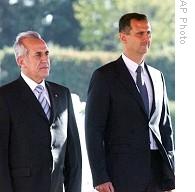
The answer is geo-political and strategic. It is also related to the political consensus process and the upcoming 2009 general-elections in Lebanon. Following the formation of a unity government in Beirut under a new president, Michel Suleiman (Sleiman), a new proactive defence doctrine for the country was contemplated. The objective of this defence doctrine is to keep Israel at bay and bring political stability and security to the country.


President Michel Suleiman

At the "National Defence Strategy" dialogue, held by the 14 Lebanese signatories of the Doha Accord, all sides have agreed that Israel is a threat to Lebanon.

In the months prior to the Israeli military campaign against Gaza, important diplomatic and political steps were taken by Beirut. President Michel Suleiman accompanied by several cabinet ministers visited Damascus (his first bilateral state visit; August 13-14, 2008) and Tehran (November 24-25, 2008).


President Suleiman and Syrian President Al Assad

In turn, General Jean Qahwaji (Kahwaji) the commander of the Lebanese Armed Forces was also in Damascus (November 29, 2008) for consultations with his Syrian counterpart General Al-Habib. While in Damascus, General Qahwaji also met with General Hassan Tourkmani, the defence minister of Syria, and the Syrian President. [11] His trip followed the visit of Lebanon's interior minister, Ziad Baroud, to Syria and was within the same framework. [12] Meanwhile, Lebanon’s defence minister, Elias Murr, went on an official visit to Moscow (December 16, 2008).

What started to emerge from these talks was that both Moscow and Tehran would provide weaponry to the Lebanese Armed Forces, which previously had been the recipients of lower-end U.S. made ordinance. The U.S. has always forbidden the Lebanese military from purchasing any heavy weapons that could challenge Israel's military strength.

It was also revealed that Russia would donate 10 MiG-29 fighter jets to Beirut in line with Lebanon's new defence strategy. [13] The use of the Russian MiG-29s would also entail the required installation of early warning and radar systems. Russian tanks, anti-tank rockets, armoured vehicles, and military helicopters are also being sought by Lebanon. [14]


Mig29

Iran has offered to supply the Lebanese military with medium-range missiles as part of a five-year Iranian-Lebanese defence agreement. [15] While in Iran, Michel Suleiman held talks with Iranian defence officials and went to an Iranian defence industry exposition.

While the talks with Moscow and Tehran aimed at arming the Lebanese Armed Forces, the talks with the Syrians were geared towards establishing and strengthening a joint security and defence framework directed against Israeli aggression. [16]

Integrating Hezbollah into the Lebanese Armed Forces

Moreover, Michel Aoun, leader of the Free Patriotic Movement and the Reform and Change Bloc in the Lebanese Parliament also visited Tehran (October 12-16, 2008; ahead of Michel Suleiman's official visit), and later Damascus (December 3-7, 2008). [17] Michel Aoun who is a central figure in the "political consensus" has endorsed and reaffirmed his political alliance with Hezbollah.


Michel Aoun

While calling for the peaceful disarmament of Hezbollah within a Lebanese defence strategy, he has accepted that Hezbollah fighters will eventally integrate into Lebanon's army. This disarmement process would only occur when the time is right and Israel no longer poses a threat to Lebanon. Hezbollah has broadly agreed to this, if and when there no longer exists an Israeli threat to the country's security. This position on Hezbollah's arms is spelled out in clause 10 (The Protection of Lebanon) of the February 6, 2006 memorandum of understanding (MoU) with Hezbollah that Michel Aoun signed on behalf of his political party, the Free Patriotic Movement.

Following his return from Tehran, Aoun also presented his case for the formation of a new Lebanese defence strategy and promised that the outcome of his visit to Iran would materialize in about six months. Aoun has also said that Iran, as the "major regional power between Lebanon and China" is of strategic importance to Lebanese interests. [18]


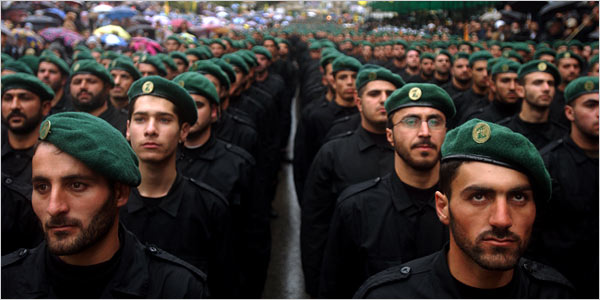
Hezbollah Paramilitary Forces

Washington's political cohorts in Lebanon are alarmed at the direction Lebanon is taking under its new defence strategy. They have criticized weapons purchases from Iran and defensive cooperation with Syria. This includes attacks on General Jean Qahwaji's visit to Syria, which was mandated by the entire Lebanese cabinet. [19] Additionally, within these pro-U.S. forces in Lebanon there has been a push for a "Swiss-like" "neutral defence policy" for Lebanon within the Middle East. Such a "neutral" position would benefit the U.S. and Israel geo-politically and strategically. Needless to say, with the threat of Israeli military aggression looming, this position is proving to be rather unpopular within Lebanon.

Ending Israeli-American pressure on Beirut to Naturalize Palestinian Refugees

The formation of a new proactive defence doctrine implies that Hezbollah fighters would be incorporated in the Lebanese Armed Forces and that the existing paramilitary forces of Hezbollah would be disbanded once certain conditions are met.

Therefore, one of Lebanon’s key political questions would be resolved. With the integration of Hezbollah fighters into the country's army together with military aid from Russia and Iran, Lebanon would acquire defensive capabilities, which would enable it to confront the threat of Israeli military aggression. These developments, which go against the prevailing pattern of U.S. client regimes in the Middle East modelled on Egypt and Saudi Arabia, have sounded an alarm bell in Tel Aviv, Washington, and London.

In response to Lebanon's rapprochement with Russia and Iran, two senior US State Department officials were rushed to Beirut in December.[20] During this mission, Dell Lee Dailey and David Hale, respectively Coordinator of the State Department's Office of Counterterrorism and Deputy-assistant Secretary responsible for Middle Eastern affairs, renewed the veiled threats of an Israeli attack against Lebanon, while casually placing the blame on Hezbollah.[21] These threats are aimed at Lebanon as a whole. They are intended to disrupt the creation of Lebanon's new defence doctrine.

The clock is ticking for Israel, the U.S., and NATO to obstruct the implementation of Beirut's new national defence doctrine.

Israel would no longer have any justifications for carrying out military incursions into Lebanon if Hezbollah were to become a full political party under a new Lebanese defence strategy. Moreover, if Beirut were able, under a new defence arrangement, to protect its borders against Israeli military threats it would not only end Tel Aviv’s ambitions to politically and economically dominate Lebanon, but it would also end Israeli pressure on Lebanon to naturalize the Palestinian war refugees waiting to return to their ancestoral lands that are occupied by Israel.

Clearly the issue of Palestinian naturalization in Lebanon is also tied to Lebanon's political consensus process and new defence strategy and was discussed by Michel Suleiman with Iranian officials in Tehran. [22]

The Middle Eastern Powder Keg: A World War III Scenario?

In 2006, when Israel attacked Lebanon, the war was presented to international public opinion as a conflict between Israel and Hezbollah. In essence the 2006 war was an Israeli attack on all of Lebanon. The Beirut government failed to take a stance, declared its "neutrality" and Lebanon's military forces were instructed not to intervene against the Israeli invaders. The reason for this was that the political parties of the Hariri-led March 14 Alliance that dominated the Lebanese government were expecting the war to end quickly and for Hezbollah (their political rival) to be defeated, and eventually excluded from playing a meaningful role on the Lebanese domestic political scene. Exactly the opposite has occurred since 2006.

Moreover, had the Lebanese government declared war on Israel, in response to Israeli aggression, Syria would have been obligated through a Lebanese-Syrian bilateral treaty, signed in 1991, to intervene in support of Lebanon.

In the case of a future Israeli war against Lebanon, the structure of military alliances is crucial. Syria could indeed intervene on the side of Lebanon. If Syria enters into the conflict, Damascus could seek the support of Tehran in the context of a bilateral military cooperation agreement with Iran.

A scenario of escalation is, therefore, possible, which could potentially spin out of control.

If Iran were to enter on the side of Lebanon and Syria in a defensive war against Israel, the U.S. and NATO would also intervene leading us into a broader war.

Both Iran and Syria have military cooperation agreements with Russia. Iran also has bilateral military cooperation agreements with China. Iran is also an observer member of the Shanghai Cooperation Organization (SCO). Iran’s allies including Russia, China, the member states of the Collective Security Treaty Organization (CSTO), and the Shanghai Cooperation Organization (SCO) could all be drawn into the broader conflict.


NOTES

[1] 'We’re fed up with empty gestures’, The Jerusalem Post, January 6, 2009.

[2] The militarization of Lebanon, extinguishing any credible armed resistance in Lebanon to Israel, and targeting Syria were also all factors for the Israeli attacks in 2006.

[3] It should be noted that the fighting between Hamas and Fatah and the Israeli campaign against the Gaza Strip that started on December 27, 2008 has obstructed the Palestinian electoral process.

[4] Amos Harel, IDF concludes large drill simulating double-front war in North, Haaretz, November 6, 2008.

[5] Barak Ravid, Israel: Lebanon is responsable for Hezbollah’s actions, Haaretz, August 8, 2008.

[6] "Hezbollah Terrorist Group; War with Israel Imminent", Al-Manar, December 17, 2008

[7] Yakkov Katz, Preparing for a possible confrontation with Hizbullah, The Jerusalem Post, December 11, 2008.

[8] Andrew Wander, Top Israeli officer says Hizbullah will be destroyed in five days 'next time', The Daily Star (Lebanon), December 17, 2008.

[9]
Ibid.

[10] Yakkov Katz, Preparing for a possible, Op.
cit.

[11] Ahmed Fathi Zahar et al., President al-Assad Receives General Qahwaji, Underlines Role of Lebanese Army in Defending Lebanon's Security and Stability, Syrian Arab News Agency (SANA), November 29, 2008.

[12] Lebanese army commander pays visit to Syria, Xinhua News Agency, November 30, 2008.

[13] Wang Yan, Russian donation of 10 Mig-29 fighters to Lebanon raises suspicions, Xinhua News Agency, December, 17, 2008; Yoav Stern, Russia to supply Lebanon with 10 MiG-29 fighter jets, Haaretz, December 17, 208; Russia 'to give' Lebanon war jets, British Broadcasting Corporation News (BBC News), December 17, 2008.

[14] Lebanon defense minister to talk arms in Moscow, Russian News and Information Agency (RIA Novosti), December 15, 2008.

[15] Zheng E, Lebanese president requests medium weapons from Iran, Xinhua News Agency, November 26, 2008; Kahwaji stresses LAF role, while politicians bicker some more, The Daily Star (Lebanon), November 27, 2008; Russian donation,
Op. cit.

[16] Sun, Lebanese army commander returns from Syria, Xinhua News Agency, November 30, 2008.

[17] Sami Moubayed, Former foe a celebrity in Damascus, Gulf News, December 4, 2008.

[18] Aoun: Iran, most powerful country, Islamic Republic News Agency (IRNA), October 21, 2008.

[19] Lebanese ctiticizes army commander's visit to Syria [sic.], Xinhua News Agency, December 1, 2008.

[20] More praise for Russia's promise of 'free' MiGs, Agence France-Presse (AFP) and The Daily Star (Lebanon), December 18, 2008.

[21] War with Israel Imminent, Op. cit.; US envoy warns against rearming Lebanon's Hezbollah, Deutsche Presse-Agentur/German Press Agency (DPA), December 17, 2008.

[22] Kahwaji stresses LAF role, Op. cit.

Hamas and Israel separately announce Gaza ceasefire

Go to Original
By Nidal al-Mughrabi

Hamas announced an immediate ceasefire in the Gaza Strip Sunday and gave Israel, which had already declared a unilateral truce, a week to pull its troops out of the territory following a three-week war.

There was shooting from both sides after their separate announcements, but broadly the ceasefire appeared to be gaining strength and Israeli troops began pulling out of Gaza, which they entered on January 3, a week after an air offensive began.

"We don't want to stay in Gaza, and we intend to leave it as soon as possible," Israeli Prime Minister Ehud Olmert said after holding talks with European leaders in Jerusalem.

Troops and tanks could be seen streaming back over the border from Gaza from early Sunday, all but ending combat after a 22-day conflict in which more than 1,300 Palestinians were killed. Ten Israeli soldiers and three civilians also died.

In Gaza, families began emerging from their places of hiding, including U.N. school compounds where some 45,000 people sought refuge during the fighting, and returning to their homes -- some only to find them damaged or destroyed.

According to the Palestinian Statistics Bureau, some 4,000 residential buildings were reduced to rubble during the conflict. Western diplomats have said it could cost at least $1.6 billion to repair the infrastructure damage in Gaza.

Hamas, whose rocket fire Israel said triggered its assault, announced its ceasefire about 12 hours after Israel's own move and said its Islamist allies in Gaza would also adhere to it.

Hamas's Gaza leader, Ismail Haniyeh, claimed a "popular victory" for Palestinians over Israel. "The enemy has failed to achieve its goals," he said in a speech on Hamas's Al-Aqsa TV.

Israel's spy services struck back, cutting into an Al-Aqsa broadcast with images of air strikes on Palestinian rocket crews and dead gunmen. A final title card read: "Hamas was defeated!"

Hamas officials, during talks with Egyptian mediators, said the faction demanded the opening of all Gaza's border crossings for the entry of "all materials, food, goods and basic needs."

French President Sarkozy -- joined by the leaders of Germany, Britain, Spain, Italy and the Czech Republic as current president of the European Union for talks with Olmert -- called on Israel to open Gaza's borders to aid as soon as possible.

WAR FALLOUT

Yet despite the signs of the ceasefire gaining momentum, there still remains no formal deal between Israel and Hamas.

The Gazan situation looks much as it did before the conflict -- armed standoff and a dim future for the 1.5 million people fenced inside the territory by a blockade aimed at punishing Hamas for rocket fire and ambitions to destroy the Jewish state.

As scores of bodies of Hamas fighters were recovered from suddenly quiet urban battlefields Sunday, Gaza medical officials said about 700 of the 1,300 dead were civilians.

Israel's leading newspapers put pictures of victorious Israeli troops on their front pages Sunday, but behind the banner headlines some commentators wondered whether the conflict had not worsened the prospects for peace with Gaza.

"This war was a just war," wrote one leading commentator in Ma'ariv, a right-of-center tabloid. "But this was not a wise war. This war presumed to change the situation ... But the situation, regrettably, will change only for the worse."

Some 17 rockets hit southern Israel after the ceasefire Olmert declared went into effect at 2 a.m. (7 p.m. EST). Israel responded with two air strikes against launching sites.

At least three rockets struck southern Israel after Hamas said it was halting attacks, Israeli police said.

Despite the breaches, the United States welcomed the ceasefire and the United Nations expressed its relief.

"The goal remains a durable and fully respected ceasefire that will lead to stabilization and normalization in Gaza," said Secretary of State Condoleezza Rice.

A spokeswoman for President-elect Barack Obama said he welcomed the truce and would say more about the situation in Gaza after he is inaugurated Tuesday.

EGYPT MEETING

In Jerusalem, Olmert spokesman Mark Regev offered hope that crossings into Gaza would open if the truce persists:

"If this ceasefire holds, and I hope it does, you'll see the crossings open to an enormous amount of humanitarian support."

In the northern Gaza Strip town of Beit Lahiya, Palestinian ambulances picked up more than 95 bodies, most of them gunmen, that had lain in the rubble of buildings and open areas, Hamas police and health officials said.

Some of those who returned to their homes were distraught to find them destroyed Sunday, but there was also hope.

"Thank God you are alive!" Abu Daoud Amer consoled a friend. "The house can be rebuilt, God willing."

The civilian death toll and destruction in the Gaza Strip brought strong international pressure on Israel to stop the offensive it launched with the declared aim of ending rocket attacks that had killed 18 people over the previous eight years.

Among the criticism leveled at Israel are accusations by senior U.N. officials that it may have committed war crimes with its widespread shelling, including the deaths of 42 people, including women and children, at a U.N. school on January 6.

Israel has dismissed the accusations, saying its army and air force have acted within the rules of war.

The Duncan Doctrine

Go to Original
By Andy Kroll

The Military-Corporate Legacy of the New Secretary of Education

On December 16th, a friendship forged nearly two decades ago on the hardwood of the basketball court culminated in a press conference at the Dodge Renaissance Academy, an elementary school located on the west side of Chicago. In a glowing introduction to the media, President-elect Barack Obama named Arne Duncan, the chief executive officer of the Chicago Public Schools system (CPS), as his nominee for U.S. Secretary of Education. "When it comes to school reform," the President-elect said, "Arne is the most hands-on of hands-on practitioners. For Arne, school reform isn't just a theory in a book -- it's the cause of his life. And the results aren't just about test scores or statistics, but about whether our children are developing the skills they need to compete with any worker in the world for any job."


Though the announcement came amidst a deluge of other Obama nominations -- he had unveiled key members of his energy and environment teams the day before and would add his picks for the Secretaries of Agriculture and the Interior the next day -- Duncan's selection was eagerly anticipated, and garnered mostly favorable reactions in education circles and in the media. He was described as the compromise candidate between powerful teachers' unions and the advocates of charter schools and merit pay. He was also regularly hailed as a "reformer," fearless when it came to challenging the educational status quo and more than willing to shake up hidebound, moribund public school systems.


Yet a closer investigation of Duncan's record in Chicago casts doubt on that label. As he packs up for Washington, Duncan leaves behind a Windy City legacy that's hardly cause for optimism, emphasizing as it does a business-minded, market-driven model for education. If he is a "reformer," his style of management is distinctly top-down, corporate, and privatizing. It views teachers as expendable, unions as unnecessary, and students as customers.


Disturbing as well is the prominence of Duncan's belief in offering a key role in public education to the military. Chicago's school system is currently the most militarized in the country, boasting five military academies, nearly three dozen smaller Junior Reserve Officer Training Corps programs within existing high schools, and numerous middle school Junior ROTC programs. More troubling yet, the military academies he's started are nearly all located in low-income, minority neighborhoods. This merging of military training and education naturally raises concerns about whether such academies will be not just education centers, but recruitment centers as well.


Rather than handing Duncan a free pass on his way into office, as lawmakers did during Duncan's breezy confirmation hearings last week, a closer examination of the Chicago native's record is in order. Only then can we begin to imagine where public education might be heading under Arne Duncan, and whether his vision represents the kind of "change" that will bring our students meaningfully in line with the rest of the world.


The Militarization of Secondary Education


Today, the flagship projects in CPS's militarization are its five military academies, affiliated with either the Army, Navy, or Marines. All students -- or cadets, as they're known -- attending one of these schools are required to enroll as well in the academy's Junior ROTC program. That means cadets must wear full military uniforms to school everyday, and undergo daily uniform inspections. As part of the academy's curriculum, they must also take a daily ROTC course focusing on military history, map reading and navigation, drug prevention, and the branches of the Department of Defense.


Cadets can practice marching on an academy's drill team, learn the proper way to fire a weapon on the rifle team, and choose to attend extracurricular spring or summer military training sessions. At the Phoenix Military Academy, cadets are even organized into an academy battalion, modeled on an Army infantry division battalion, in which upper-class cadets fill the leading roles of commander, executive officer, and sergeant major.


In addition, military personnel from the U.S. armed services teach alongside regular teachers in each academy, and also fill administrative roles such as academy "commandants." Three of these military academies were created in part with Department of Defense appropriations -- funds secured by Illinois lawmakers -- and when the proposed Air Force Academy High School opens this fall, CPS will be the only public school system in the country with Air Force, Army, Navy, and Marine Corps high school academies.


CPS also boasts almost three dozen smaller Junior ROTC programs within existing high schools that students can opt to join, and over 20 voluntary middle school Junior ROTC programs. All told, between the academies and the voluntary Junior ROTC programs, more than 10,000 students are enrolled in a military education program of some sort in the CPS system. Officials like Duncan and Chicago Mayor Richard M. Daley justify the need for the military academies by claiming they do a superlative job teaching students discipline and providing them with character-building opportunities. "These are positive learning environments," Duncan said in 2007. "I love the sense of leadership. I love the sense of discipline."


Without a doubt, teaching students about discipline and leadership is an important aspect of being an educator. But is the full-scale uniformed culture of the military actually necessary to impart these values? A student who learns to play the cello, who studies how to read music, will learn discipline too, without a military-themed learning environment. In addition, encouraging students to be critical thinkers, to question accepted beliefs and norms, remains key to a teacher's role at any grade level. The military's culture of uniformity and discipline, important as it may be for an army, hardly aligns with these pedagogical values.


Of no less concern are the types of students Chicago's military academies are trying to attract. All of CPS's military academies (except the Rickover Naval Academy) are located in low-income neighborhoods with primarily black and/or Hispanic residents. As a result, student enrollment in the academies consists almost entirely of minorities. Whites, who already represent a mere 9% of the students in the Chicago system, make up only 4% of the students enrolled in the military academies.


There is obviously a correlation between these low-income, minority communities, the military academies being established in them, and the long-term recruitment needs of the U.S. military. The schools essentially functional as recruiting tools, despite the expectable military disclaimers. The Chicago Tribune typically reported in 1999 that the creation of the system's first military school in the historically black community of Bronzeville grew, in part, out of "a desire for the military to increase the pool of minority candidates for its academies." And before the House Armed Services Committee in 2000, the armed services chiefs of staff testified that 30%-50% of all Junior ROTC cadets later enlist in the military. Organizations opposing the military's growing presence in public schools insist that it's no mistake the number of military academies in Chicago is on the rise at a time when the U.S. military has had difficulty meeting its recruitment targets while fighting two unpopular wars.


It seems clear enough that, when it comes to the militarization of the Chicago school system, whatever Duncan's goals, the results are likely to be only partly "educational."


Merging the Market and the Classroom


While discussing his nomination, President-elect Obama praised the fact that Duncan isn't "beholden to any one ideology." A closer examination of his career in education, however, suggests otherwise. As Chicago's chief executive officer (not to be confused with CPS's chief education officer), Duncan ran his district in a most businesslike manner. As he put it in a 2003 profile in Catalyst Chicago, an independent magazine that covers education reform, "We're in the business of education." And indeed, managing the country's third-largest school system does require sharp business acumen. But what's evident from Duncan's seven years in charge is his belief that the business of education should, first and foremost, embrace the logic of the free market and privatization.


Duncan's belief in privatizing public education can be most clearly seen in Chicago's Renaissance 2010 plan, the centerpiece of his time in that city. Designed by corporate consulting firm A.T. Kearney and backed by the Commercial Club of Chicago, an organization representing some of the city's largest businesses, Renaissance 2010 has pushed hard for the closing of underperforming schools -- to be replaced by multiple new, smaller, "entrepreneurial" schools. Under the plan, many of the new institutions established have been privatized charter or "contract" schools run by independent nonprofit outfits. They, then, turn out to have the option of contracting school management out to for-profit education management organizations. In addition, Renaissance 2010 charter schools, not being subject to state laws and district initiatives, can -- as many have -- eliminate the teachers' union altogether.


Under Duncan's leadership, CPS and Renaissance 2010 schools have adopted a performance-driven style of governance in which well-run schools and their teachers and administrators are rewarded, and low-performing schools are penalized. As Catalyst Chicago reported, "Star schools and principals have been granted more flexibility and autonomy, and often financial freedom and bonus pay." Low-performing schools put on probation, on the other hand, "have little say over how they can spend poverty funding, an area otherwise controlled by elected local school councils… [Local school councils] at struggling schools have also lost the right to hire or fire principals -- restrictions that have outraged some parent activists."


Students as well as teachers and principals are experiencing firsthand the impact of Duncan's belief in competition and incentive-based learning. This fall, the Chicago Public Schools rolled out a Green for Grade$ program in which the district will pay freshmen at 20 selected high schools for good grades -- $50 in cash for an A, $35 for a B, and even $20 for a C. Though students not surprisingly say they support the program -- what student wouldn't want to get paid for grades? -- critics contend that cash-for-grades incentives, which stir interest in learning for all the wrong reasons, turn being educated into a job.


Duncan's rhetoric offers a good sense of what his business-minded approach and support for bringing free-market ideologies into public education means. At a May 2008 symposium hosted by the Renaissance Schools Fund, the nonprofit financial arm of Renaissance 2010, entitled "Free to Choose, Free to Succeed: The New Market of Public Education," Duncan typically compared his job running a school district to that of a stock portfolio manager. As he explained, "I am not a manager of 600 schools. I'm a portfolio manager of 600 schools and I'm trying to improve the portfolio." He would later add, "We're trying to blur the lines between the public and the private."


A Top-Down Leadership Style


Barack Obama built his campaign on impressive grassroots support and the democratic nature of his candidacy. Judging by his continued outreach to supporters, he seems intent on leading, at least in part, with the same bottom-up style. Duncan's style couldn't be more different.


Under Duncan, the critical voices of parents, community leaders, students, and teachers regularly fell on deaf ears. As described by University of Illinois at Chicago professor and education activist Pauline Lipman in the journal Educational Policy in 2007, Renaissance 2010 provoked striking resistance within affected communities and neighborhoods. There were heated community hearings and similarly angry testimony at Board of Education meetings, as well as door-to-door organizing, picketing, and even, at one point, a student walk-out.


"The opposition," Lipman wrote, "brought together unions, teachers, students, school reformers, community leaders and organizations, parents in African American South and West Side communities, and some Latino community activists and teachers." Yet, as she pointed out recently, mounting neighborhood opposition had little effect. "I'm pretty in tune with the grassroots activism in education in Chicago," she said, "and people are uniformly opposed to these policies, and uniformly feel that they have no voice."


During Duncan's tenure, decision-making responsibilities that once belonged to elected officials shifted into the hands of unelected individuals handpicked by the city's corporate or political elite. For instance, elected local school councils, made up mostly of parents and community leaders, are to be scaled back or eliminated altogether as part of Renaissance 2010. Now, many new schools can simply opt out of such councils.


Then there's the Renaissance Schools Fund. It oversees the selection and evaluation of new schools and subsequent investment in them. Made up of unelected business leaders, the CEO of the system, and the Chicago Board of Education president, the Fund takes the money it raises and makes schools compete against each other for limited private funding. It has typically been criticized by community leaders and activists for being an opaque, unaccountable body indifferent to the will of Chicago's citizens.


Making the grade?


Despite his controversial educational policies, Duncan's supporters ultimately contend that, as the CEO of Chicago's schools, he's gotten results where it matters -- test scores. An objective, easily quantifiable yet imperfect measure of student learning, test scores have indeed improved in several areas under Duncan (though many attribute this to lowered statewide testing standards and more lenient testing guidelines). Between 2001 and 2008, for instance, the percentage of elementary school students meeting or exceeding standards on the Illinois Standards Achievement Test increased from 39.5% to 65%. The number of CPS students meeting or exceeding the Illinois Learning Standards, another statewide secondary education achievement assessment, also increased from 38% in 2002 to 60% in 2008.


When measured on a national scale, however, Duncan's record looks a lot less impressive. In comparison to other major urban school districts (including Los Angeles, Boston, New York City, and Washington, D.C.) in the National Assessment of Educational Progress, or "The Nation's Report Card," Chicago fourth and eighth graders ranked, with only one exception, in the bottom half of all districts in math, reading, and science in 2003, 2005 and 2007. In addition, from 2004 to 2008, the Chicago Public Schools district failed to make "adequate yearly progress" as mandated by the Bush administration's No Child Left Behind Act.


Even if Duncan's policies do continue to boost test scores in coming years, the question must be asked: At whose expense? In a competition-driven educational system, some schools will, of course, succeed, receiving more funding and so hiring the most talented teachers. At the same time, schools that aren't "performing" will be put on probation, stripped of their autonomy, and possibly closed, only to be reopened as privately-run outfits -- or even handed over to the military. The highest achieving students (that is, the best test-takers) will have access to the most up-to-date facilities, advanced equipment, and academic support programs; struggling students will likely be left behind, separate and unequal, stuck in decrepit classrooms and underfunded schools.


Public education is not meant to be a win-lose, us-versus-them system, nor is it meant to be a recruitment system for the military -- and yet this, it seems, is at the heart of Duncan's legacy in Chicago, and so a reasonable indication of the kind of "reform" he's likely to bring to the country as education secretary.

Why Citi Turned Around on Mortgage "Cramdowns"

Go to Original
By Robert Reich

The latest data show one out of ten homeowners in the United States is either late in making a mortgage payment or in such serious arrears as to risk foreclosure. Last week, congressional Dems breathed a sigh of relief when Citigroup dropped its opposition to a proposed change in the bankruptcy laws allowing distressed homeowners to do what owners of commercial property and second homes can already do when they can't pay up -- use bankruptcy proceedings as a means of working out better deals. (It's called a "cramdown." The practical effect wouldn't be hundreds of thousands of bankruptcy judges striking new deals, as conservative lawmakers predict; the mere option of going into bankruptcy would give homeowners more bargaining leverage with mortgage lenders in striking better deals.)

As long as Citigroup opposed this measure, it didn't stand a chance. Citi's clout in Washington is legendary. But on January 8, Citigroup's CEO, Vikram Pandit released a statement saying that Citi "believes it will serve as an additional tool to the extensive home retention programs currently in place to help at-risk borrowers." The announcement was greeted with kudos by House and Senate Dems. The bankruptcy provision is now moving, and is likely to be attached to the stimulus bill.

What happened? Until last Thursday, Citi had been a leader of the Bankruptcy Coalition of the Financial Services Roundtable, an industry group that had staunchly opposed the bill -- along with Bank of America, JP Morgan Chase, and Wells Fargo.

Could it be that Citi's Pandit knew last week that he'd soon need even more help from Congress than the $45 billion bailout the bank already received? Shares of Citigroup had seemed to regain their footing after the bailout. But then, this Monday, all hell broke loose. Citi shares plunged 17 percent, as investors got word of a deal Citi was cooking to sell its valuable Smith Barney brokerage unit to Morgan Stanley. The drop in Citi shares brought the stock back to the lowest level since the government gave Citi its first dollop of bailout funds last November. Citi is losing capital at an astounding rate -- nearly $100 million a day in the fourth quarter alone. Today the firm posted a loss of $8.29 billion for the fourth quarter, completing its worst year in history.

Citi has already got the sweetest bailout deal of any big bank, but the probability seems high that it will want more bailout money. This is the easiest explanation for Pandit's turnaround on the cramdown legislation -- something the Democratic Congress and distressed homeowners very much want.

In other words, the Wall Street bailout has had exactly the same effect for Congress that the proposed bankruptcy provision would have for homeowners -- it has increased its bargaining power over those who ordinarily pull the strings. The massive tax-payer financed bailout of Wall Street, largely a product of Wall Street's power in Washington, seems to be weakening the Street's ability to veto financial legislation it doesn't like. I'm not sure whether this is something we should be celebrating as a small victory for democracy, or condemning as an extortionate price for reducing Wall Street's grip.

Obama Adviser Urges More Rigorous Global Financial Regulation

Go to Original
By Anthony Faiola

A top economic adviser to the incoming Obama administration unveiled a plan Thursday to radically rethink the global financial system, including measures that would dramatically expand government control over banking and investment in the United States.

The report -- which recommends limiting the size of banks, monitoring executive pay and regulating hedge funds -- offers the first hint of the kind of change to the financial system that President-elect Barack Obama may push for in coming months.

Obama has pledged to present a package of reforms to prevent another round of the financial crisis that began in the United States, ahead of a summit of world leaders in London this April. Observers saw in Thursday's report potential building blocks of Obama's plan. Although issued by the Group of 30 -- an organization of international economists and financial policymakers -- its lead author is Paul Volcker, the chairman of the Federal Reserve during the Carter and Reagan administrations who will serve as a special adviser to the Obama White House. Part of Volcker's role is to help mastermind what could become the biggest overhaul of the U.S. financial system in decades.

"I think this is a clear sign that the new administration is going to push for a major overhaul, for major structural reforms of the regulatory system," said Steven Schrage, the Scholl Chair in International Business at the Center for Strategic and International Studies. "Having this highly esteemed group backing that proposal is going to put pressure to present those changes before [the] April summit."

The report's recommendations may find support among those in the United States and Europe who have called for tighter regulation over the financial system in the wake of the current economic crisis. But elements of the plan were already opposed Thursday by some in the financial industry, where some worry that the push for tighter government regulation may go too far.

The report offered 18 recommendations that would insert government regulators into the boardrooms of financial institutions as never before. The plan calls for vastly increased oversight of major banks, going as far as to recommend the end of an era of mega banks whose size makes their failure potentially catastrophic to the global financial system. To limit their size and scope, banks, the document states, should be prohibited from managing private-equity or hedge funds. And deposits should not be concentrated in the hands of too few banks.

"Keep them small, so that any failure won't have systematic importance," Volcker said at a news conference.

Money-market mutual funds that offer services similar to banks, including dollar-for-dollar withdrawal at any time, should be subjected to increased government oversight, the report said. Currently, most do not operate that way. But those bank-like mutual funds that want to avoid tighter regulation should sell relatively safe financial instruments and clearly state to customers that the value of their funds may or may not remain stable.

The proposal suggests that the U.S. government should clarify the status of mortgage giants Fannie Mae and Freddie Mac, either making them government agencies or regulating them as independent mortgage brokers. Credit-rating agencies would also be subjected to greater scrutiny.

Volcker said he would press the new administration to consider the measures, saying major changes are imperative because the financial system is "broken."

"It's a four-letter word," he said. "It's a mess."

Elements of the plan -- such as imposing regulation on hedge funds -- echo calls for closer supervision made by policymakers in the United States and abroad in past months. But Thursday's report was more specific and aggressive in imposing government restrictions on the financial system than a broad outline of changes agreed to by the Bush administration during a meeting of leaders representing the Group of 20 economic powers in Washington last November.

The Obama administration is expected to work closely with key congressional leaders including Rep. Barney Frank (D-Mass) on legislation that could restructure existing regulatory agencies and impose new guidelines on U.S. financial institutions. The scope of Volcker's proposal, analysts say, suggests that Obama's plan may contain highly ambitious reforms.

Although financial industry officials concede that more regulation is likely needed to prevent a repeat of the current crisis, they also said that some of the measures in the report appeared to go too far. For instance, they opposed the suggestion that banks limit their deposits and size.

"You want to apply the appropriate amount of regulation to address the concern that this kind of crisis never happens again," said Scott Talbott, senior vice president of government affairs for Financial Services Roundtable, which represents the largest financial institutions in the United States. "But at the same time, you don't want to stifle innovation, creativity or the allocation of resources to take appropriate risks."

Although the report calls for global reform, it acknowledged charges that flaws in the U.S. financial system were to blame for starting the current global economic crisis. Thusly, it noted that "several of the issues and recommendations have a direct U.S. focus."

The report renewed calls for greater international cooperation on regulation, and new laws to oversee exotic financial derivatives, made during the November summit in Washington. With cautious support by President Bush, plans are moving forward, for instance, to enhance international cooperation in overseeing major banks through the Financial Stability Forum in Switzerland. But European leaders have eagerly awaited a signal from Obama on his ideas for new rules for the global financial system.

It is unclear how many of the recommendations will make their way into Obama's final plan, but the report could lift the spirits of Europeans who have called for tighter government oversight on executives' pay and risk management in financial institutions -- an area where the Bush administration has offered tepid support. The report urges the government to enforce systematic board reviews of executive pay as well as new guidelines to measure the level of risk a firm is taking with exotic investments.