Go to Original
Washington - The tax audit rates of the largest companies are less than half what they were 20 years ago while more small and mid-size businesses are coming under scrutiny, according to an organization that monitors the Internal Revenue Service.
The Syracuse University-based Transactional Records Access Clearinghouse described what it said was a "historic collapse" in audits for corporations holding assets of $250 million or more. About 26 percent of them were audited in the 2007 budget year compared with 34 percent in 2006 and 43 percent in 2005.
The IRS did not dispute the numbers, based on agency data. But it strongly disagreed with suggestions it was easing oversight of the biggest corporations.
Enforcement revenues from large companies rose by one-third in 2007 from the previous year, from $10.6 billion to $14.2 billion, said IRS Deputy Commissi
oner Barry Shott, who heads the Large and Mid-Size Business Division.
While the number of examinations has declined, "what we are doing is focusing our resources better on where the noncompliance is," Shott said in an interview with The Associated Press.
Shott said the focus in recent years has been on tax shelters and `extraordinarily complicated" partnerships and S corporations where shareholders, rather than the company, must report income or losses. Last year the IRS examined 17,700 S corporations, compared with 14,000 the previous year, and 12,200 partnerships, compared with 9,800.
But the TRAC report concluded that the IRS also was concentrating on regular small and mid-sized companies to boost audit numbers.
"Moving the focus of the corporate auditors away from the large corporations and toward the smaller ones has been quite effective when it came to increasing the overall number of these kinds of audits but actually was counterproductive in financial terms," the researchers said.
The new IRS commissioner, Douglas Shulman, said in a response that he intends to make "targeting noncompliance with our tax laws ... a high priority."
According to IRS statistics, 15 percent, or 4,473, of companies with $10 million to $50 million in assets were examined in 2007. That compares with 12.3 percent, or 3,535 companies, that were audited in 2005.
In the same two years, the percentage of audits of corporations in the $50 million to $100 million range fell from 16.4 percent to 11.4 percent. For corporations in the $100 million to $250 million range, the percentage dropped from 17.5 percent to 12.1 percent .
Among the largest corporations above $250 million in assets, 3,424 were audited in 2007, down from a peak of 4,859 in 2005.
TRAC also questioned the financial benefits of the shift. The group said that last year the government uncovered $682 in additional recommended taxes for every revenue agent hour spent auditing the smallest corporations, compared with $7,498 in additional taxes for audits of the largest corporations.
Dean Zerbe, national managing director for Houston-based alliantgroup, which provides tax services for medium-sized companies, said his fear was that "in the IRS' zeal to show Congress improved numbers in corporate audit, it is America's small and medium businesses that are taking it on the chin."
Shulman told the Senate Finance Committee last week that audits of businesses in general rose from 52,000 in 2006 to 59,500 in 2007.
He acknowledged that audits of the largest corporations were down. But he said that "in times of flat budgets, the agency cannot increase activity across the board, but must address the areas where there is growth and potential risk."
Shott also cited a new program where larger companies work with the IRS during the year so there will not be disputes at tax-filing season. Participants in this program rose from 17 in 2005 to 73 this budget year, he said.
The returns of these companies do not show up in enforcement statistics, he said, but the collaboration can avoid controversies that can go on for years.
Having more money was not necessarily an advantage for individual taxpayers. The IRS said that last year it audited 9.25 percent of those with incomes of more than $1 million, compared with 6.3 percent in 2006. For those earning less than $100,000, the chances of getting audited were less than 1 percent.
The tax agency said total enforcement revenues in the 2007 budget year, from collections and appeals activities, were $59.2 billion, up from $48.7 billion the previous year.
Monday, April 14, 2008


Big Oil to Big Wind: Texas Veteran Sets Up $10 Billion Clean Energy Project
Go to Original
By Ed Pilkington
Dallas - T Boone Pickens is famous for thinking big. He founded his Texan oil company, Mesa Petroleum, in 1956 with just $2,500 (£1,200) in the bank. After a string of audacious takeovers he turned it into an independent empire that challenged the big oil companies, and today he is worth $3bn.
Now this straight-talking Southerner is launching the biggest and most audacious project of his career. This month he will make the first down payment on 500 wind turbines at a cost of $2m each. The order is the first material step towards his goal of building the world's largest wind farm.
Over the next four years he intends to erect 2,700 turbines across 200,000 acres of the Texan panhandle. The scheme is five times bigger than the world's current record-holding wind farm and when finished will supply 4,000 megawatts of electricity - enough to power about one million homes.
It's not just the breathtaking scale of the scheme that is striking, though at a total cost of $10bn it impresses even Pickens himself: "It's pretty mind boggling," he says. The fact that Pickens, a tycoon who made his fortune in oil, has turned his attention to wind power is an indication of how the tectonic plates are moving. Until recently wind was seen as marginal and alternative; now it is being eyed by Wall Street.
"Don't get the idea that I've turned green," Pickens tells the Guardian in the Dallas offices of his new venture Mesa Power. "My business is making money, and I think this is going to make a lot of money."
His fascination with wind developed as Pickens engaged in his favourite leisure pursuit - quail hunting. For years he has been shooting Bobwhite quail on his 68,000-acre ranch in the panhandle. "I've been hunting quail for 50 years, I know where the wind is," Pickens says.
The idea formed that this area of Texas, with its wide-open space, low population and steady south-westerlies would make a perfect location for wind-generated energy. Studies proved him right - there was more wind than even he had imagined, much of it at peak times in the middle of the day when power sells at a premium.
So he set about convincing neighbouring ranchers to join his scheme, promising them between $10,000 and $20,000 in annual royalties for every turbine they allowed on their land. They have all signed up, eager to cash in on this literal windfall. (Pickens, by contrast, refuses to have any of the turbines placed on his own ranch. "They are ugly!" he says, unashamedly.)
To see exactly what the promise is to ranchers and rural communities of the new dash for wind, you have to drive four hours west of Dallas into the Texan prairies. Until a couple of years ago Sweetwater was a gently declining railroad town, its population falling year on year and its infrastructure quietly rotting. Now it is a boom town, a 21st-century equivalent of the Wild West. German wind technicians who have poured into the area have coined a name for it - the Wind West.
The three largest wind farms in America are all situated in the surrounding area, Nolan county, which, with a population of just 18,000, now produces more wind power than the UK, France and California.
While other towns in the region are struggling with plummeting house prices and job losses, Sweetwater is in the midst of a construction explosion. Two new companies opened this week, one servicing the blades of the county's 2,000 turbines, another renting out cranes used in erecting new turbines. The turbines, state of the art models 400 feet to the tip of their blades, span out for 150 miles in any direction.
New roads and houses are going up, and local schools and medical centres have been renovated using the influx of tax revenues from the energy companies. Greg Wortham, Sweetwater's mayor, says he has watched over the past two years as wind power was transformed "from a hobby - a green thing - into an industry. Suddenly it was all about welders and engineers and truckers. We have companies here begging for new workers and paying them more than the thousands being laid off by the car companies."
Back in Dallas, Pickens believes there are several reasons to invest in this new energy source. Beyond the mere profit motive, which clearly excites him, there is the fact that Texan oil has been on the wane since it peaked at 10m barrels a day in 1973, and is already down to half that amount. "Oil fields have a declining curve - you find one, it peaks and starts downhill, you've got to find another one to replace it. It drives you crazy! With wind, there's no decline."
There is also a political edge to his obsession. Politics and Pickens go together, as is obvious from the walls of his offices, lined with photographs of him with world leaders. One shows him with the Queen, Prince Philip and George HW Bush; another is with Margaret Thatcher and Ronald Reagan; a third shows him on board Air Force One with the current President Bush. There is a signed calendar from Arnold Schwarzenegger on the table.
As the pictures suggest, Pickens has for many years been a major financial backer of both George Bushes, but he professes to be frustrated by the lack of action on energy by this administration and all its predecessors. "George Bush has done nothing. Nothing. Every guy that ran for president clear back to Nixon said he would make us energy independent, but not one goddamned thing has been done. Zero. The biggest problem facing the United States in the next 50 years is energy and nobody has come up with a solution."
Pickens, being Pickens, has come up with a solution - and it makes his own gargantuan plans for a wind farm in the panhandle look tiny. For the benefit of the Guardian, he draws on a white board his master scheme. He carves out an enormous corridor of land running north to south through the middle of the US - along the great plains - where he would build an army of wind farms. Then he draws an equally enormous corridor running east to west from Texas to southern California which he would similarly dedicate to solar energy.
"You need a giant plan for America. Not the pissant 83 megawatt [windfarm] deals being stamped all over the country. There needs to be a huge plan from someone with leadership. It's going to take years to do, but it has to start now." Only then, he explains, can the US stop what he regards as the madness of a flood of money flowing out of America to the oil producers of the Middle East. "That money is going God knows where - a few friends, a lot of enemies. We've got to stop it."
T Boone Pickens certainly is thinking big. And all this as he prepares to celebrate his 80th birthday next month. How is it that he appears to be expanding his ambitions at a stage in life when most people are retrenching theirs? "You're getting older so you are running out of time," he says. "So let's go! We haven't got long, and we've got to get this job finished."
By Ed Pilkington
Dallas - T Boone Pickens is famous for thinking big. He founded his Texan oil company, Mesa Petroleum, in 1956 with just $2,500 (£1,200) in the bank. After a string of audacious takeovers he turned it into an independent empire that challenged the big oil companies, and today he is worth $3bn.
Now this straight-talking Southerner is launching the biggest and most audacious project of his career. This month he will make the first down payment on 500 wind turbines at a cost of $2m each. The order is the first material step towards his goal of building the world's largest wind farm.
Over the next four years he intends to erect 2,700 turbines across 200,000 acres of the Texan panhandle. The scheme is five times bigger than the world's current record-holding wind farm and when finished will supply 4,000 megawatts of electricity - enough to power about one million homes.
It's not just the breathtaking scale of the scheme that is striking, though at a total cost of $10bn it impresses even Pickens himself: "It's pretty mind boggling," he says. The fact that Pickens, a tycoon who made his fortune in oil, has turned his attention to wind power is an indication of how the tectonic plates are moving. Until recently wind was seen as marginal and alternative; now it is being eyed by Wall Street.
"Don't get the idea that I've turned green," Pickens tells the Guardian in the Dallas offices of his new venture Mesa Power. "My business is making money, and I think this is going to make a lot of money."
His fascination with wind developed as Pickens engaged in his favourite leisure pursuit - quail hunting. For years he has been shooting Bobwhite quail on his 68,000-acre ranch in the panhandle. "I've been hunting quail for 50 years, I know where the wind is," Pickens says.
The idea formed that this area of Texas, with its wide-open space, low population and steady south-westerlies would make a perfect location for wind-generated energy. Studies proved him right - there was more wind than even he had imagined, much of it at peak times in the middle of the day when power sells at a premium.
So he set about convincing neighbouring ranchers to join his scheme, promising them between $10,000 and $20,000 in annual royalties for every turbine they allowed on their land. They have all signed up, eager to cash in on this literal windfall. (Pickens, by contrast, refuses to have any of the turbines placed on his own ranch. "They are ugly!" he says, unashamedly.)
To see exactly what the promise is to ranchers and rural communities of the new dash for wind, you have to drive four hours west of Dallas into the Texan prairies. Until a couple of years ago Sweetwater was a gently declining railroad town, its population falling year on year and its infrastructure quietly rotting. Now it is a boom town, a 21st-century equivalent of the Wild West. German wind technicians who have poured into the area have coined a name for it - the Wind West.
The three largest wind farms in America are all situated in the surrounding area, Nolan county, which, with a population of just 18,000, now produces more wind power than the UK, France and California.
While other towns in the region are struggling with plummeting house prices and job losses, Sweetwater is in the midst of a construction explosion. Two new companies opened this week, one servicing the blades of the county's 2,000 turbines, another renting out cranes used in erecting new turbines. The turbines, state of the art models 400 feet to the tip of their blades, span out for 150 miles in any direction.
New roads and houses are going up, and local schools and medical centres have been renovated using the influx of tax revenues from the energy companies. Greg Wortham, Sweetwater's mayor, says he has watched over the past two years as wind power was transformed "from a hobby - a green thing - into an industry. Suddenly it was all about welders and engineers and truckers. We have companies here begging for new workers and paying them more than the thousands being laid off by the car companies."
Back in Dallas, Pickens believes there are several reasons to invest in this new energy source. Beyond the mere profit motive, which clearly excites him, there is the fact that Texan oil has been on the wane since it peaked at 10m barrels a day in 1973, and is already down to half that amount. "Oil fields have a declining curve - you find one, it peaks and starts downhill, you've got to find another one to replace it. It drives you crazy! With wind, there's no decline."
There is also a political edge to his obsession. Politics and Pickens go together, as is obvious from the walls of his offices, lined with photographs of him with world leaders. One shows him with the Queen, Prince Philip and George HW Bush; another is with Margaret Thatcher and Ronald Reagan; a third shows him on board Air Force One with the current President Bush. There is a signed calendar from Arnold Schwarzenegger on the table.
As the pictures suggest, Pickens has for many years been a major financial backer of both George Bushes, but he professes to be frustrated by the lack of action on energy by this administration and all its predecessors. "George Bush has done nothing. Nothing. Every guy that ran for president clear back to Nixon said he would make us energy independent, but not one goddamned thing has been done. Zero. The biggest problem facing the United States in the next 50 years is energy and nobody has come up with a solution."
Pickens, being Pickens, has come up with a solution - and it makes his own gargantuan plans for a wind farm in the panhandle look tiny. For the benefit of the Guardian, he draws on a white board his master scheme. He carves out an enormous corridor of land running north to south through the middle of the US - along the great plains - where he would build an army of wind farms. Then he draws an equally enormous corridor running east to west from Texas to southern California which he would similarly dedicate to solar energy.
"You need a giant plan for America. Not the pissant 83 megawatt [windfarm] deals being stamped all over the country. There needs to be a huge plan from someone with leadership. It's going to take years to do, but it has to start now." Only then, he explains, can the US stop what he regards as the madness of a flood of money flowing out of America to the oil producers of the Middle East. "That money is going God knows where - a few friends, a lot of enemies. We've got to stop it."
T Boone Pickens certainly is thinking big. And all this as he prepares to celebrate his 80th birthday next month. How is it that he appears to be expanding his ambitions at a stage in life when most people are retrenching theirs? "You're getting older so you are running out of time," he says. "So let's go! We haven't got long, and we've got to get this job finished."
China and America: The Tibet Human Rights PsyOp
Go to Original
By Michel Chossudovsky
By Michel Chossudovsky
The human rights issue has become the centerfold of media disinformation.
China is no model of human rights but neither are the US and its indefectible British ally, responsible for extensive war crimes and human rights violations in Iraq and around the World. The US and its allies, which uphold the practice of torture, political assassinations and the establishment of secret detention camps, continue to be presented to public opinion as a model of Western democracy to be emulated by developing countries, in contrast to Russia, Iran, North Korea and the People’s Republic of China.
Human Rights "Double Standards"
While China’s alleged human rights violations in relation to Tibet are highlighted, the recent wave of killings in Iraq and Palestine are not mentioned. The Western media has barely acknowledged the Fifth "anniversary" of Iraq’s "Liberation" and the balance sheet of the US sponsored killings and atrocities perpetrated against an entire population, in the name of a "global war on terrorism".
There are more than 1.2 million Iraqi civilian deaths, 3 million wounded. The United Nations High Commission for Refugees (UNHCR) indicates a figure of 2.2 million Iraqi refugees who have fled their country and 2.4 million "internally displaced persons":
"Iraq’s population at the time of the US invasion in March 2003 was roughly 27 million, and today it is approximately 23 million. Elementary arithmetic indicates that currently over half the population of Iraq are either refugees, in need of emergency aid, wounded, or dead." (Dahr Jamail, Global Research, December 2007)
The Geopolitical Chessboard
There are deep-seated geopolitical objectives behind the campaign against the Chinese leadership.
US-NATO-Israeli war plans in relation to Iran are at an advanced state of readiness. China has economic ties as well as a far-reaching bilateral military cooperation agreement with Iran. Moreover, China is also an ally of Russia, Kazakhstan, the Kyrgyz Republic, Tajikistan and Uzbekistan in the context of the Shanghai Cooperation Organization (SCO). Since 2005, Iran has an observer member status within the SCO.
In turn, the SCO has ties to the Collective Security Treaty Organization (CSTO), an overlapping military cooperation agreement between Russia, Armenia, Belarus, Uzbekistan, Kazakhstan, the Kyrgyz Republic, Tajikistan.
In October of last year the Collective Security Treaty Organization (CSTO) and the Shanghai Cooperation Organization (SCO) signed a Memorandum of Understanding, laying the foundations for military cooperation between the two organizations. This SCO-CSTO agreement, barely mentioned by the Western media, involves the creation of a full-fledged military alliance between China, Russia and the member states of SCO/CSTO. It is worth noting that the SCTO and the SCO held joint military exercises in 2006, which coincided with those conducted by Iran. (For further details see Michel Chossudovsky, Russia and Central Asian Allies Conduct War Games in Response to US Threats, Global Research, August 2006)
In the context of US war plans directed against Iran, the US is also intent upon weakening Iran’s allies, namely Russia and China. In the case of China, Washington is seaking to disrupt Beijing’s bilateral ties with Tehran as well as Iran’s rapprochement with the SCO, which has its headquarters in Beijing.
China is an ally of Iran. Washington’s intention is to use Beijing’s alleged human rights violations as a pretext to target China, an ally of Iran.
In this regard, a military operation directed against Iran can only succeed if the structure of military alliances which link Iran to China and Russia is disrupted. This is something which German Chancellor Otto von Bismarck understood in relation to the structure of competing military alliances prevalent prior to World War I. The Triple Alliance was an agreement between Germany, the Austro-Hungarian Empire and Italy formed in 1882. The Triple Alliance ultimately came to an end in 1914, when Italy withdrew from the Triple Alliance and declared its neutrality, leading to the outbreak of World War I.
Encircling China
With the exception of its Northern frontier which borders on the Russian Federation, Mongolia and Kazakhstan, China is surrounded by US military bases.
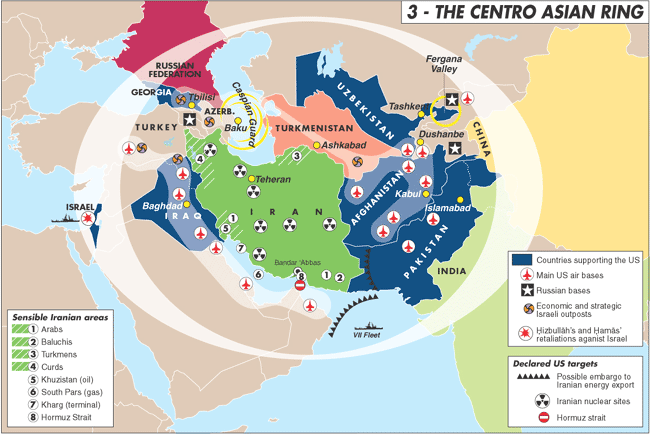
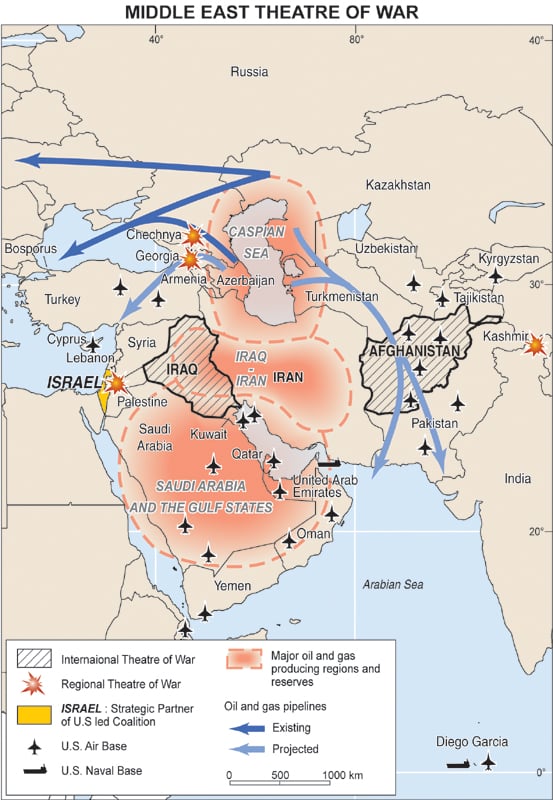
The Eurasian Corridor
Since the 2001 invasion and occupation of Afghanistan, the US has a military presence on China’s Western frontier, in Afghanistan and Pakistan. The U.S. is intent upon establishing permanent military bases in Afghanistan, which occupies a strategic position bordering on the former Soviet republics, China and Iran.
Moreover, the US and NATO have also established since 1996, military ties with several former Soviet republics under GUUAM (Georgia, Ukraine, Uzbekistan and Moldava). In the post 9/11 era, Washington has used the pretext of the "global war against terrorism" to further develop a U.S. military presence in GUUAM countries. Uzbekistan withdrew from GUUAM in 2002.(The organization is now referred to as GUAM).
China has oil interests in Eurasia as well as in sub-Saharan Africa, which encroach upon Anglo-American oil interests.
What is at stake is the geopolitical control over the Eurasian corridor.
In March 1999, the U.S. Congress adopted the Silk Road Strategy Act, which defined America’s broad economic and strategic interests in a region extending from the Eastern Mediterranean to Central Asia. The Silk Road Strategy (SRS) outlines a framework for the development of America’s business empire along an extensive geographical corridor.
The successful implementation of the SRS requires the concurrent "militarization" of the entire Eurasian corridor as a means to securing control over extensive oil and gas reserves, as well as "protecting" pipeline routes and trading corridors. This militarization is largely directed against China, Russia and Iran.
The militarization of the South China Sea and of the Taiwan Straits is also an integral part of this strategy which, in the post 9/11 era, consists in deploying "on several fronts".
Moreover, China remains in the post-Cold War era a target for a first strike nuclear attack by the US.
In the 2002 Nuclear Posture Review (NPR), China and Russia are identified along with a list of "rogue States" as potential targets for a pre-emptive nuclear attack by the US. China is listed in the NPR as "a country that could be involved in an immediate or potential contingency". Specifically, the Nuclear Posture Review lists a military confrontation over the status of Taiwan as one of the scenarios that could lead Washington to use nuclear weapons against China.
China has been encircled: The U.S. military is present in the South China Sea and the Taiwan Straights, in the Korean Peninsula and the Sea of Japan, as well as in the heartland of Central Asia and on the Western border of China’s Xinjiang-Uigur autonomous region. Moreover, as part of the encirclement of China, "Japan has gradually been amalgamating and harmonizing its military policies with those of the
Weakening China from within: Covert Support to Secessionist Movements
Consistent with its policy of weakening and ultimately fracturing the People’s Republic of China, Washington supports secessionist movements both in Tibet as wall as in the Xinjiang-Uigur autonomous region which borders onto North Eastern Pakistan and Afghanistan.
In Xinjiang-Uigur, Pakistani intelligence (ISI), acting in liaison with the CIA, supports several Islamist organizations. The latter include the Islamic Reformist Party, the East Turkestan National Unity Alliance, the Uigur Liberation Organization and the Central Asian Uigur Jihad Party. Several of these Islamic organizations have received support and training from Al Qaeda, which is a US sponsored intelligence asset. The declared objective of these Chinese-based Islamic organizations is the "establishment of an Islamic caliphate in the region" (For further details see Michel Chossudovsky, America’s War on Terrorism, Global Research, Montreal, 2005, Chapter 2).
The caliphate would integrate Uzbekistan, Tajikistan, Kyrgyzstan (West Turkestan) and the Uigur autonomous region of China (East Turkestan) into a single political entity.
The "caliphate project" encroaches upon Chinese territorial sovereignty. Supported by various Wahabi "foundations" from the Gulf States, secessionism on China’s Western frontier is, once again, consistent with U.S. strategic interests in Central Asia. Meanwhile, a powerful U.S.-based lobby is channeling support to separatist forces in Tibet.
By tacitly promoting the secession of the Xinjiang-Uigur region (using Pakistan’s ISI as a "go-between"), Washington is attempting to trigger a broader process of political destabilization and fracturing of the People’s Republic of China. In addition to these various covert operations, the U.S. has established military bases in Afghanistan and in several of the former Soviet republics, directly on China’s Western border.
The militarization of the South China Sea and of the Taiwan Straits is also an integral part of this strategy.(Ibid)
The Lhasa Riots
The violent riots in Tibet’s capital in mid-March were a carefully staged event. In their immediate aftermath, a media disinformation campaign supported by political by Western leaders directed against China was launched.
There are indications that US intelligence played a behind the scenes role in what several observers have described as a carefully premeditated operation.(See our analysis below).
The Lhasa event in mid-March was not a spontaneous "peaceful" protest movement as described by the Western media The riots involving a gang of mobsters were premeditated. They had been carefully planned. Tibetan activists in India associated with the Dalai Lama’s government in exile "hinted they were indeed expecting the disturbances. But they refuse to elaborate how they knew or who their collaborators were" (Guerilla News)
The images do not suggest a mass protest rally but rather a rampage led by a few hundred individuals. Buddhist monks were involved in the rampage. According to China Daily (March 31, 2008), the Tibetan Youth Congress (TYC) based in India, considered by China as a "hard-line organization" affiliated to the Dalai Lama, was also behind the violence. The TYC’s training camps are funded by the National Endowment for Democracy (NED). (See the text of the Congressional Hearings regarding NED support to the TYC)


CLICK TO VIEW VIDEO OF LHASA RIOTS
Video footage confirms that civilians were stoned, beaten and in some cases killed. Most of the victims were Han Chinese. At least ten people were burned to death as a result of acts of arson, according to statements of the Tibet government. These statements were confirmed by several eyewitness reports. According to a China Daily report:
"five shop assistants at a clothing store were burnt to death before they had any chance to escape. A 1.7-meter-tall man named Zuo Yuancun was torched down to chunks of horrid flesh and skeletons. A migrant worker had his liver stabbed and bled by mobsters. A woman was beaten hard by the attackers and had her ear sliced off." (People’s Daily, March 22, 2008)
Meanwhile, the Western media casually described the looting and arson as a "peaceful demonstration" which the Chinese authorities suppressed with the use of force. There are no accurate reports (from Chinese and Western news sources) on the nature of the Chinese police operation launched to repress the riots. Western press reports point to the deployment of more than 1000 soldiers and police in the Tibetan capital.
Businesses, schools were attacked, cars were set on fire. According to Chinese reports, there are 22 dead and 623 injured. "Rioters set fire at more than 300 locations, mostly private houses, stores and schools, and smashed vehicles and damaged public facilities."


The planning of the riots was coordinated with the media disinformation campaign, which accused the Chinese authorities of having instigated the looting and arson. The Dalai Lama accused Beijing of "disguising its troops as monks" to give the impression that Buddhist monks were behind the riots. The claims were based on a four year old photograph of soldiers dressing up as monks in a theatrical stage performance (See South China Morning Post, 4 April 2008).
The mainland newspaper {People’s Daily] said the security forces quelling riots in Lhasa could not possibly have been wearing the uniforms shown in the photograph because they were summer uniforms, unsuitable for the cold March weather.
It also said the PAP had changed to new uniforms in 2005, which feature shoulder emblems. The armed officers shown in the photograph were in old-style uniforms which had been phased out after 2005. ... Xinhua said the photograph was taken during a performance years ago, when soldiers borrowed robes from monks before performing on stage. (Ibid)
The Dalai Lama’s claim that the Chinese authorities had instigated the riots, quoted in the Western media, is supported by a statement of a former Communist Party official Mr. Ruan Ming who "claims the CCP carefully staged the incidents in Tibet in order to force the Dalai Lama to resign and to justify future repression of the Tibetans. Mr. Ruan Ming was a speechwriter for former CCP General Secretary Hu Yaobang." (quoted in The Epoch Times)

2003 photograph used by the media to accuse China of having deliberately instigated the riots.
"This [2003] photo was apparently made when soldiers were ordered to put on
robes to play as actors in a movie."
See http://buddhism.kalachakranet.org/chinese-orchestrating-riots-tibet.htm
The Role of US Intelligence
The organization of the Lhasa riots are part of a consistent pattern. They constitute an attempt to trigger ethnic conflict in China. They serve US foreign policy interests.
To what extent has US intelligence played an undercover role in the current wave of protests regarding Tibet?
Given the covert nature of intelligence operations, there is no tangible evidence of direct CIA involvement. However, there are various Tibetan organizations linked to the Tibet "government in exile" which are known to be supported by the CIA and/or by the CIA’s civilian front organization, the National Endowment for Democracy (NED).
The CIA’s involvement in channeling covert support to the Tibetan secessionist movement goes back to the mid-1950s. The Dalai Lama was on the CIA’s payroll from the late 1950s until 1974:
The CIA conducted a large scale covert action campaign against the communist Chinese in Tibet starting in 1956. This led to a disastrous bloody uprising in 1959, leaving tens of thousands of Tibetans dead, while the Dalai Lama and about 100,000 followers were forced to flee across the treacherous Himalayan passes to India and Nepal.
The CIA established a secret military training camp for the Dalai Lama’s resistance fighters at Camp Hale near Leadville, Colorado, in the US. The Tibetan guerrillas were trained and equipped by the CIA for guerrilla warfare and sabotage operations against the communist Chinese.
The US-trained guerrillas regularly carried out raids into Tibet, on occasions led by CIA-contract mercenaries and supported by CIA planes. The initial training program ended in December 1961, though the camp in Colorado appears to have remained open until at least 1966.
The CIA Tibetan Task Force created by Roger E McCarthy, alongside the Tibetan guerrilla army, continued the operation codenamed "ST CIRCUS" to harass the Chinese occupation forces for another 15 years until 1974, when officially sanctioned involvement ceased.
McCarthy, who also served as head of the Tibet Task Force at the height of its activities from 1959 until 1961, later went on to run similar operations in Vietnam and Laos.
By the mid-1960s, the CIA had switched its strategy from parachuting guerrilla fighters and intelligence agents into Tibet to establishing the Chusi Gangdruk, a guerrilla army of some 2,000 ethnic Khamba fighters at bases such as Mustang in Nepal.
This base was only closed down in 1974 by the Nepalese government after being put under tremendous pressure by Beijing.
After the Indo-China War of 1962, the CIA developed a close relationship with the Indian intelligence services in both training and supplying agents in Tibet." (Richard Bennett, Tibet, the ’great game’ and the CIA, Global Research, March 2008)
The National Endowment for Democracy (NED)
The National Endowment for Democracy (NED), which channels financial support to pro-US opposition groups around the World has played a significant role in triggering "velvet revolutions" which serve Washington’s geopolitical and economic interests.
The NED, although not formally part of the CIA, performs an important intelligence function within the arena of civilian political parties and NGOs. It was created in 1983, when the CIA was being accused of covertly bribing politicians and setting up phony civil society front organizations. According to Allen Weinstein, who was responsible for setting up the NED during the Reagan Administration: "A lot of what we do today was done covertly 25 years ago by the CIA." (’Washington Post’, Sept. 21, 1991).
The NED provided funds to the "civil society" organizations in Venezuela, which initiated an attempted coup against President Hugo Chavez. In Haiti, the NED supported the opposition groups behind the armed insurrection which contributed to unseating President Bertrand Aristide in February 2004. The coup d’ Etat in Haiti was the result of a carefully staged military-intelligence operation. (See Michel Chossudovsky, The Destabilization of Haiti, Global Research, February 2004)
The NED funds a number of Tibet organizations both within China and abroad. The most prominent pro-Dalai Lama Tibet independence organization funded by the NED is the International Campaign for Tibet (ICT), founded in Washington in 1988. The ICT has offices in Washington, Amsterdam, Berlin and Brussels. Distinct from other NED funded Tibet organizations, the ICT has a close cozy and " overlapping" relationship with the NED and the US State Department::
Some of ICT’s directors are also integral members of the ‘democracy promoting’ establishment, and include Bette Bao Lord (who is the chair of Freedom House, and a director of Freedom Forum), Gare A. Smith (who has previously served as principal deputy assistant secretary in the U.S. Department of State’s Bureau of Democracy, Human Rights and Labor), Julia Taft (who is a former director of the NED, the former U.S. Assistant Secretary of State and Special Coordinator for Tibetan Issues, has worked for USAID, and has also served as the President and CEO of InterAction), and finally, Mark Handelman (who is also a director of the National Coalition for Haitian Rights, an organization whose work is ideologically linked to the NED’s longstanding interventions in Haiti).
The ICT’s board of advisors also presents two individuals who are closely linked to the NED, Harry Wu, and Qiang Xiao (who is the former executive director of the NED-funded Human Rights in China).
Like their board of directors, ICT’s international council of advisors includes many ‘democratic’ notables like Vaclav Havel, Fang Lizhi (who in 1995 – at least – was a board member of Human Rights in China), Jose Ramos-Horta (who serves on the international advisory board for the Democracy Coalition Project), Kerry Kennedy (who is a director of the NED-funded China Information Center), Vytautas Landsbergis (who is an international patron of the British-based neoconservative Henry Jackson Society – see Clark, 2005), and until her recent death, the “mid-wife of the neocons” Jeane J. Kirkpatrick (who was also linked to ‘democratic’ groups like Freedom House and the Foundation for the Defense of Democracies). (Michael Barker, "Democratic Imperialism": Tibet, China, and the National Endowment for Democracy Global Research, August 13, 2007)
Other NED funded Tibet organizations include the Students for a Free Tibet (SFT) referred to earlier. The SFT was founded in 1994 in New York City "as a project of US Tibet Committee and the NED-financed International Campaign for Tibet (ICT). The SFT is most known for unfurling a 450 foot banner atop the Great Wall in China; calling for a free Tibet." (F. William Engdahl, Risky Geopolitical Game: Washington Plays ‘Tibet Roulette’ with China, Global Research, April 2008).
The SFT together with five other Tibet organizations proclaimed last January "the start of a ’Tibetan people’s uprising" ... and co-founded a temporary office in charge of coordination and financing." ( Ibid)
"The NED also funds the Tibet Multimedia Center for “information dissemination that addresses the struggle for human rights and democracy in Tibet,” also based in Dharamsala. And the NED finances the Tibetan Center for Human Rights and Democracy.(Ibid)
There is a division of tasks between the CIA and the NED. While the CIA provides covert support to armed paramilitary rebel groups and terrorist organizations, the NED finances "civilian" political parties and non governmental organizations with a view to instating American "democracy" around the World.
The NED constitutes, so to speak, the CIA’s "civilian arm". CIA-NED interventions in different part of the World are characterized by a consistent pattern, which is applied in numerous countries.
PsyOp: Discrediting the Chinese Leadership
The short-term objective is to discredit the Chinese leadership in the months leading up to the Beijing Olympic games, while also using the Tibet campaign to divert public opinion from Middle East war and the war crimes committed by the US, NATO and Israel.
China’s alleged human rights violations are highlighted as a distraction, to provide a human face to the US led war in the Middle East. Moreover, US sponsored war plans directed against Iran are barely acknowledged by the Western media. Moreover, with Tibet making the headlines, the real humanitarian crisis in the Middle East is not front page news.
More generally, the issue of human rights is distorted: realities are turned upside down, the extensive crimes committed by the US and its coalition partners are either concealed or justified as a means to protecting society against terrorists.
A "double standards" in the assessment of human rights violations has been instated. In the Middle East, the killing of civilians is categorized as collateral damage. It is justified as part of the "global war on terrorism". The victims are said to be responsible for their own deaths.
The Olympic Torch
Carefully timed demonstrations on China’s human rights violations in Western capitals have been set in motion.
A partial boycott of the Olympic games seems to be underway. French Foreign Minister Bernard Kouchner (a strong protagonist of US interests who has a relationship to the Bilderbergs), has called for a boycott of the opening ceremonies of the Olympics. Kouchner said the idea should be discussed at a meeting of EU foreign ministers
The Olympic torch was lit at a ceremony in Greece, which was disrupted by "pro-Tibet activists". The event was sponsored by "Reporters Without Borders", an organization known to have links to US intelligence. (See, Diana Barahona, Reporters Without Borders Unmasked, May 2005). "Reporters Without Borders" also receives support for the National Endowment for Democracy (NED).
The Olympic Torch is symbolic. The Psychological operation (PsyOp) consists in targeting the Olympic torch in the months leading up the Beijing Olympic games.
At each phase of this process, the Chinese leadership is denigrated by the Western media.
Global Economic Implications
The Tibet campaign directed against the Chinese leadership could backlash.
We are at the crossroads of the most serious economic and financial crisis of modern history. The unfolding economic crisis bears a direct relationship to the US sponsored military adventure in the Middle East and Central Asia.
China play a strategic role with regard to US military expansionism. So far it has not exercised it Veto power in the United Nations Security Council in relation to the several US sponsored UNSC resolutions directed Iran.
China also plays a central role in the global economy and financial system.
Resulting from an accumulated trade surplus with the US, China’s now holds 1.5 trillion dollars worth of US debt instruments (including US Treasury bills). It has the ability to significantly disrupt international currency markets. The US dollar would plunge to even lower levels, were China to sell off its dollar denominated debt holdings.(For further details see: F. William Engdahl, op cit)
Moreover, China is the largest producer of a wide range of manufactured goods which constitute, for the West, a significant share of monthly household consumption. Western retail giants rely on the continued and uninterrupted flow of cheap labor industrial commodities from China.
For the Western countries, China’s insertion into the structures of global trade, investment, finance and intellectual property rights under the World Trade Organization (WTO) is absolutely crucial. Were Beijing to decide to curtail its "Made in China" manufacturing exports to the US, America’s fragile and declining manufacturing base would not be able to fill the gap, at least in the short run.
Moreover, the US and its coalition partners including the UK, Germany, France and Japan have important investment interests in China. In 2001, the US and China signed a bilateral trading agreement prior to the accession of China to the WTO. This agreement allows US investors, including the major Wall Street financial institutions, to position themselves in Shanghai’s financial and trading system as well as in China’s domestic banking market.
While China is, in some regards, the West’s "cheap labor industrial colony", China’s relationship to the global trading system is by no means cast in steel.
China’s relationship to global capitalism has its roots in the "Open Door Policy" initially formulated in 1979. (Michel Chossudovsky, Towards Capitalist Restoration. Chinese Socialism after Mao, Macmillian, London, 1986, chapters 7 and 8)
Since the 1980s, China has become the main supplier of industrial goods to Western markets. Any threat against China and/or military venture directed against China’s Eurasian allies including Iran could potentially disrupt China’s extensive trade in manufactured goods. China’s export oriented industrial base is the source of tremendous wealth formation in the advanced capitalist economies. Where does the wealth of the Walton family, owners of WalMart, originate? WalMart does produce anything. It imports cheap labor commodities "Made in China" and resells them in the US retail market at up to ten times their factory price.
This process of "import led development" has allowed the Western "industrialised" countries to close down a large part of their manufacturing outlets. In turn, China’s industrial sweat shops serve to generate multibillion dollar profits for Western corporations, including the retail giants, which purchase and/or outsource their production to China.
Any threat of a military nature directed against China could have devastating economic consequences, far beyond the familiar upward spiral in the price of crude oil.
America’s War on Terrorism, Global Research, Montreal 2005
Click to order In this new and expanded edition of Michel Chossudovsky’s 2002 best seller, the author blows away the smokescreen put up by the mainstream media, that 9/11 was an attack on America by "Islamic terrorists". Through meticulous research, the author uncovers a military-intelligence ploy behind the September 11 attacks, and the cover-up and complicity of key members of the Bush Administration.
The expanded edition, which includes twelve new chapters focuses on the use of 9/11 as a pretext for the invasion and illegal occupation of Iraq, the militarisation of justice and law enforcement and the repeal of democracy.
According to Chossudovsky, the "war on terrorism" is a complete fabrication based on the illusion that one man, Osama bin Laden, outwitted the $40 billion-a-year American intelligence apparatus. The "war on terrorism" is a war of conquest. Globalisation is the final march to the "New World Order", dominated by Wall Street, the Anglo-American oil giants and the U.S. military-industrial complex.
September 11, 2001 provides a justification for waging a war without borders. Washington’s agenda consists in extending the frontiers of the American Empire to facilitate complete U.S. corporate control, while installing within America the institutions of the Homeland Security State.


Chossudovsky peels back layers of rhetoric to reveal a complex web of deceit aimed at luring the American people and the rest of the world into accepting a military solution which threatens the future of humanity.
The last chapter includes an analysis of the London 7/7 Bomb Attacks.
Cynthia McKinney 4 President - Explosivo Verde, Los Angeles
Cynthia McKinney's Green presidential campaign stops at the Zero Point Art Space in South Los Angeles at the Explosivo Verde Green Party party. Organized by the Los Angeles Greens (www.losangelesgreens.org) Saturday, April 12th.
Inside Story - Syria's economic reforms
It has been 8 years since Bashar al-Assad, Syria's president, promised economic reforms. In this special episode of Inside Story from Damascus, we ask what impact the reforms have had and if they have created more opportunities for young Syrians.
US Lenders Freeze Home Equity Credit Lines
Go to Original
By Gretchen Morgenson
New York - It was the lending institutions and mortgage originators that got the United States into this credit mess, but it is the American consumers, taxpayers and those companies' shareholders who will end up shouldering most of the costs.
The latest example of this is in the mass freezing of home equity lines of credit going on across the United States. Reeling from losses on their wretched loan decisions of recent years, lenders are preventing borrowers with pristine credit and significant equity in their homes from tapping into credit lines that they paid dearly to secure.
In the past 30 days, lenders have sent several hundred thousand letters advising borrowers that their home equity lines of credit are frozen, estimated Michael Kratzer, president of FeeDisclosure.com, a Web site intended to help consumers reduce fees on home loans.
Major lenders - including Washington Mutual, IndyMac Bank and the Greenpoint Mortgage Unit of Capital One - say that declining property values are prompting the decisions to cut off credit.
Banks have the right, of course, to rescind these credit lines at any time under the terms of the contracts they struck with borrowers. And as home prices have tumbled in many parts of the United States, banks are undoubtedly trying to protect themselves from exposure to additional losses.
But these actions are being taken even in areas where property prices are rising, Kratzer said. What's worse, the letters provide no explanation for how the lenders determined that the property values underlying the equity lines had fallen.
Frozen home equity lines will surely intensify the consumer spending downturn and put added pressure on an already weak economy.
On Friday, U.S. consumer confidence, as measured by the University of Michigan, plummeted to its lowest level since 1982. The drop was attributed mostly to higher fuel and food costs, but consumers' views on their current and expected personal financial situations dropped to the lowest readings since November 1982 and April 1980, respectively.
One especially exasperating aspect of now-you-see-them, now-you-don't equity lines is that borrowers are not receiving refunds for fees they paid to secure the credit in the first place.
These fees can be significant, Kratzer said: On a $50,000 line, for example, fees of $1,500 are common. If the line is being frozen at, say, $25,000, why shouldn't the borrower be entitled to receive a refund of $750?
Borrowers who have excellent credit scores may also find that status hurt when a home equity line is frozen. That is because when a lender suddenly caps a $50,000 line at $25,000, the borrower will appear to have tapped the entire amount of the loan, a factor that can reduce a person's credit score. Never mind that, based on the original amount of the credit line, the borrower is using only half of it.
Ronald Martin, 31, a U.S. naval aviator deployed in Iraq, received one of these letters recently from IndyMac Bank. "We regret to inform you that your IndyMac Bank Home Equity account has been temporarily frozen," the letter began.
Martin's wife, Leigh Anne, a substitute teacher who lives in their home in Camarillo, California, said the notice had surprised her because she and her husband had excellent credit scores and had not even tapped the IndyMac line. While home values in the Martins' neighborhood had fallen, the Martins were not under water on their mortgage, which had been taken out in spring 2005.
"You paid to use that equity line and now they are saying you can't use it," Leigh Anne Martin said. "We've never been late on our mortgage. We have a good savings account. We pay every bill we ever had on time - what did we do wrong?"
The IndyMac letter said the Martins' credit was being suspended because "the value of the dwelling has declined significantly below its appraised value used at origination." IndyMac said it would re-evaluate the property value each quarter and, if it improved, the freeze would be lifted.
Officials representing IndyMac declined to comment.
Sara Gaugl, a Washington Mutual spokeswoman, said the bank actively manages the amount of credit it extends to customers. "We have a process in place for customers who wish to appeal a credit line decrease decision," she said. "We also will continue to assist homeowners who may have unique or special situations."
Kratzer, who has recently fielded calls and e-mail messages from more than 500 borrowers in straits similar to the Martins', said lenders who were reining in credit should provide an explanation of how they determined that property values associated with the lines had declined sharply.
"How are lenders arriving at the new loan-to-value ratios?" Kratzer asked. "When you secure a loan or home equity line, a full appraisal is generally required. But these processes aren't being used when the lender calculates a new value to reduce an existing credit line."
Kratzer said he had heard from frozen-out borrowers in 11 areas where the median home price actually increased in the last quarter of 2007, the most recent figures available from the National Association of Realtors. These areas include Yakima, Washington; Appleton, Wisconsin; Raleigh-Cary, North Carolina; and Champaign-Urbana, Illinois.
Borrowers in areas where prices remained flat have also contacted him.
"Are they applying blanket values to ZIP codes, neighborhoods or entire regions?" Kratzer asked. "We're all left to wonder about the process."
Luckily for the Martins, they are not in need of additional credit on their IndyMac line. But other borrowers who have contacted Kratzer say they are in the middle of home improvement projects that they can no longer finance, or have college tuition bills that they were going to pay using the credit lines. Now they can't.
Medical expenses, another reason that borrowers tap their equity lines, are also posing problems for some homeowners.
And small-business owners who use home equity lines to bridge cash-flow gaps throughout the year are also being stricken by these curbs, Kratzer said. He has also heard from people who paid down some of their home equity lines, expecting to be able to draw on them again. Now, they are out of luck.
"In a perfect world, lenders would fully disclose the process and criteria used to make these valuations and decisions," Kratzer said. "These borrowers have a solid payment history, good credit scores and plenty of equity to satisfy most of the lenders' loan-to-value formulas. Instead, the banks are just shutting them off."
By Gretchen Morgenson
New York - It was the lending institutions and mortgage originators that got the United States into this credit mess, but it is the American consumers, taxpayers and those companies' shareholders who will end up shouldering most of the costs.
The latest example of this is in the mass freezing of home equity lines of credit going on across the United States. Reeling from losses on their wretched loan decisions of recent years, lenders are preventing borrowers with pristine credit and significant equity in their homes from tapping into credit lines that they paid dearly to secure.
In the past 30 days, lenders have sent several hundred thousand letters advising borrowers that their home equity lines of credit are frozen, estimated Michael Kratzer, president of FeeDisclosure.com, a Web site intended to help consumers reduce fees on home loans.
Major lenders - including Washington Mutual, IndyMac Bank and the Greenpoint Mortgage Unit of Capital One - say that declining property values are prompting the decisions to cut off credit.
Banks have the right, of course, to rescind these credit lines at any time under the terms of the contracts they struck with borrowers. And as home prices have tumbled in many parts of the United States, banks are undoubtedly trying to protect themselves from exposure to additional losses.
But these actions are being taken even in areas where property prices are rising, Kratzer said. What's worse, the letters provide no explanation for how the lenders determined that the property values underlying the equity lines had fallen.
Frozen home equity lines will surely intensify the consumer spending downturn and put added pressure on an already weak economy.
On Friday, U.S. consumer confidence, as measured by the University of Michigan, plummeted to its lowest level since 1982. The drop was attributed mostly to higher fuel and food costs, but consumers' views on their current and expected personal financial situations dropped to the lowest readings since November 1982 and April 1980, respectively.
One especially exasperating aspect of now-you-see-them, now-you-don't equity lines is that borrowers are not receiving refunds for fees they paid to secure the credit in the first place.
These fees can be significant, Kratzer said: On a $50,000 line, for example, fees of $1,500 are common. If the line is being frozen at, say, $25,000, why shouldn't the borrower be entitled to receive a refund of $750?
Borrowers who have excellent credit scores may also find that status hurt when a home equity line is frozen. That is because when a lender suddenly caps a $50,000 line at $25,000, the borrower will appear to have tapped the entire amount of the loan, a factor that can reduce a person's credit score. Never mind that, based on the original amount of the credit line, the borrower is using only half of it.
Ronald Martin, 31, a U.S. naval aviator deployed in Iraq, received one of these letters recently from IndyMac Bank. "We regret to inform you that your IndyMac Bank Home Equity account has been temporarily frozen," the letter began.
Martin's wife, Leigh Anne, a substitute teacher who lives in their home in Camarillo, California, said the notice had surprised her because she and her husband had excellent credit scores and had not even tapped the IndyMac line. While home values in the Martins' neighborhood had fallen, the Martins were not under water on their mortgage, which had been taken out in spring 2005.
"You paid to use that equity line and now they are saying you can't use it," Leigh Anne Martin said. "We've never been late on our mortgage. We have a good savings account. We pay every bill we ever had on time - what did we do wrong?"
The IndyMac letter said the Martins' credit was being suspended because "the value of the dwelling has declined significantly below its appraised value used at origination." IndyMac said it would re-evaluate the property value each quarter and, if it improved, the freeze would be lifted.
Officials representing IndyMac declined to comment.
Sara Gaugl, a Washington Mutual spokeswoman, said the bank actively manages the amount of credit it extends to customers. "We have a process in place for customers who wish to appeal a credit line decrease decision," she said. "We also will continue to assist homeowners who may have unique or special situations."
Kratzer, who has recently fielded calls and e-mail messages from more than 500 borrowers in straits similar to the Martins', said lenders who were reining in credit should provide an explanation of how they determined that property values associated with the lines had declined sharply.
"How are lenders arriving at the new loan-to-value ratios?" Kratzer asked. "When you secure a loan or home equity line, a full appraisal is generally required. But these processes aren't being used when the lender calculates a new value to reduce an existing credit line."
Kratzer said he had heard from frozen-out borrowers in 11 areas where the median home price actually increased in the last quarter of 2007, the most recent figures available from the National Association of Realtors. These areas include Yakima, Washington; Appleton, Wisconsin; Raleigh-Cary, North Carolina; and Champaign-Urbana, Illinois.
Borrowers in areas where prices remained flat have also contacted him.
"Are they applying blanket values to ZIP codes, neighborhoods or entire regions?" Kratzer asked. "We're all left to wonder about the process."
Luckily for the Martins, they are not in need of additional credit on their IndyMac line. But other borrowers who have contacted Kratzer say they are in the middle of home improvement projects that they can no longer finance, or have college tuition bills that they were going to pay using the credit lines. Now they can't.
Medical expenses, another reason that borrowers tap their equity lines, are also posing problems for some homeowners.
And small-business owners who use home equity lines to bridge cash-flow gaps throughout the year are also being stricken by these curbs, Kratzer said. He has also heard from people who paid down some of their home equity lines, expecting to be able to draw on them again. Now, they are out of luck.
"In a perfect world, lenders would fully disclose the process and criteria used to make these valuations and decisions," Kratzer said. "These borrowers have a solid payment history, good credit scores and plenty of equity to satisfy most of the lenders' loan-to-value formulas. Instead, the banks are just shutting them off."
Senator: Probe of Rising Gasoline Prices Needed
Go to Original
By Les Blumenthal
Washington - With the price of crude oil hovering near $110 a barrel and gasoline prices at record levels, a Washington senator says federal regulators need to stop delaying and start investigating whether petroleum markets are being manipulated.
Democratic Sen. Maria Cantwell said the Federal Trade Commission should move quickly to implement a provision she inserted in a national energy bill approved by Congress late last year that gives it authority to investigate whether excessive speculation and manipulation have driven up prices.
"Their response has been tepid," Cantwell said in an interview. "They said they want to work with us, but they need to get in the game."
Cantwell said the FTC response wasn't surprising. She said she expected the agency would "run out the clock" and leave the manipulation regulations for the next administration to write and implement.
"They didn't ask for the authority and they've never been excited about it," Cantwell said. "They say they want to work with us. Given the impact on the economy, they need to get started."
An FTC spokesman, Frank Dorman, declined to comment.
Cantwell noted that crude oil prices have doubled over the past year despite adequate inventories, no major disruption in supply and a slight drop in demand in the United States as the economy has cooled.
At congressional hearings over the past several weeks, oil company executives and market analysts have been at a loss to explain the sharp increase in crude oil prices. Cantwell said an Exxon Mobil executive recently told a House of Representatives committee that he thought the price of crude oil should be about $50 to $55 a barrel, given current supply and demand.
In 2005, Cantwell persuaded Congress to adopt a law that banned manipulation in the electricity and natural gas markets and ordered the Federal Energy Regulatory Commission to enforce it. The law came in the wake of the West Coast energy crisis of 2000-2001 during which electricity prices in Washington, Oregon and California rose steeply amid allegations that Enron Corp. and other energy marketers had schemed to manipulate wholesale prices.
Since then, FERC has conducted 64 investigations that have resulted in 13 settlements involving the payment of $40 million in civil fines, Cantwell said. FERC also pursued two enforcement actions that resulted in the payment of nearly $460 million in fines.
FERC wrote and implemented its market manipulation rules in six months, according to Cantwell.
"That speaks to the fact if you are motivated, you can get it done," she said, adding that while she didn't know whether petroleum companies have engaged in the same type of manipulation tactics that Enron did, "I think there are things that are happening out there."
By Les Blumenthal
Washington - With the price of crude oil hovering near $110 a barrel and gasoline prices at record levels, a Washington senator says federal regulators need to stop delaying and start investigating whether petroleum markets are being manipulated.
Democratic Sen. Maria Cantwell said the Federal Trade Commission should move quickly to implement a provision she inserted in a national energy bill approved by Congress late last year that gives it authority to investigate whether excessive speculation and manipulation have driven up prices.
"Their response has been tepid," Cantwell said in an interview. "They said they want to work with us, but they need to get in the game."
Cantwell said the FTC response wasn't surprising. She said she expected the agency would "run out the clock" and leave the manipulation regulations for the next administration to write and implement.
"They didn't ask for the authority and they've never been excited about it," Cantwell said. "They say they want to work with us. Given the impact on the economy, they need to get started."
An FTC spokesman, Frank Dorman, declined to comment.
Cantwell noted that crude oil prices have doubled over the past year despite adequate inventories, no major disruption in supply and a slight drop in demand in the United States as the economy has cooled.
At congressional hearings over the past several weeks, oil company executives and market analysts have been at a loss to explain the sharp increase in crude oil prices. Cantwell said an Exxon Mobil executive recently told a House of Representatives committee that he thought the price of crude oil should be about $50 to $55 a barrel, given current supply and demand.
In 2005, Cantwell persuaded Congress to adopt a law that banned manipulation in the electricity and natural gas markets and ordered the Federal Energy Regulatory Commission to enforce it. The law came in the wake of the West Coast energy crisis of 2000-2001 during which electricity prices in Washington, Oregon and California rose steeply amid allegations that Enron Corp. and other energy marketers had schemed to manipulate wholesale prices.
Since then, FERC has conducted 64 investigations that have resulted in 13 settlements involving the payment of $40 million in civil fines, Cantwell said. FERC also pursued two enforcement actions that resulted in the payment of nearly $460 million in fines.
FERC wrote and implemented its market manipulation rules in six months, according to Cantwell.
"That speaks to the fact if you are motivated, you can get it done," she said, adding that while she didn't know whether petroleum companies have engaged in the same type of manipulation tactics that Enron did, "I think there are things that are happening out there."
US and Iran holding 'secret' talks on nuclear programme
Go to Original
By Anne Penketh
Iran and the United States have been engaged in secret "back channel" discussions for the past five years on Iran's nuclear programme and the broader relationship between the two sworn enemies, The Independent can reveal.
One of the participants, former senior US diplomat Thomas Pickering, explained that a group of former American diplomats and experts had been meeting with Iranian academics and policy advisers "in a lot of different places, although not in the US or Iran".
"Some of the Iranians were connected to official institutions inside Iran," he said in a telephone interview from Washington. The group was organised by the UN Association of the USA, a pro-UN organisation. Its work was facilitated by the Stockholm International Peace Research Institute, a government-funded think-tank chaired by the former chief UN weapons inspector for Iraq, Rolf Ekeus.
While the nuclear issue was "prominent", Mr Pickering said, "we discussed what's going on domestically in both countries and wide-ranging issues" affecting the US-Iran relationship. Although none of the group members was from the US or Iranian governments, he said that "each side kept their officials informed". The Bush administration "did not discourage us," he added.
Mr Pickering declined to go into greater detail for fear of jeopardising future meetings of the group of about a dozen Americans and Iranians, although the number of participants varies. Back- channel talks have often provided crucial impetus in solving the world's most intractable disputes. They usually only become public in case of agreement, as seen with Northern Ireland and the Oslo accords on the Middle East, or failure, as in the case of an Israeli-Syrian informal channel.
The revelation about the existence of an Iran-US back channel coincides with the recent publication by three of its American members, including Mr Pickering, of proposals aimed at overcoming the deadlock between Iran and the West over Tehran's nuclear ambitions. The initiative addresses the crunch issue of Iran's right to enrich uranium on its own soil while providing guarantees that the nuclear fuel will not be diverted for military purposes.
Mr Pickering spoke of a "rather positive" reaction to the plan, which provides for an international consortium to jointly manage and run uranium enrichment on Iranian soil.
However, the Bush administration has not responded, and remains wedded to its current policy of sanctions aimed at forcing Iran to halt uranium enrichment in line with UN demands, while offering the opportunity to enrich uranium outside the country through a Russian consortium. A Foreign Office spokesman said Britain was "aware" of the proposals but did not have an official response. The Iranian government, according to Mr Pickering, has let it be known that "they would not respond unless it was offered officially".
In arms-control circles the plan has gained traction "because he's so respected," said George Perkovich of the Carnegie Endowment for International Peace, referring to Mr Pickering, who is a former US undersecretary of state. The initiative, co-signed by the UNA-USA president William Luers, a former diplomat, and Jim Walsh, a nuclear expert from the Massachusetts Institute of Technology, was first aired at the end of February in The New York Review of Books where it has generated further discussion.
Mr Pickering says that he and his colleagues decided to act now because US policy was "stuck", in the light of Iran's refusal to bow to the UN demand to halt uranium enrichment, despite the imposition of economic sanctions. Prospects for face-to-face US-Iran talks are therefore blocked, he says, arguing that the case is urgent because Iran is continuing to install centrifuges at its main enrichment plant in Natanz.
But other experts point out that with the 3,000 centrifuges at Natanz spinning at only 20 percent of capacity because of technical problems, there is time for the West to play a waiting game.
James Acton, a nuclear specialist at King's College London Department of War Studies, said the challenge would be to prevent Iran obtaining a clandestine route to a nuclear weapon thanks to the technical know-how that would be obtained from foreign partners.
Mr Pickering said: "It can be feasible if governments wish to make it so, technically and financially. But it will take a lot of negotiation."
Some analysts pointed out that a breakthrough was unlikely so long as George Bush was in the White House and Mahmoud Ahmadinejad holds the presidency of Iran, where elections are scheduled for next year. "Why would Iran go for it now? They feel like they've won, there are not enough sanctions, and there is no threat of war," said Mr Perkovich.
Calling Iran's bluff?
The Luers-Pickering-Walsh initiative gives Iran the opportunity to prove that its nuclear intentions are peaceful by yielding to the Iranians' key demand for a uranium enrichment programme on Iranian soil. The enrichment activities would take place under the supervision of a jointly managed international consortium. The plan is the most detailed of its kind since 2005. Conditions to be negotiated with Iran would include:
*a UN Security Council resolution authorising the arrangement and specifying that if Iran breaks the agreement, member states would be authorised to take punitive action;
*Iran would be barred from producing highly enriched uranium, which is weapons grade fuel, or reprocessed plutonium, which can be an alternative route to producing a bomb;
*Iran would implement the stringent inspection measures in the Additional Protocol to the nuclear non-proliferation treaty;
*Iran would commit itself to building only "safe" light-water reactors.
By Anne Penketh
Iran and the United States have been engaged in secret "back channel" discussions for the past five years on Iran's nuclear programme and the broader relationship between the two sworn enemies, The Independent can reveal.
One of the participants, former senior US diplomat Thomas Pickering, explained that a group of former American diplomats and experts had been meeting with Iranian academics and policy advisers "in a lot of different places, although not in the US or Iran".
"Some of the Iranians were connected to official institutions inside Iran," he said in a telephone interview from Washington. The group was organised by the UN Association of the USA, a pro-UN organisation. Its work was facilitated by the Stockholm International Peace Research Institute, a government-funded think-tank chaired by the former chief UN weapons inspector for Iraq, Rolf Ekeus.
While the nuclear issue was "prominent", Mr Pickering said, "we discussed what's going on domestically in both countries and wide-ranging issues" affecting the US-Iran relationship. Although none of the group members was from the US or Iranian governments, he said that "each side kept their officials informed". The Bush administration "did not discourage us," he added.
Mr Pickering declined to go into greater detail for fear of jeopardising future meetings of the group of about a dozen Americans and Iranians, although the number of participants varies. Back- channel talks have often provided crucial impetus in solving the world's most intractable disputes. They usually only become public in case of agreement, as seen with Northern Ireland and the Oslo accords on the Middle East, or failure, as in the case of an Israeli-Syrian informal channel.
The revelation about the existence of an Iran-US back channel coincides with the recent publication by three of its American members, including Mr Pickering, of proposals aimed at overcoming the deadlock between Iran and the West over Tehran's nuclear ambitions. The initiative addresses the crunch issue of Iran's right to enrich uranium on its own soil while providing guarantees that the nuclear fuel will not be diverted for military purposes.
Mr Pickering spoke of a "rather positive" reaction to the plan, which provides for an international consortium to jointly manage and run uranium enrichment on Iranian soil.
However, the Bush administration has not responded, and remains wedded to its current policy of sanctions aimed at forcing Iran to halt uranium enrichment in line with UN demands, while offering the opportunity to enrich uranium outside the country through a Russian consortium. A Foreign Office spokesman said Britain was "aware" of the proposals but did not have an official response. The Iranian government, according to Mr Pickering, has let it be known that "they would not respond unless it was offered officially".
In arms-control circles the plan has gained traction "because he's so respected," said George Perkovich of the Carnegie Endowment for International Peace, referring to Mr Pickering, who is a former US undersecretary of state. The initiative, co-signed by the UNA-USA president William Luers, a former diplomat, and Jim Walsh, a nuclear expert from the Massachusetts Institute of Technology, was first aired at the end of February in The New York Review of Books where it has generated further discussion.
Mr Pickering says that he and his colleagues decided to act now because US policy was "stuck", in the light of Iran's refusal to bow to the UN demand to halt uranium enrichment, despite the imposition of economic sanctions. Prospects for face-to-face US-Iran talks are therefore blocked, he says, arguing that the case is urgent because Iran is continuing to install centrifuges at its main enrichment plant in Natanz.
But other experts point out that with the 3,000 centrifuges at Natanz spinning at only 20 percent of capacity because of technical problems, there is time for the West to play a waiting game.
James Acton, a nuclear specialist at King's College London Department of War Studies, said the challenge would be to prevent Iran obtaining a clandestine route to a nuclear weapon thanks to the technical know-how that would be obtained from foreign partners.
Mr Pickering said: "It can be feasible if governments wish to make it so, technically and financially. But it will take a lot of negotiation."
Some analysts pointed out that a breakthrough was unlikely so long as George Bush was in the White House and Mahmoud Ahmadinejad holds the presidency of Iran, where elections are scheduled for next year. "Why would Iran go for it now? They feel like they've won, there are not enough sanctions, and there is no threat of war," said Mr Perkovich.
Calling Iran's bluff?
The Luers-Pickering-Walsh initiative gives Iran the opportunity to prove that its nuclear intentions are peaceful by yielding to the Iranians' key demand for a uranium enrichment programme on Iranian soil. The enrichment activities would take place under the supervision of a jointly managed international consortium. The plan is the most detailed of its kind since 2005. Conditions to be negotiated with Iran would include:
*a UN Security Council resolution authorising the arrangement and specifying that if Iran breaks the agreement, member states would be authorised to take punitive action;
*Iran would be barred from producing highly enriched uranium, which is weapons grade fuel, or reprocessed plutonium, which can be an alternative route to producing a bomb;
*Iran would implement the stringent inspection measures in the Additional Protocol to the nuclear non-proliferation treaty;
*Iran would commit itself to building only "safe" light-water reactors.
Six US cities tamper with traffic cameras for profit
Go to Original
Six U.S. cities have been found guilty of shortening the amber cycles below what is allowed by law on intersections equipped with cameras meant to catch red-light runners. The local governments in question have ignored the safety benefit of increasing the yellow light time and decided to install red-light cameras, shorten the yellow light duration, and collect the profits instead.
The cities in question include Union City, CA, Dallas and Lubbock, TX, Nashville and Chattanooga, TN, Springfield, MO, according to Motorists.org, which collected information from reports from around the country. This isn’t the first time traffic cameras have been questioned as to their effectiveness in preventing accidents. In one case, the local government was forced to issue refunds by more than $1 million to motorists who were issued tickets for running red lights.
The report goes on to note these are just instances that have been identified, and there may be more out there, and urges visitors to send in their own findings.
Inflation hits consumers worldwide
Go to Original
By Mark Trumbull
Gas pumps in the United States tell the same story as rice prices in Thailand: Inflation is a global phenomenon this year.
Oil hit a record $112 per barrel this week, and a United Nations official warned of continued pressure on food prices, which by one index are up 45 percent in the past year.
The challenges are worst in developing nations, where raw materials account for a larger share of consumer spending. But another factor - the sagging value of the US dollar - means that imports cost more in America and other nations that peg their currencies to the dollar.
Still, regardless of this currency phenomenon, several broad forces are pushing prices up.
After years of strong global economic growth, prices of oil, grains, and some metals have spiked. Investors are adding fuel to that fire by buying up hard assets like commodities, which are viewed as a hedge against inflation.
More fundamentally, many nations have been relatively loose in the creation of money supply. For all the news about interest-rate cuts by the Federal Reserve, this trend goes well beyond US shores.
"We got to the higher inflation rates we have today versus a few years ago because monetary policy in general has not been real restrictive," says Jay Bryson, global economist at Wachovia Corp., a bank and investment firm in Charlotte, N.C. "At the end of the day the central banks of the world were running relatively loose policies."
That creates a tug-of-war for policymakers now, because the world's largest economy is slowing down and may be entering a recession. The question in the US, and some other advanced economies, is whether to focus on stimulating growth or fighting inflation - which typically require opposite policies.
In its "World Economic Outlook" report issued Wednesday, the International Monetary Fund warned of a sharp slowdown in global economic growth this year, with America in recession.
IMF economists see global growth of 3.7 percent this year, much lower than the 4.8 percent they had forecast last October. At the same time, the report warned of rising inflation pressures.
The Federal Reserve has been easing cutting short-term interest rates to stimulate a recovery. And the Bank of England cut its interest rate Thursday.
Most economists say the Fed's moves are appropriate. But they also point to the possible need for concerted action by the world's central banks to fight inflation once the US economy has been stabilized.
"The near term worry here is probably too-slow global growth" in the next few quarters, Mr. Bryson says. "But if a US recession proves to be fairly mild in depth, "then the bigger worry may go back towards inflation."
Still, for consumers worldwide, the price pressures are a very present and urgent concern. As of this week, Americans are paying a record $3.36 per gallon for gasoline, the American Automobile Association reported.
Skyrocketing food prices, meanwhile, have sparked panic and hoarding of grain in some nations. India has restricted rice exports. Indonesia and several African nations are experiencing unrest over food and fuel prices, the UN Food and Agriculture Organization says.
"There is a risk that this unrest will spread in countries where 50 to 60 percent of income goes to food," said Jacques Diouf, the FAO's director general, on Wednesday according to a Reuters report. "We have seen riots in Egypt, Cameroon, Haiti, and Burkina Faso."
The erosion of purchasing power worldwide seems to some extent surprising, given the weakening of economic growth. Often, a cooling economy would relieve pressure on commodity prices.
But inflationary pressures often take time to abate. And today, a majority of the world's economic growth is occurring in developing nations such as China, where hunger for raw materials continues unfazed by the US slowdown.
Some economists say that upward pressure on commodity prices should cool this year, especially due to ripple effects from a US recession. But others aren't sure.
"The [economic] surprise of 2008 so far has been the upside surge in inflation, not the downside cut to growth," a team of economists at Merrill Lynch wrote in a March 26 report. "The current global economic expansion will come to an end when emerging market central banks decide to deal with this threat more aggressively."
In theory, prices for given products can move up or down without sparking the broader phenomenon of inflation - defined as a rise in the overall price level.For instance, prices for homes and many electronic goods are falling in the US, even as fuel and food costs rise.
But commodity pressures grab headlines, and can effect self-fulfilling expectations that affect the behavior of businesses and consumers.
Moreover, whether it's called inflation or a price shock, the cost of energy and food could remain under upward pressure now because of supply constraints. It's getting harder for nations to find low-cost oil supplies, and grains are now in demand as auto fuels as well as food.
"The world economy is in a very difficult position, and policymakers do need to be concerned about both [inflation and growth]," says Charles McMillion, an economist at MBG Information Services in Washington.
A key fuel of overall inflation is money supply, and central banks around the world appear to have tilted in recent years toward providing plenty of it.
Moreover, the Merrill Lynch report shows overall money supply growth ratcheting upward in the past year, led by nations other than the US.
Brian Bethune, an economist at Global Insight in Lexington, Mass., predicts that a negative trend - a weakening in the world economy this year - will ultimately dampen commodity prices. "We're going to get into a zone where everything is going to be weak together."
By Mark Trumbull
Gas pumps in the United States tell the same story as rice prices in Thailand: Inflation is a global phenomenon this year.
Oil hit a record $112 per barrel this week, and a United Nations official warned of continued pressure on food prices, which by one index are up 45 percent in the past year.
The challenges are worst in developing nations, where raw materials account for a larger share of consumer spending. But another factor - the sagging value of the US dollar - means that imports cost more in America and other nations that peg their currencies to the dollar.
Still, regardless of this currency phenomenon, several broad forces are pushing prices up.
After years of strong global economic growth, prices of oil, grains, and some metals have spiked. Investors are adding fuel to that fire by buying up hard assets like commodities, which are viewed as a hedge against inflation.
More fundamentally, many nations have been relatively loose in the creation of money supply. For all the news about interest-rate cuts by the Federal Reserve, this trend goes well beyond US shores.
"We got to the higher inflation rates we have today versus a few years ago because monetary policy in general has not been real restrictive," says Jay Bryson, global economist at Wachovia Corp., a bank and investment firm in Charlotte, N.C. "At the end of the day the central banks of the world were running relatively loose policies."
That creates a tug-of-war for policymakers now, because the world's largest economy is slowing down and may be entering a recession. The question in the US, and some other advanced economies, is whether to focus on stimulating growth or fighting inflation - which typically require opposite policies.
In its "World Economic Outlook" report issued Wednesday, the International Monetary Fund warned of a sharp slowdown in global economic growth this year, with America in recession.
IMF economists see global growth of 3.7 percent this year, much lower than the 4.8 percent they had forecast last October. At the same time, the report warned of rising inflation pressures.
The Federal Reserve has been easing cutting short-term interest rates to stimulate a recovery. And the Bank of England cut its interest rate Thursday.
Most economists say the Fed's moves are appropriate. But they also point to the possible need for concerted action by the world's central banks to fight inflation once the US economy has been stabilized.
"The near term worry here is probably too-slow global growth" in the next few quarters, Mr. Bryson says. "But if a US recession proves to be fairly mild in depth, "then the bigger worry may go back towards inflation."
Still, for consumers worldwide, the price pressures are a very present and urgent concern. As of this week, Americans are paying a record $3.36 per gallon for gasoline, the American Automobile Association reported.
Skyrocketing food prices, meanwhile, have sparked panic and hoarding of grain in some nations. India has restricted rice exports. Indonesia and several African nations are experiencing unrest over food and fuel prices, the UN Food and Agriculture Organization says.
"There is a risk that this unrest will spread in countries where 50 to 60 percent of income goes to food," said Jacques Diouf, the FAO's director general, on Wednesday according to a Reuters report. "We have seen riots in Egypt, Cameroon, Haiti, and Burkina Faso."
The erosion of purchasing power worldwide seems to some extent surprising, given the weakening of economic growth. Often, a cooling economy would relieve pressure on commodity prices.
But inflationary pressures often take time to abate. And today, a majority of the world's economic growth is occurring in developing nations such as China, where hunger for raw materials continues unfazed by the US slowdown.
Some economists say that upward pressure on commodity prices should cool this year, especially due to ripple effects from a US recession. But others aren't sure.
"The [economic] surprise of 2008 so far has been the upside surge in inflation, not the downside cut to growth," a team of economists at Merrill Lynch wrote in a March 26 report. "The current global economic expansion will come to an end when emerging market central banks decide to deal with this threat more aggressively."
In theory, prices for given products can move up or down without sparking the broader phenomenon of inflation - defined as a rise in the overall price level.For instance, prices for homes and many electronic goods are falling in the US, even as fuel and food costs rise.
But commodity pressures grab headlines, and can effect self-fulfilling expectations that affect the behavior of businesses and consumers.
Moreover, whether it's called inflation or a price shock, the cost of energy and food could remain under upward pressure now because of supply constraints. It's getting harder for nations to find low-cost oil supplies, and grains are now in demand as auto fuels as well as food.
"The world economy is in a very difficult position, and policymakers do need to be concerned about both [inflation and growth]," says Charles McMillion, an economist at MBG Information Services in Washington.
A key fuel of overall inflation is money supply, and central banks around the world appear to have tilted in recent years toward providing plenty of it.
Moreover, the Merrill Lynch report shows overall money supply growth ratcheting upward in the past year, led by nations other than the US.
Brian Bethune, an economist at Global Insight in Lexington, Mass., predicts that a negative trend - a weakening in the world economy this year - will ultimately dampen commodity prices. "We're going to get into a zone where everything is going to be weak together."
Subscribe to:
Posts (Atom)