Saturday, April 29, 2017

WATER PROTECTORS FROM POLLUTED COMMUNITIES LEAD PEOPLE’S CLIMATE MARCH

Go to Original
By 


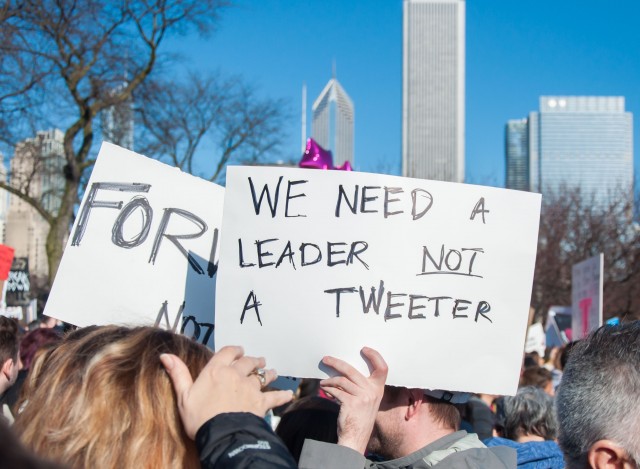
THOUSANDS OF PEOPLE will gather in Washington, D.C., Saturday for a march to demand action on climate change and rejecting the Trump administration’s promise to overturn or scale back the federal efforts on climate. The People’s Climate March comes one day after President Donald Trump announced yet another executive giveaway to the fossil fuel industry, an order that will begin a legally contentious attempt to cancel President Barack Obama’s bans on offshore drilling in the Arctic and off the Atlantic coast. The order could eventually open for drilling additional new waters in the Gulf of Mexico, or even in the Pacific, where hardly any new drilling has taken place since a massive spill coated beaches in the 1960s and helped launch the environmental movement.
Trump has framed his promises to push forward energy infrastructure projects and to deregulate industry as a jobs program, with residents of industry towns as beneficiaries. But climate march attendees from centers of fossil fuel production, transportation, and processing tell a different story. They come from places where creeks run orange, where the air smells like tar, where a depleted water table causes the land to crack and cave in.
The climate march follows the Women’s March, the Native Nations March, the Tax March, and last weekend’s March for Science. But as with past marches, demonstrators with the most at stake will face their biggest battles not in the nation’s capitol, but in small communities that few have heard of.
On Wednesday, Remy, an artist who goes by one name, was working out of a pop-up art space in a vacant restaurant in the Washington, D.C., neighborhood of Cleveland Park, building a massive covered wagon that will lead the march. The wagon will be pierced with arrows printed with words like “sovereignty” and will emit simulated fire and smoke. To Remy, the project’s references to colonialism, racism, and greed speak to the root causes of the climate crisis. He said making it a spectacle is important, because “it’s sometimes hard for us to get our messages across inside these NGO- and non-profit-led spaces.” He reflected on the event, “Are we just marching to march? Are we having photo ops to build our brand? Because if that’s what we’re doing I’m busy; my community needs me.”

Remy and his partner on the project, Wiyaka Eagleman, were away from home much of the past year. Eagleman joined the fight against the Dakota Access Pipeline early on, back in April 2016 when the first anti-pipeline camp, called Sacred Stone, was constructed. The year before, he’d been involved in a different camp in South Dakota, near the Rosebud Sioux Reservation where he’s from. There, he and other tribal members occupied land on the Keystone XL pipeline’s path.
Remy soon joined Eagleman in North Dakota and both stayed for months, participating in direct actions against the Dakota Access pipeline that were violently repressed by police. Within days of his inauguration, Trump issued an executive action cancelling an expanded environmental impact study on the project and fast-forwarding the project’s completion. The camps were forcibly closed.
An order on the same day revived the Keystone XL. Now oil is flowing through the Dakota Access pipeline, and Eagleman has been on the road, visiting other sites of dissent in Iowa and Oklahoma. He sees the Dakota Access fight as one that has now dispersed to new oil and gas infrastructure construction sites in places including Louisiana and Nebraska.
But for Remy growing up, coal was the dirty neighbor. He’s from the Navajo Nation in Arizona, “canyons within canyons,” as he describes it. Remy grew up in the shadow of Peabody Coal’s Kayenta mine and its sole client, the massive Navajo Generating Station, a quarter of which is owned by the federal government. The plant and the mine together employ 750 people and pay the Navajo Nation about $40 million annually in royalties and lease payments.
When Peabody built the mine in 1967, it uncovered a village that included nearly 200 sets of human remains, which were sent to Southern Illinois University and have never been returned. The huge plant is one of the most polluting in the nation, casting a murky haze over the Grand Canyon.
For years, the coal mine’s owners fought to expand the project, clashing with local people like Remy’s uncle, Marshall Johnson. By last February, persistently low natural gas prices convinced the plant owners it no longer made economic sense to keep burning coal. They announced it would close by 2019 – a huge victory for Remy’s uncle.

But under Trump, even that victory, driven by market forces, is at risk. Trump’s Interior Secretary Ryan Zinke recently attended meetings aimed at exploring options for keeping the plant open. And Peabody Coal executives reportedly pledged to “turn over every rock” in search of a way to avoid closure.
For veteran environmental justice organizers that have been fighting polluting fossil fuel projects in their communities for decades, that boomerang feeling has been particularly painful this election cycle. On Thursday, many longtime organizers began arriving in time for an annual environmental justice forum in advance of the march. For the second year in a row, the forum included a direct action training, reflecting a movement-wide turn toward more confrontational strategies.
“I used to try really hard not to feel hard at my neighbors and feel hard at people who voted for certain people,” said Teri Blanton, who grew up and raised children in Kentucky coal country’s Harlan County and has been a key figure in the fight against mountaintop removal coal mining. But, she said, “I’m carrying the same signs I carried when Clinton went into office, when Bush went into office, and when Obama went into office.”
Blanton lost a brother to a coal mining accident and her father to black lung disease. She recalled a creek that ran behind her old house that was destroyed by strip mining. The “little woman that was the creek-watcher,” too nervous to report problems herself, would notify Blanton when the creek had changed to black or was running orange. Blanton fought for more than a decade to get a stream protection rule passed that would prevent coal companies from dumping strip mining waste near creeks. Obama finally signed such a rule last December, but in February Congress used the Congressional Review Act, in effect only after a new president takes office, to cancel it.
Explaining what she sees as the importance of the march, Blanton said, “I think it gives me some energy and some will, to know that I’m not alone in this belief that we have to stand up and do something.”

The EPA’s Office of Environmental Justice is in line to close as well, according to a Trump administration budget proposal. Goldman Prize winner Hilton Kelley worked closely with the office for years to push industry in the mostly African-American refinery town of Port Arthur, Texas, to prevent accidents that cause clouds of chemicals to periodically waft through his neighborhood.
“The moment you relax regulations, what these guys have a tendency to do is to operate those units until they break down and spend money only when they have to,” Kelley said.
The community is home to many of the chemical manufacturers and petroleum refineries that absorb the nation’s oil and gas boom. Oil carried by the Dakota Access pipeline will end up there, and tar sands oil that may eventually be carried by the Keystone XL is already arriving in Port Arthur by rail. Community members suffer from widespread respiratory problems and cancers. Since a study of the cumulative impact of inhaling various chemicals has never been undertaken, “We shoulder the burden of proof,” said Kelley. “It’s another game that the system plays to keep corporate America one step ahead of us.”
Refinery communities like Kelley’s dot Texas’s Gulf Coast, but at the Southern tip of the state’s coastline, Brownsville has largely avoided fossil fuel industry development. That may soon change.
Back at the pop-up art space, Bekah Hinojosa, who’s from a town near Brownsville called Weslaco, constructed giant puppets on sticks depicting EPA head Scott Pruitt, Secretary of State and former Exxon Mobil CEO Rex Tillerson, and President Trump. Her community is under threat of being hit by both Trump’s obsession with border security and his push to expand the fossil fuel industry.
Brownsville, a mostly Latino community that is one of the most impoverished in Texas, is already bisected in places by a border wall that leaves land owned by U.S. citizens on the southern side of the structure — a zone referred to as “No Man’s Land.” Trump would fill the remaining gaps in the area’s wall.

Meanwhile, three Liquid Natural Gas export facilities have been proposed in the city’s port, meant to expand the market for gas extracted via hydraulic fracturing. The Federal Energy Regulatory Commission is expected to decide next year whether the facilities will go forward. For now, her community awaits the results of a space rocket collision analysis, exploring the likelihood that a rocket from the nearby SpaceX facility will collide with one of the new plants.
Hinojosa has little faith that her community’s objections will resonate with the commission, which has long been considered a rubber stamp for natural gas projects. Trump is expected to appoint industry-friendly regulators to vacant commission positions, further reducing the chances FERC will say no. Hinojosa is also painfully aware of the fact that her community abuts the coast. Any new offshore development that comes out of Trump’s latest order makes her home that much more vulnerable to spills in the Gulf.
Now that the Dakota Access fight has died down and the Keystone XL fight is only beginning to ramp up, Remy and Eagleman are planning to spend time at home. After the march, Remy said he plans to head back to help with his family’s ranch in the Navajo Nation. Eagleman will go back to the Rosebud Sioux Reservation.
“I think I need to start fighting in my own homeland against things like drugs, alcohol. Just being away this whole month, I could be home at this hearing for uranium mining or I could be helping my family,” said Eagleman. He’s preparing for a renewed Keystone XL fight, but the events of the last year have weighed on him. “I’m trying to find my own space, trying to heal.”

There’s a Logic to Trump’s War On the Media

Trump goes after the news media not because he thinks they’re strong, but because he thinks they’re weak and he can diminish them further.

Go to Original
By David Greenberg


Donald Trump’s attacks on the news media since taking office have been so persistent, so over-the-top, so deranged—in a word, so Trumpian—that it’s not surprising to see a backlash. Journalists are denouncing Trump for his continuous stream of vitriol toward them. Newspapers and magazines are enjoying spikes in subscriptions and support. Around 200 activists even congregated in Times Square one Sunday in February to show solidarity with the press corps against Trump’s onslaught.
The press’s job of keeping the public well informed about national and international affairs is no doubt harder than ever today. Trump’s eagerness to attack the media relentlessly and without restraint has made it harder still. But the ultimate reason that a demagogue like Trump mounts such crude, broad-brush attacks is that the institutional power of the press has diminished, and Trump descries political advantage in putting more pressure on them.
In 2017, the news media command considerably less authority than they once did to set the news agenda, arbitrate disputes over public issues, or even establish a common standard of what we ought to be discussing. Seeing that weakness, Trump appears to believe that he doesn’t need the mainstream media the way his predecessors did—and that when it comes to raw, open warfare with the journalists who cover him, he has nothing to lose. Whether he is right or wrong will depend on the performance of the press in the next four years.


The Nixon Precedent

When we hear the young Trump administration described as “unprecedented” in its treatment of the media, we often forget that all presidents spar with the press, often viciously. Almost every administration in modern times—since the rise of an influential press corps in the early 20th century—has at some point been labeled the “worst ever” in its treatment of the fourth estate, only to have such florid overstatements debunked in the light of history.
But if there is one close parallel with Trump in recent presidential history, it is with Richard Nixon, generally considered the president most unfriendly to the news media until now. Like Trump, Nixon hated the press for two very different reasons, one political, the other personal.
The political argument, stoked by aides like Pat Buchanan and Roger Ailes who preached a cultural populism, was that America’s elite newsrooms and television networks were riddled with liberals who promote an ideological agenda or at least let their opinions color their reporting. A familiar right-wing talking point today, this claim was relatively novel in the 1960s. But it gained traction during that tumultuous decade thanks to coverage of events ranging from the civil rights protests to the riots at the 1968 Democratic convention. Nixon embraced this view from the start of his presidency. In 1969, his vice president, Spiro Agnew, entered the history books with a pair of speeches assailing the bias of the leading news organizations. Over the years, the “liberal media” claim did yeoman’s work for the rising conservative movement. It mobilized an angry base of scapegoat-hungry voters and simultaneously helped to discredit any news or commentary critical of the conservative movement’s leaders or ideas.
If ideology fed Nixon’s attack on the press as biased, it was personal animus that gave the attack its nasty bite. A self-described “paranoiac,” with deep resentments that spawned an extravagant sense of entitlement, Nixon saw enemies everywhere. At least since his 1952 slush-fund scandal, when he almost had to step down as Dwight Eisenhower’s vice presidential running mate, he had been convinced that the press corps had it in for him. Aides commented that he couldn’t distinguish legitimate criticisms or even routine questioning from personal animus.
The result was a self-fulfilling prophecy: Regarding journalists as the enemy, President Nixon punished or lashed out at them in myriad ways. But the more he did so, the more aggressively they went after him, thus validating his suspicions. Watergate in particular confirmed many reporters’ resolve to practice what came to be called “adversarial journalism.” Sometimes this adversarial posture was channeled into hard-hitting, critical reportage. During the ensuing decades, however, it increasingly appeared as gratuitous scandal-mongering, snide and captious television punditry, or overblown feeding frenzies over small-bore pseudo-scandals. The result was to damage the press corps’ standing with not only conservatives but voters of all stripes.

The Twitter President

This kind of attack—rash, brash, mean-spirited, juvenile—will be familiar to any of the 26 million people who follow the real Donald J. Trump on Twitter. Compared to most of us, Trump began tweeting early, in 2009, though initially he used his feed to promote himself and various dubious business ventures. Then, sometime in 2011, as Politico noted in a chronicle of Trump the tweeter, he realized that the platform was ideally suited for insults and abuse. The more serious he grew about a presidential run, the more he turned to Twitter to generate attention, build a following, take down his opponents, and develop his persona as the blunt, no-nonsense voice of the dispossessed.
Of course, Trump’s tweets have also caused him huge problems. He seemed to hit bottom during the fall campaign when he went on an early-morning tweet bender berating the Venezuelan-born Alicia Machado for disclosing how he humiliated her during her term as Miss Universe. Trump was able to overcome the fallout from his online impulsivity and get elected in part because his aides stopped him from tweeting in the campaign’s last weeks, to focus on touting his economic message. But any expectations that as president Trump would lay down his digital guns were quickly revealed to be wishful thinking.
Conventional wisdom holds that Trump likes Twitter because it gives him a direct pipeline to communicate with these 26 million followers (roughly half of whom seem to be journalists). But this argument doesn’t really hold up. For decades, presidents and even presidential candidates have found ways to break through the filter of press analysis and framing and reach the public directly. At first they did so by giving speeches that, according to custom, newspapers reprinted in full; later their words were broadcast on television or radio (though they did depend on the broadcasters’ cooperation). They’ve always been able to issue press releases and statements. Twitter isn’t entirely new in this respect.
What Twitter does is provide the perfect outlet for Trump’s unbridled, emotionally laden style of communication. Twitter is ideally suited for a particular vein of internet speech that goes back to what was called, in the internet’s earliest days, “flaming”—the propensity when arguing online to fire off angry, nasty, or insulting comments, often with little relevance to the substance at hand. Face-to-face communication forces us to reckon with the human being we’re arguing with; writing or typing a response compels reflection and revision. Even if you’re on one of the cable TV shout-fests, you’re probably aware of the millions watching. But when you tweet from the isolation of your laptop or phone, with no editor to review your comments, it’s easy to let fly with vituperative, ill-considered, misspelled, badly punctuated, ALL CAPS bursts of unreflective emotion.
This is what distinguishes Trump’s tweets from everyone else’s. Barack Obama, after all, pioneered the White House Twitter feed, to much fanfare in early 2009, but few people can remember a single Obama tweet. He used the platform mainly as another way to disseminate the same public relations fare that the White House Communications Office has issued for decades. Hillary Clinton, too, tweeted, sometimes wittily, but as disclosures from John Podesta’s hacked emails showed, her campaign had as many as a dozen staffers weigh in on crafting a 140-character squib—a process guaranteed to snuff out not only any raw emotion but also the immediacy and authenticity that make tweets like Trump’s so appealing, or appalling.
Trump’s tweets are especially popular among journalists, probably because unlike so much of the scripted, crafted political communication that they encounter, Trump’s seem authentically his own. (Not all of them are.) As a result, even while Trump was just one Republican in a pack of 17, his provocations attracted an undue amount of attention—not just on Twitter but in the print and broadcast outlets where these journalists worked. Trump’s outrageousness, showcased on Twitter, gave him the exposure he needed to differentiate himself from his rivals and vault to the top of the polls. It’s an old axiom in journalism that conflict makes news, and Trump’s invective does. Not coincidentally, it is often directed at the media. When The New York Times last January compiled a list of the (now more than 300) “People, Places and Things Donald Trump Has Insulted on Twitter,” roughly one-third of the targets were journalists, news shows, or news organizations—who by and large seem to revel in the attention even if a few occasionally take genuine offense.
In and of itself, Twitter isn’t transformative. What made it so useful for Trump in 2016—and perhaps will help him in his presidency as well—was a political climate of extreme impatience with conventional political and journalistic authorities. In the past, Trump’s blunderbuss assaults on all manner of racial and ethnic groups, his glaring flip-flops and contradictions and fabricated claims, his mile-long rap sheet of genuine scandals would have sunk his candidacy; scores of candidates have been felled by transgressions far more trivial than any of Trump’s top 20 offenses. But Trump’s gaffes, scandals, and prevarications perversely made him more popular—because the press’s efforts to highlight his shady business practices or gratuitous insults wound up making him seem, to many, like a slayer of the reviled mainstream media. His tweeting usually played out in the same way. The recklessness and lack of discipline that many assumed to be Trump’s Achilles’ heel turned out to be his secret weapon.
Finally, Trump’s tweeting helps him set the agenda. It puts journalists in a reactive position. Thousands of them chase after his tweets—retweeting them, responding to them, fact-checking them, ridiculing them, taking umbrage at them, using them as the basis for columns, hot takes, and idle chatter on what Trump has called “the shows.” Journalists have no obligation to lavish  attention on his swipes at Meryl Streep or the newly elected Democratic party chair Tom Perez or even their own institutions (as when he wrote, “The FAKE NEWS media (failing @nytimes, @NBCNews, @ABC, @CBS, @CNN) is not my enemy, it is the enemy of the American People!”). Sometimes these tweets aren’t particularly newsworthy and can be ignored. Yet journalists not only take pleasure in responding to Trump’s tweets; they seem to feel obliged to cover these dashed-off half-thoughts as part of their professional duties.

Weakened Warriors

But the key factor that has enabled Trump to adopt his gonzo style is the loss of power by the fourth estate. Since Nixon’s day, the cultural authority of the mainstream news media has plummeted. It’s now simply much harder for journalists to gain a hearing with the broad slice of the public that used to trust what they reported. As a result, their efforts to correct Trump’s misinformation, highlight problems in his presidency, or even report on corruption, scandal, and dysfunction have to swim against the tide if they are to reach the huge swaths of the electorate who trust Trump more than they trust the press.
Several long-term developments have weakened the press institutionally. The prevalence of adversarial reporting (especially in the form of crude gotcha journalism as opposed to substantive investigation) diminished reporters in the public eye. To many citizens, regardless of ideology, the typical Washington journalist now seemed preening, self-important, and unremittingly negative. The explosion of armchair television punditry, at the expense of reporting, had a similar effect.
Another blow came with proliferation first of cable TV news and then of internet blogs and start-up webzines. The multitude of outlets scattered the news-consuming public’s attentions, further chipping away at the authority once commanded by news-gathering reporters at blue-chip newspapers and sober-minded television anchors at the big networks. The cable channels and new websites could also filch the heart of a story from the top-tier news outlets and serve it up to younger or more casual readers in a snarky package, blurring the line between reportage and parasitical commentary. Twitter has exacerbated the tendency to parasitism, allowing commentators of varying degrees of knowledge and talent to opine about news gathered by others; it has also increased the emphasis on snark, as purportedly neutral Washington reporters—men and women who are expected to banish any hint of editorializing from their news stories—dispense with professionalism to spin out sassy, hostile, nit-picking, pompous, and ill-informed opinions, whether about Trump or anything else that pops up on their phones.
And then there was the 40-year right-wing drumbeat about the mainstream media’s purported liberal bias, which convinced many conservatives not to trust sources like The New York Times or the network news shows—outlets that, not long ago, were widely recognized as neutral and nonpartisan bearers of information. In the 1990s came the rise in quick succession of talk radio, Fox News, and countless right-wing internet sites. These outlets amounted to a full menu of alternative news sources providing conservatives with counter-arguments and ripostes to any judgments proffered in the mainstream media, which, increasingly, they felt license to ignore.
During George W. Bush’s presidency, this undertaking expanded to construct a kind of alternate reality for the right. Under Bush, the conservative movement consummated a decades-long degradation of experts—in economics, science, law, intelligence, and other fields—on whom journalists had long depended to help readers make reliable sense of the world. Experts who doubted the administration’s claims, whether about Iraq’s nuclear weapons program, global warming, or Bush’s own economic policies, were themselves dismissed as partisans who cloaked their political conclusions in the trappings of disinterested expertise. Observers wryly labeled Bush’s presidency “postmodern,” in which no fixed truth existed and all arguments were reduced to their political utility.
Already, early in the new century, some were speaking of a “post-truth” society. Others used pretentious coinages like “epistemic closure” to explain the imperviousness of tightly knit ideological communities—now often forged online—to countervailing evidence. But in the following decade, things got worse still. Not just in the usual shadowy corners of society but increasingly out in the open, outré conspiracy theories now flourished—the most infamous of them being the slander that Barack Obama wasn’t born in the United States. As the conservative but anti-Trump radio host Charlie Sykes wrote, “The echo chamber had morphed into a full-blown alternate reality silo of conspiracy theories, fake news and propaganda.” Where Cold War delusions, like the supposed communist plot to fluoridate our water, could be sidelined by media gatekeepers, now worldwide interconnectedness allows nonsense to spread far and wide. Pseudo-scandals like Benghazi gripped not just the usual smattering of crackpots who had spun scenarios about the Kennedy assassination or Roswell but also ranking members of Congress, influential voices in the right-wing mediasphere, and individuals on Twitter who managed to build up large and loyal followings—including, of course, Donald Trump.

The Road Back

Reporters now face the challenge of regaining the trust of citizens on the left as well as the right. These disaffected Americans no longer seem hungry for the old meal of straight-up reported news with a twist of analysis and a side of opinion. They prefer other fare: the ideological reinforcements of the cable news ranters; the self-congratulatory humor and sputtering indignation of the comedy anchors; the alternate universes of the social media conspiracists; or simply the generalized noise of the internet.
Instead of rebuilding their credibility, some journalists seem to be chasing these audiences by emulating sites like BuzzFeed and The Huffington Post instead of the Times and the Post. The Times seems poised to make the potentially fatal mistake of cutting back on editing. The snark-filled tweets of reporters—who act as if they’re joking in the breakroom rather than speaking for the papers of record—further chip away at their authority. Still other ostensibly fair-minded reporters, lured by the cameras, slip out of the temperate personas they don for PBS or Charlie Rose and take potshots at the president on MSNBC. This approach will never win back the readers who are seeking uncolored, trustworthy information. Confronted with the cacophony of fury and complaint that floods the airwaves and fills the screens, Trump and his supporters can write it off as “so much anger and hatred.”
Understandably, journalists who feel targeted by Trump want to fight back. But their counterpunching won’t be effective if it’s perceived as either self-aggrandizing or partisan. For more than a century, American journalism has thrived by placing reporting over ideology. The most persuasive rebuttal to the right wing’s “liberal media” claim has always been the simple fact of the press’s overriding professionalism. In the world of the mainstream media, where journalists aspire to be objective and nonpartisan, all the professional rewards and incentives—prizes, prestige, advertising dollars, personal satisfactions—accrue not to those who spout off in news columns or land a punch against a political target, but to those who dig up big news, uncover secrets, and score scoops. Not every individual journalist has necessarily articulated this understanding of what keeps them on the straight and narrow, but most follow it nonetheless. Lately, however, it seems that fewer reporters appreciate the value of upholding traditional journalistic norms and are in danger of sacrificing long-held principles for the short-term satisfaction of getting in a jab at Trump.
There are ways to fight back that can enhance the press’s standing rather than lowering it. Instead of hollering about being called an “enemy of the people,” a reporter can explain to readers the distinctive and fraught history of that phrase, as Andrew Higgins of The New York Times did. Instead of crying “liar” when Trump falsely claims that three million people voted illegally, a newspaper can track down the source of that fictitious statistic, as The Guardian did back in December, and explain how it reached the president-elect’s ears.
Even more important, reporters have dug deep into the burgeoning Russia scandal, the backgrounds of Trump’s cabinet nominees, the disarray behind his misguided immigration ban, and other big developments of the administration’s early days. Context and clarifying information, not outrage, is what journalists can produce to keep the public informed and restore their position as sources of reliable news.
Twelve days into the Trump presidency, Reuters editor-in-chief Steve Adler issued a memo to his staff noting the “challenging” environment for journalists, in which the president had already called them “among the most dishonest human beings on earth” and his chief strategist, Steve Bannon, called the media “the opposition party.” But instead of boycotting administration briefings or trying to rally support for the press, he said, Reuters would redouble its commitment “to reporting fairly and honestly, by doggedly gathering hard-to-get information—and by remaining impartial.”
The big unanswered question, though, is whether reporting out the facts and bringing to light new information will in the current media environment sway any of those who’ve given up on the mainstream media. Some may be hunkered in right-wing mediaspheres, where suspicions of the leading media institutions, bolstered daily by Trump’s cries of fake news, prove an insurmountable barrier to changing minds. Others are scattered in their attentions, unwilling or unable to devote the time to sorting claims from counterclaims.
History again provides perspective, and maybe hope. In previous times, similar problems existed, if not to the same degree. During Watergate, the White House and other skeptical voices initially dismissed the scandal as what Donald Trump would call fake news. But in time, the reporting of a small few penetrated the right-wing bubbles. “At the beginning, all of us assumed Watergate was … what Ron Ziegler told us it was,” wrote William F. Buckley: “nothing more than a third-rate burglary.” But in time, the scales fell from Buckley’s eyes, and he came to think that those who stood by Nixon did so “because the alternative is to wake up in the morning and find that they are in agreement with a particular conclusion reached by The New York Times.” Even many of them changed their minds by the end.
In the coming four years, reporting will count for more than ever. Whether Donald Trump turns out to be an overgrown child or a fearsome menace, a proto-fascist or a paper tiger, it seems clear already that a lot of journalists are determined—not in the spitballs wars of Twitter or the food-fights of the cable news shows, but in the great gray columns of newsprint that are necessary to set forth a story in full—to put up a fight.

Historical Amnesia and the Burden of the Euro-American Past in the Age of Trump

Go to Original
By Westenley Alcenat


This article is published in collaboration with Black Perspectives.
In the last 100 days since he began his presidency, President Trump's administration has unleashed a powerful nativist movement anchored on racist and xenophobic sentiments. Yet, the "Muslim Ban" notwithstanding, conventional wisdom, especially in liberal circles, would still have us believe the gospel of American exceptionalism as a home for refugees, the tired masses, and the poor. This narrative of the US's enlightened benevolence posits Trump as an aberration of American humanitarian norms and values. As a result, it disavows the past to explain the rise of Donald Trump as an enigma. Among the greatest advocates of this elision of the past is former President Barack Obama, who has offered his election on the altar of American exceptionalism as the great American story. As he conceives it, his rise is testament to the irrefutable progress of the US's march towards a more perfect Union. President Obama, like any other American, is of course entitled to see in his election a triumph of the better ideals of American democracy. However, this narrative also suppresses the fact that the Civil Rights Movement has not been followed by a teleological plane towards "better race relations" -- a misnomer that supposes power relations between vastly unequal parties. What is left out is that decades of institutional racism in the guise of civility and color blindness have not been a panacea for centuries of systemic wrongs.
Color blindness and political correctness pushed the most racist Americans underground and to the fringe. It also forced the mild-mannered ones to contain this ideology within the confines of their segregated neighborhoods. In the process, we substituted white privilege for white supremacy and talked about race instead of racism. Much of that vernacular consists of distinctions without a difference. This was all in the noble hope of coping with a rather tortuous past. However, in just a few decades, from Presidents Reagan and now Trump, the house has been collapsing -- even as we elected a Black man to the presidency and had a female presidential nominee. The rise of Black Lives Matter and the browning of the US by newcomers lifted the veil to show a bubbling implosion of decades of white frustration since the 1960s. Racism did experience a setback, but it has been dormant, as the so-called "silent majority" never forgave President Lyndon Johnson for enacting some of the Civil Rights agenda. The convenient lie we told ourselves was that American racism had ceased to function properly. Meanwhile, it was fomenting into the backlash that ushered Trump into power. What we really had was not a transformative country; we simply managed to create the mirage of a civil society, one fraught with racism but without visible racists. As the comedian Chris Rock was quoted by the Washington Post, "Donald Trump [not Mr. Obama] is America's natural state." From Mr. Rock's perspective, "Barack Obama was an aberration" in the annals of American history.
Indeed, Donald Trump is a historical continuation of many things American. His vitriol is part of a legacy that mirrors the Jeffersonian ideals of Herrenvolk nationalism. This ideology justified the mass expropriation of indigenous land. Widely celebrated as the triumph of Jacksonian democracy, Jefferson's dream was briefly defeated by the Civil War and Reconstruction eras, only to resurface in chameleon-like form that allows for racism to coexist next to utopian ideals of post-racialism. If today's liberals and progressives are dismayed and shocked by the rise of President Trump, that too is itself an exercise in ignorance. At worst, it devalues the historical lives of Native Americans who remain a colony within a nation, held captive and alienated in their homeland by white encroachment and ethnic cleansing. It detracts from the known facts of Black Americans who have lived longer in slavery and state-sanctioned Jim Crow than in freedom, and of Asian and Brown Americans who have seen decades of varying moratoriums on entry, concentration camps and exclusionary measures like the Chinese Exclusion and Geary Acts, which were not abolished in earnest until 1965. The cumulative effects of this history are, in some ways, the rectification of Jeffersonian-Jacksonian ideals in the form of Trumpism. Perhaps for fear of what it might reveal, this contemporary phenomenon is subjected to a lack of critical retrospection on the past. Instead, many have settled to view it as an interruption of the American melting-pot story. Today's narrative of American exceptionalism would have us believe that Trump's "Muslim Ban" is exceptional. If this is so, what are we to make of the Chinese exclusion policies that, for the first time in 1882, proscribed federal restrictions on entry to the US by an ethnic group deemed to be an endangerment to Euro-American nationalism?
The blissful ignorance that dismisses Donald Trump as an anomaly distorts facts. Any sense of moral responsibility becomes impossible when the footprints and forces of history are rendered invisible. It is not that the US subscribes to immorality, but rather it settles for amorality. In an amoral world, the unacknowledged burdens of history provide cover for evading moral culpability. In that world, silencing past and present history turns even the most intelligent among us into learned idiots. To take an example, little scrutiny follows former secretary of defense Donald Rumsfeld's book Known and Unknown, which turns a contradiction in terms into an acceptable mockery by an entire electorate. The absurdity of this culture of evasion preceded President Donald Trump. In fact, the president perfected if not personified it by deploying what his ghost biographer called a "truthful hyperbole." Creating a cacophony around facts and truths and of what is supposedly known and unknown about American history assures that Anglo-America always lives to tell its exceptional version of the tale.
In some regards, the real version of the tale, as Susan Sontag once remarked, is that "If America is the culmination of Western white civilization, as everyone from the Left to the Right declares, then there must be something terribly wrong with Western white civilization." So much so, argued Sontag, that even "Kant, Marx, Balanchine ballets, et al., don't redeem what this particular civilization has wrought upon the world." Sontag's caustic remark ignited the backlash of apologists who emphasized her flawed choice of words, which equated western barbarism to white people as a cancer. One can condemn and repudiate her word choices without, as some are wont to do, detracting from her more salient point. What Sontag underlines is the violence and cruelty that have been imposed on many of the world's darker-skinned peoples in the name of Euro-American progress. Generations after, racial imperialism has left Western Europe and the US in a morally dubious position. Consequently, where the US is concerned, and may be right, about stabilizing countries, its ethical leadership is questioned and its ability to dictate to others the virtues of peace is undermined by a history of racial capitalism.
Today, the globalization project of the West has marshaled the destructive capacity of capitalism with enough brute force that even white constituencies who had previously reaped the greatest benefits are now just as disaffected and sometimes left behind as are the wider racialized global lumpen-proletariat. The flight of jobs, industries, and the sheer carelessness of a disinterested global elite fueled these discontented parties to strengthen President Trump's nativist message. Even more ironic is that the often-disenfranchised poor and working classes of white Americans voted as a block with their wealthier counterparts. Islamophobia and the threat of labor competition from Central American immigrants helped catapult Mr. Trump to power. Trump's ingenuity was to set himself apart from his class of propertied elites while parodying himself as a modern-day Horatio Alger. Meanwhile, President Trump's cabinet, staffed with men and women whose opulence resembles the Gilded Age, have for decades ignored the plights and declining fortunes of workers of all races. Yet, those who have been left without jobs, education, strong families or safe streets are beginning to realize the cost of the US's individualism and materialism. They are realizing that this vanity has been hidden underneath the social gospel of capitalist progress. When stripped bare, the ideologies of progress, which have extracted so much from the rest of the world, have penetrated even the most developed economies of Europe and the US. Rooted in a Social Darwinist outlook on humanity, the West has, for five centuries, felt justified in inflecting European Universalism as the end-all-be-all on the world's poor and working masses. Today, no worker, European, Asian, or African, is exempted from the creative destruction of capitalism.
The paradox of the disaffected poor and working white constituencies voting as a block with their vastly wealthier nemeses reveals fractures in American capitalism. In a desperate effort to rebel against elites, a majority of the country's white Americans voted to appoint Trump as the czar who will save them from capitalism. Much like disaffected Germans and Italians who looked to the demagoguery of Adolf Hitler and Mussolini by racializing European Jews, nativist laborers are turning against their much more maligned immigrant counterparts, men and women who are themselves displaced by the casualties of American corporatism. From London to South Africa, and Washington to Mumbai, nativism and nationalism have put a chokehold on the disenfranchised global masses. Much of the discontent with globalization looks for solace in isolationism, which Trump extols to his electorate as a virtue. The chickens have come home to roost, as history that has been too long sanitized shows its ugly head in the form of Trumpism. Fortunately, the world's societies now have the hindsight to read the present back into the past as prologue. In other words, the trinity of imperialism, racism and militarism has reached a brink. As the writer Pankaj Mishra recently put it, "The centuries of civil war, imperial conquest, genocide and slavery in Europe and America were downplayed with reason and individual autonomy made the modern world, and became with its liberal democracies a vision of the superior people everyone else ought to catch up with." 
Donald Trump was never an aberration on the US's record. He is the product of a US struggling with the poverty of an ethics of capitalism that has unleashed the cult of redemptive white nationalism. In spite of this emergent racial nationalism, the traditions of enlightened cosmopolitanism, liberal democratic humanism and rationalism, we are told, must be defended because Trumpism is "not who we are." But if that is a historically accurate assessment of American identity, how do we explain the centuries-long politics of violence and suppression both domestically and imperially? Where does European-American history begin and end? At the exceptional period of post-1945 economic growth? Or do we acknowledge the fact that the modernization project of American capitalism has often accompanied the historical traumas and violent nationalism that Trumpism promises to inflict on its targets? If we are to move forward to a more radically egalitarian future, the age of Trump cannot be quarantined within the box of Euro-American exceptionalism.
Our world today, and American society especially, is confronted with the fact that this sanitized history has obscured deeper tragedies that have resurfaced. Our societies must come to terms with the fact that the US's sanitized version of the world and its own narratives impel us to speak back to how white supremacy utilizes power to reframe the past. Just three months into a Trump administration, we have entered the age of "Euro-American Absurdism," when post-truths and "truthful hyperboles" reign supreme. Repelling this trend and moving forward, we have to abolish the convenience of selective memory of American history and look at the past as it was, not as we wish it were.

Critics blast US shipment of fighter jets to Israel

Israel is the first country outside the US to get access to the F-35 warplane, the most expensive ever developed.


Go to Original
By


Israel received three F-35 stealth fighter jets from the United States at the weekend - a new generation of "near-invisible" planes that critics fear will free the country's hand to launch air strikes and spying operations against neighbouring states undetected.
In total, Israel has bought 50 F-35s from manufacturer Lockheed Martin, and claims it will have the first squadron combat-ready before the end of the year. 
Israel is the first country outside the US to be allowed access to the warplane, said to be the most expensive ever developed. 
The F-35's main selling point is its advanced stealth capabilities, reportedly allowing it to evade even the most sophisticated anti-aircraft missile systems. Lockheed describes the plane as "virtually invisible".
According to Israeli officials, the jet will be able to outsmart Russian S-300 missiles, which are stationed in both Syria and Iran. Israel has launched repeated air strikes in Syria over the past five years, while Prime Minister Benjamin Netanyahu has suggested he wants to attack Iran.
Analysts have noted that, although the jet comes with a huge price tag - each plane costs around $110m - US taxpayers will be footing the bill.  
Israel's fleet of F-35s are to be financed out of US military aid. The annual $3bn Israel receives from Washington will rise next year to $3.8bn, under a 10-year deal agreed by Barack Obama shortly before he stepped down as US president.
"Israel would never have been able to build its military might without the US - and now it will have even greater freedom to wreak suffering across the region," Mustafa Barghouti, head of the Palestinian National Initiative party, told Al Jazeera. "The US has turned a blind eye as Israel has used its advanced weapons against Lebanon, Gaza, Syria and elsewhere."
Ash Carter, Obama's defence secretary, hailed Israel's purchase of the F-35 as allowing the two countries' air forces to work more closely together. The US military has ordered more than 2,400 of the jets. "Together, we will dominate the skies," he said in December.
Israel's older squadrons of F-15s and F-16s, which have been in use since the 1970s, are due to be gradually phased out in favour of the stealth fighter. 
At Israel's insistence, no Arab countries have so far been allowed to buy the F-35. In the original negotiations, the Pentagon agreed that the jet would ensure that Israel maintained its "qualitative military edge" over its neighbours.
Israeli military officials pressed for the F-35 partly because Arab states such as Saudi Arabia began acquiring large numbers of F-15s.
"This is about ensuring Israel's regional military superiority for a long time," Efraim Inbar, director of the Begin-Sadat Centre for Strategic Studies at Bar Ilan University, told Al Jazeera. "Israel wants to be able to project power over long distances, and this plane promises to do that." 
According to Israeli military analysts, one of the first uses of the F-35 could be in Syria, where Israel has been especially active since the outbreak of civil war there six years ago. It has regularly launched strikes against Syrian army positions, claiming to be preventing the transfer of weapons to the Lebanese group Hezbollah.
The risks of escalation have heightened for Israel as other states - notably Iran, Russiaand Turkey - have been drawn into Syria too.
This week, Israel made a rare public admission that it carried out an air strike in Syria last month. Unusually, the Syrian military responded to the attack by launching anti-aircraft missiles at the Israeli planes, though none are believed to have hit their targets.
Inbar said the biggest prize for Israel was the F-35's potential use against Iran. Its stealth capabilities mean it could be used either to carry out attacks or for reconnaissance missions. It would also be able to pass over intermediary countries unseen.
Netanyahu has repeatedly suggested that Israel might attack Tehran, either alone or with US help, over claims that it harbours ambitions to develop a nuclear weapon.
According to Israeli analyst Amos Harel, one offensive use of the new fighter would be to launch an undetected, first-wave attack against another country's radar and anti-aircraft missile systems. That would then open the way for a second wave of planes, including F-15s, F-16s and drones, to bomb sites without fear of retaliation. 
Last week, US defence secretary James Mattis made a brief visit to Israel - the first senior official from Donald Trump's new administration to do so. His meetings focused on alleged threats from Iran and Syria, Israeli media reported.
Israeli officials have suggested that the F-35 will not be used against Palestinians, as they have no radar or anti-aircraft batteries. "We are not buying the F-35 to attack Gaza," one told Haaretz.
But Barghouti said he doubted that. "This plane will be used everywhere - and given that Gaza is defenceless against such attacks, it could be the place where Israel tests it first."
As well as being the first military to receive the fighter outside the US, Israel is the only country that has been allowed to modify the plane's software and integrate its own components and weapons systems. 
Jeff Halper, whose recent book War Against the People examined the close military ties between Israel and the US, said the payoff for the US was that Israel would refine the F-35's combat role and carry out trouble-shooting for Lockheed and the US military.
"Israel serves as the test-bed for the development of these kinds of new weapons," he told Al Jazeera. "The F-35 will be tested in the field, in real time by Israel. The likelihood is that the first time the plane is used in combat will be with Israeli pilots flying it."
Production of the F-35 also illustrates the increasingly tight ties between Israeli and US arms manufacturers, noted Halper. Israeli companies won contracts worth more than $250m last year with Lockheed, which makes the F-35.
They included Elbit Systems, which helps develop helmets and radio systems, and Israel Aerospace Industries, which works on Lockheed's wing sets. 
Avi Dadon, a senior official in the Israeli defence ministry, told Defense News in February that with the arrival of the F-35s, Israel expected to "further deepen" cooperation, boosting the Israeli economy. 
Halper said: "Israel exploits this involvement in research and development and finds commercial spin-offs, both in military and non-military applications. This is part of the reason why Israel has a reputation for being the 'start-up nation'."
Barghouti said Israel was allowed to act as an unofficial intermediary with other countries, such as India, selling them military equipment cheaper than the US or without the restrictions imposed by the Pentagon.
He added that Israel received more than $20bn a year in help from the US, including aid, cooperation with military industries, preferential trade status, and donations from a network of philanthropic organisations. 
Some Israeli analysts are critical of the extent to which Israel is now dependent on the US military. Emmanuel Sakal, a former general and expert on battlefield strategies at the Begin-Sadat Centre, told Al Jazeera: "Israel needs to be less reliant on the US, not more. Israel needs to be able to act on its own in times of crisis."
He said the F-35 was "no magic bullet", and the money could have been better spent on developing other aspects of the Israeli military, including its ground forces.
The F-35 programme has courted much controversy over its costs, as well as over-runs and problems in the plane's three-decade development. 
A Pentagon report last year suggested that the F-35 had major design flaws, especially with its software. It is also reported to have lost in a mock dogfight with the much older F-16. 
Trump has threatened to reassess the US military's purchase of large numbers of F-35s. With costs over the jet's lifetime expected to reach $1.5 trillion, Trump accused the programme of being "out of control". 
Inbar said: "The plane has a lot of problems, and we will have to see if it can be made combat-ready as quickly as the Israeli air force believes."