FAIR USE NOTICE: This blog may contain copyrighted material.Such material is made available for educational purposes, to advance understanding of human rights, democracy, scientific, moral,ethical, and social justice issues, etc. This constitutes a ’fair use’of any such copyrighted material as provided for in Title 17 U.S.C. section 107 of the US Copyright Law. This material is distributed without profit.
Dutch Prime Minister Mark Rutte's party has won the most seats in parliamentary elections, exit polls say.
Early results confirmed the exit polls, with his centre-right VVD Party on course for 31 out of 150 seats.
Three parties are projected to win 19 seats each: Geert Wilders' anti-immigration Freedom Party (PVV), the Christian Democrats and D66.
Mr Wilders' party had been leading in opinion polls but support for the party appeared to slip in recent days.
With 10.9% of votes counted early on Thursday, the VVD had polled 17.8%.
Voter participation in the general election was high; the 81% turnout was the highest for 30 years.
Analysts say a high turnout may have benefited pro-EU and liberal parties.
"Today was a celebration of democracy," Mr Rutte said, adding that the Netherlands had said no to the "wrong kind of populism".
Although the VVD had lost several seats since the last election, many had expected the party to lose much more ground to the Freedom Party.
Many had been watching the vote in the Netherlands closely, as an indication for how populist parties may fare in other elections in EU countries.
France goes to the polls next month to elect a new president, while Germany is due to hold a general election in September.
German Chancellor Angela Merkel has called Mr Rutte to congratulate him, while Luxembourg Prime Minister Xavier Bettel has also tweeted his congratulations.
Martin Schulz, president of the European Parliament until earlier this year, said he was "relieved" Mr Wilders' party had lost.
"We must continue to fight for an open and free Europe!" he added on Twitter (in German).
However, Mr Wilders warned that Mr Rutte "has not seen the last of me".
He previously said that the "patriotic revolution" would continue to take place, and "the genie will not go back into the bottle".
Champagne but no fizz: Anna Holligan, BBC News, the Hague
Pharrell Williams' song Happy pumped out across a conference hall converted to host the victorious VVD.
"Of course he'll still be prime minister," a loyal party member with black rimmed glasses told us. "He's the best man for the job."
Entry to the gathering was invitation only. Most of the foreign press were contained in a side room. The champagne was flowing but there wasn't much fizz. The mild-mannered, measured Mark Rutte appears to have been given a mandate.
He will say he stopped the "dominos of populism" from falling, but to do that he shifted himself to occupy the populists' territory, talking tough on immigration and integration.
As parliamentary seats are allocated in exact proportion to a party's vote share, the VVD party will need to go into coalition with other parties.
The VVD had ruled out a coalition with the Freedom Party - but not the other two runners-up, the Christian Democratic Appeal (CDA) party, and the Democrats 66 (D66) party, which are both pro-EU.
The CDA said it was delighted with its election result and looked forward to helping form a coalition.
The VVD will need at least three other parties before it can secure a majority.
Hence, the other smaller parties will be seen as potential power-brokers.
Exit polls suggest the Green-Left party performed strongly, winning a total of 16 seats, compared to four in the last parliament.
Meanwhile, the Socialist Party took 14 seats, while the VVD's previous coalition partner, the Labour Party, saw its number of seats plunge from 38 to nine.
Analysts said it appeared to have been punished for its role in the coalition government, where it helped pass austerity measures.
Party leader Lodewijk Asscher called it "a bitter evening for labour - unbelievably disappointing".
"Rebuilding the party begins today," he said.
VVD - People's Party for Freedom and Democracy (Leader: PM Mark Rutte)
PVV - Freedom Party (Leader: Geert Wilders)
CDA - Christian Democratic Appeal (Leader: Sybrand Buma)
When a Chinese American businesswoman who sells access to powerful people recently purchased a $15.8 million penthouse in a building owned by President Donald Trump, the deal raised a key question. Was this a straightforward real estate transaction, or was this an effort to win favor with the new administration? The woman, Angela Chen, refused to discuss the purchase with the media. The White House and the Trump Organization would not comment on it. Further investigation by Mother Jones has unearthed a new element to the story: Chen has ties to important members of the Chinese ruling elite and to an organization considered a front group for Chinese military intelligence.
Chen, who also goes by the names Xiao Yan Chen and Chen Yu, purchased the four-bedroom condo in the Trump Park Avenue building in New York City on February 21. As Mother Jones first reported, Chen runs a business consulting firm, Global Alliance Associates, which specializes in linking US businesses seeking deals in China with the country's top power brokers. "As counselors in consummating the right relationships—quite simply—we provide access," Chen's firm boasts on its website. But Chen has another job: She chairs the US arm of a nonprofit called the China Arts Foundation, which was founded in 2006 and has links with Chinese elites and the country's military intelligence service.
The China Arts Foundation was created by Deng Rong, the youngest daughter of Deng Xiaoping, the iconic revolutionary figure and Chinese leader. Deng Rong is what's known in China as a princeling—a term used for the sons and daughters of former high-ranking officials or officers in the Chinese Communist Party who now hold significant sway in business and political circles. Since 1990, Deng has also served as a vice president of the China Association for International Friendly Contacts, which is an affiliate of the intelligence and foreign propaganda division of the People's Liberation Army (PLA). China experts say CAIFC exists to cultivate relationships with former leaders and retired military officials and diplomats of various countries, including the United States and the United Kingdom, in order to influence foreign defense policies toward China and the Far East.
"When, as here, the public interest is implicated, we're left at a loss. You shouldn't be asking these questions about a president."
To sum up: An influence-peddler who works with a princeling tied to Chinese military intelligence placed $15.8 million in the pockets of the president of the United States.
Mark Stokes, executive director of the Project 2049 Institute, a Virginia-based think tank that focuses on national security policy with respect to Asia, says CAIFC's leadership consists largely of retired (and some current) Chinese military and government officials. Stokes, who has written about Chinese political warfare, says CAIFC has become "an important channel of access to [Chinese Communist Party] princelings." He adds that "by influencing perceptions" of China (especially in connection to controversial issues, such as China's stance toward Taiwan), CAIFC hopes to "influence policies of foreign governments, particularly related to defense and national security."
The China Arts Foundation bills itself as a promoter of cultural exchanges between the United States and China, often involving classical music. The group has a branch in New York, which is run by Angela Chen, and another in Hong Kong. Various members of China's elite serve on the group's board, including Wang Boming, one of the founders of China's stock market; Hong Kong orchestra conductor Long Yu; and Marjorie Yang, a political power broker and textile magnate who's nicknamed the "cotton princess." (Yang is reportedly bankrolling the campaign of John Tsang, a candidate for chief executive of Hong Kong, the city's highest office.) Li Zhaoxing, a former foreign minister, and Guo Shuqing, the chairman of China's banking regulation commission, were named as board members in a promotional video posted on the website of the foundation's American branch.
On Tuesday, after Mother Jones made inquiries, the website for the China Arts Foundation International went offline. (You can view an archived version of the site here.)
Angela Chen's role with the China Arts Foundation has brought her into contact with prominent American and Chinese figures. In 2014, the foundation hosted its Chinese New Year gala at New York's Le Cirque restaurant on behalf of Deng Rong, and the guests included billionaire Chinese real estate developer Zhang Xin, philanthropist and banker Steven Rockefeller, and Stephen Schwarzman, the billionaire investor and CEO of the Blackstone Group. The Chinese consul general in New York, Zhang Qiyue, and former US Ambassador to China Jon Huntsman attended a 2015 benefit dinner hosted by the foundation.
A congressional committee that studies US-China relations labeled CAIFC "a front organization for the International Liaison Department of the People's Liberation Army's General Political Department."
The promotional video indicates that there has been a working relationship between the China Arts Foundation and CAIFC. In it, Chen's group takes credit for sponsoring numerous international summits, including a meeting of international business leaders and think tank experts called the Sanya Forum, which was organized by CAIFC. Several China experts tell Mother Jones that CAIFC engages in legitimate cultural exchange activitiesbut that it has long been seen as part of the Chinese military intelligence apparatus. In a 2002 article published in the China Quarterly, a peer-reviewed British academic journal, George Washington University professor and China scholar David Shambaugh characterized CAIFC as an offshoot of the intelligence bureau of the People's Liberation Army. He noted that CAIFC's offices are located in a Beijing compound used by military units.
In 2012, the Republican National Committee considered a resolution expressing concern about a cultural exchange program organized by CAIFC because of the group's ties to Chinese military intelligence. The resolution, which was not adopted, was fueled by a report from a congressional committee that studies US-China relations. The report labeled CAIFC "a front organization for the International Liaison Department of the People's Liberation Army's General Political Department."
CAIFC has also prompted concerns at the US State Department. During Hillary Clinton's tenure as secretary of state, an aide to Bill Clinton sought the State Department's approval for the former president to make a November 2012 speaking appearance co-sponsored by CAIFC and the China Arts Foundation, according to government emails released through the Freedom of Information Act. An official at the State Department noted that CAIFC's leadership included current and former Chinese government officials and wrote to Clinton's aide, "I don't believe we've approved Chinese gov't entities in the past and so we will need to further consider this one." In the end, Clinton's aide told the State Department that the former president was backing out of the appearance.
In 2015, a high-ranking CAIFC official was detained as part of an anti-graft campaign by the Chinese army. A South China Morning Poststory on the arrest described him as "the chief of a Chinese military intelligence agency." The paper noted that the official "was in charge of overseas espionage and is better known to the West as the vice-chairman of the government-backed China Association for International Friendly Contact, which used to be the Department of Enemy Work."
Chen's purchase of the penthouse unit from Trump was the first deal consummated by Trump's company since he became president. Prior to taking office, Trump claimed he would remove himself from the daily operations of his business empire, but he remains the owner of the limited liability company that sold Chen the unit. How the deal went down remains a mystery. Chen apparently paid cash, and the apartment she purchased, unlike other penthouse units in the Trump Park Avenue building, was not publicly listed for sale. Chen currently lives in an apartment on a lower floor of the building and uses the unit as a mailing address for the China Arts Foundation and her consulting company. Before moving to Washington, Jared Kushner and Ivanka Trump lived in the same building. (They are currently trying to sell their apartment.)
Trump Organization Chief Financial Officer Allen Weisselberg, who, along with Trump's two adult sons, was handed the task of running Trump's business empire while he is in the Oval Office, signed the sale documents with Chen. He did not respond to a request for comment. Chen also did not respond to multiple requests for comment about the apartment deal or her relationship with Deng Rong and CAIFC. CAIFC did not respond to an email seeking comment.
When Trump became president, the Trump Organization enlisted an ethics adviser, attorney Bobby Burchfield, to vet potential business deals involving Trump. Burchfield declined to comment about the Chen transaction or explain the vetting process for her purchase of the Trump Park Avenue penthouse.
Norm Eisen, who served as President Barack Obama's lead ethics lawyer, says the links between Chen, the foundation, CAIFC, and the Chinese government and military raise "a series of very profound and troubling questions." He notes that there is no transparency regarding the vetting of business deals benefiting Trump. Without such a process, he points out, there are well-founded questions about the true source of the funds used to buy the $15.8 million condo. "When, as here, the public interest is implicated, we're left at a loss," Eisen says. "You shouldn't be asking these questions about a president."
House Speaker Paul D. Ryan (R-Wis.) says Obamacare is in a “death spiral,” and he should know: He’s the one who cut the power to Obamacare’s engines and pointed its nose downward.
President Trump says, “ObamaCare is imploding and will only get worse,” and he should know: He’s the one who placed the explosives under Obamacare’s foundation.
House Energy and Commerce Committee Chairman Greg Walden (R-Ore.), co-author of the GOP health-care bill, says of Obamacare: “We’ve arrived at the scene of a pretty big wreck.” And he, too, should know: He’s the one who dumped oil and tire spikes on the road.
This is some prodigious cynicism, even by Washington standards. In the past couple of months, the Trump administration and the new GOP Congress have done all they could to undermine Obamacare, and now that their efforts are beginning to succeed they’re claiming Obamacare is collapsing under its own weight.
The Affordable Care Act may or may not be in the death spiral Republicans have long craved, but it has definitely deteriorated since the Trump administration and the new GOP Congress assumed power. And no wonder: They sabotaged it.
They withdrew TV and online advertising encouraging people to sign up for coverage during the crucial period before the deadline. The White House issued an executive order and took other actions that strongly implied it would no longer enforce the “individual mandate” requiring people to sign up for coverage. And the constant promises of imminent repeal have spooked both insurers and individuals from participating.
Trump and congressional allies have, in short, created a self-fulfilling expectation of collapse. “What’s happened since the Trump administration took power is tremendous uncertainty about the future of the ACA,” said Larry Levitt of the Kaiser Family Foundation, which conducts health-care research but takes no position on the law. “For people who were on the fence about participating, the future uncertainty pushes them over. Many insurers, meanwhile, were willing to suffer short-term losses with the promise of future profits, but if the ACA’s future is uncertain there’s little reason to stick around.”
Now opponents of the law are using the wreckage they created to justify their own plan, which the nonpartisan Congressional Budget Office projects would cause 24 million more people to go without coverage than would have under Obamacare. It would dramatically cut coverage for poor and middle-class Americans, increase costs sharply for older Americans and give hundreds of billions in tax breaks to the wealthy and corporate interests. There would actually be more people without health insurance under the GOP plan than there were before Obamacare.
Confronted with the task of selling this cruel plan to the public, the administration and its allies are doing what they’ve done before: attempting to deny reality. They’re seeking to discredit the CBO, perhaps hoping people won’t recall that Republicans picked the man who runs it: Keith Hall, a conservative former George W.Bush administration economist .
Worse, they’re perpetuating the canard that Obamacare was collapsing on its own, leaving them no choice but to repeal it. Walden argued that “if we don’t intercede now, fewer will have access to insurance — period.” Ryan said the “law is collapsing” and asked: “Are we going to stay with Obamacare and ride out the status quo?” And Trump floated a fallback plan: pass nothing, let Obamacare fail and blame Democrats for it.
But they aren’t “letting” Obamacare fail; they’re causing it. As I wrote six months ago, Obamacare extended coverage to more than 20 million, and it works well for most. Slightly more than 2 million people, mostly in rural areas, don’t have competitive plans to choose from and are seeing huge premium increases. Congress could have fixed that by giving insurers incentives to participate in those markets. Instead, Republican lawmakers refused to help insurers and then crowed when insurers complained.
Last month, Aetna chief executive Mark Bertolini said Obamacare was in a “death spiral” — and Trump gleefully tweeted about it. But the CBO, in its report Monday, said the exchanges would remain “stable in most areas” if the current law were left intact, because subsidies and the individual mandate would sustain demand.
The problem is that the administration has been working aggressively to suppress demand, by suggesting the mandate to buy insurance won’t be enforced and by ending government attempts to enroll people. A Brookings Institution analysis said a decline in enrollment for 2017 likely wasn’t caused by premium increases. Joshua Peck, former chief marketing officer for HealthCare.gov, estimated in a post on Medium that Trump deterred 480,000 people from signing up.
Obamacare isn’t failing; it’s being destroyed. And those committing the sabotage ought to own whatever happens next, whether they pass a replacement or not.
Judge Derrick Watson issues a restraining order just hours before the president’s new executive order would have taken effect.
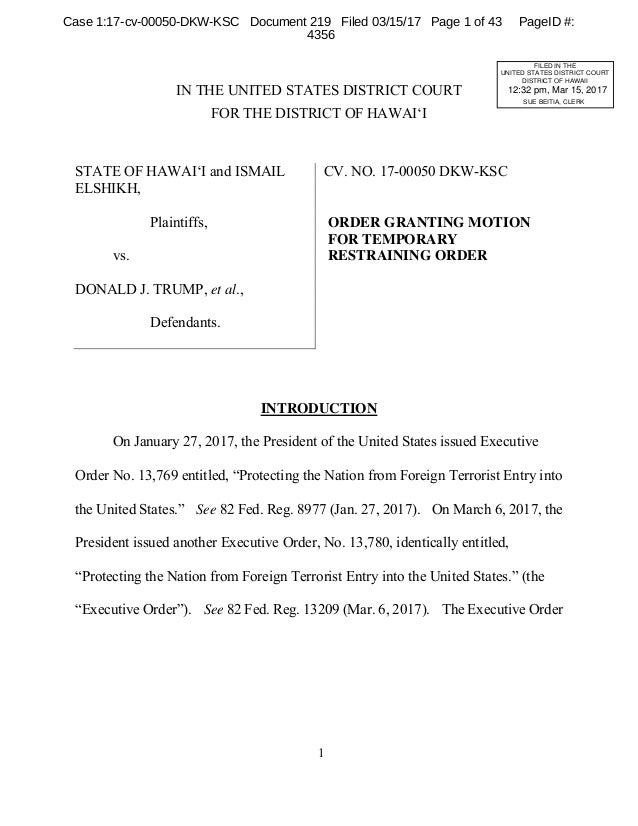
Go to Original ByRui Kaneya In a case of legal deja vu, President Donald Trump’s new executive order on immigration suffered a major setback Wednesday, when a federal judge in Honolulu issued a temporary restraining order to keep the travel ban from taking effect as scheduled at 6:01 p.m. Hawaii time.
Following a hearing Wednesday, U.S. District Court Judge Derrick Watson ruled that Hawaii “met their burden of establishing a strong likelihood of success on the merits of” its lawsuit.
Watson’s ruling — nationwide in scope — was a resounding victory for Hawaii, which mounted a legal challenge last week to overturn the newly revised travel ban on grounds that it unconstitutionally targets Muslims and discriminates based on national origin.
At the hearing, held in a packed courtroom in downtown Honolulu, the Trump administration struggled to convince Watson that he should allow the travel ban to take effect as scheduled.
Watson appeared unconvinced by acting Solicitor General Jeffrey Wall’s argument that past statements by Trump and aides shouldn’t be considered when assessing whether the new order was motivated by “religious animus.”
Watson pointedly asked: “How do we assess that the neutrality (of the new order’s text) isn’t a subterfuge in some way?”
Wednesday’s hearing came on a day that attorneys from two other states were in federal courts challenging the new order, which suspends refugee resettlements and temporarily halts the issuance of new visas to citizens of six Muslim-majority countries.
Six hours before Watson’s hearing, U.S. District Judge Theodore Chuang in Greenbelt, Maryland, heard oral arguments on a lawsuit brought by refugee aid groups but declined to issue a ruling from the bench.
Chuang said his ruling will come “hopefully today” but indicated that he’ll likely issue a narrow ruling that isn’t nationwide in scope.
Starting at 11 a.m. Hawaii time, another judge in Seattle began holding a hearing on a similar lawsuit brought by four Washington residents who are concerned that their relatives in the banned countries could be disrupted by Trump’s new ban.
That hearing was before U.S. District Judge James Robart, who squelched Trump’s first travel ban attempt with a temporary restraining order Feb. 3. That decision was upheld by a three-judge panel of the 9th U.S. Circuit Court of Appeals on Feb. 9.
This is a developing story. Watch Civil Beat for updates.
Bannon's journey "from right-wing media outlier to top propagandist of the U.S. empire," shows how his "economic agenda and racism go hand in hand."
The latest episode of Abby Martin's "Empire Files" examines the professional and ideological trajectory of perhaps the most powerful person in the White House, Steve Bannon.
While much of Bannon's story is well known, Martin argues that it is essential to map Bannon's political development because "we need to understand the ideology behind [Bannon's] policies in order to best defeat them."
The episode examines Bannon's almost 40-year rise through the darkest corners of the U.S. far-right, quoting the former head of the Ku Klux Klan, David Duke, who says that with Bannon "you have an individual who's basically creating the ideological aspects of where we're going. And ideology is ultimately the most important aspect of any government."
Martin traces Bannon's journey from young navy officer "in love with war" and disappointed the U.S. didn't invade Iran to prevent the 1979 revolution, to a leading propagandist for the far-right fringes of the Republican party, to chief policy maker for the Trump administration where his "most outlandish fantasies have been put into action."
While Bannon's stops along the way included a well-known six-year stint at Goldman Sachs and several years as editor and chief of the "alt-right platform" Breitbart News, Martin explores some of the more obscure and creepy moments in Bannon's development connecting a "lack of ethics in his professional life" — raising funds for an internet company run by a group of accused pedophiles — to his "disturbing history of alleged domestic abuse" — noting that the mother of his twin daughters requested that Bannon's visitations take place in public after he allegedly hit his then 17-month-old daughter.
Before taking over Breitbart News in 2010 Bannon used his personal wealth to become — in the words of colleagues at Breitbart News referring to the notorious Nazi filmmaker — "the Leni Riefenstahl of the Tea-Party movement," by making films which, Martin notes, portrayed "an array far-right dystopian fantasies which depict a society in collapse, invaded by criminal armies."
While those films were never successful, they brought him to Breitbart News where he also founded a right-wing think tank, the Government Accountability Institute, to mainstream his brand of anti-Black, anti-Muslim, anti-immigrant "economic nationalism."
After Trump declared his candidacy for the presidency in 2015, Breitbart's readership more than doubled from 8 million a month to almost 18, and Bannon found his path to real power.
"A new relationship was born," says Martin. "Trump had something Bannon always wanted — a bigger megaphone for his right-wing dreams of transforming U.S. society — and Bannon had something Trump cherished too: a doting audience."
Martin roots Trump's success in Bannon's brand of narrowcast populism, which "appeals to [White] people because he's pointing out actual problems in society" — such as the neoliberal assault on the middle class with both establishment Democrats and Republicans have been unwilling to address — yet blaming them on a racialized Other.
While Martin notes that there is little new in this strategy — "throughout history rulers have rallied the white working class against other poor people to avert blame for systemic crisis" — she concludes that Bannon's rise is symptomatic of much larger systemic ills.
"The fact that someone like Steve Bannon could attain such a high seat of power shows how illegitimate the system really is, how quickly steps towards progress can be reversed."
Five Palestinians were injured after Israeli forces opened live fire at locals during a predawn detention raid Wednesday in Duheisha refugee camp near Bethlehem in the southern occupied West Bank.
Locals told Ma'an that fierce clashes broke out between local youth and Israeli troops who raided the camp around dawn to detain one young Palestinian man from his home, identified as former prisoner Murad Zeghari.
Three young men were injured during the clashes, identified by locals as Ahmad al-Jeewi, Muath Abu Nassar, and Muhammad Faris Fararja.
Witnesses and family members told Ma'an that 40-year-old Iyad Ibrahim Ramadan was shot in the leg while he was standing on the rooftop of his home in the camp, before his brothers Mahmoud and Shadi rushed him to a car to drive him to the Bethlehem Arab Society Hospital in Beit Jala.
As they were driving through the neighboring town Doha, Israeli troops opened fire on their car. Mahmoud, 34, sustained injuries after being hit in the head with shrapnel. Shadi, who was driving the car, was unharmed.
The Ramadan brothers are the sons of the Jenin governor Ibrahim Ramadan, who also lives in Duheisha refugee camp. Family members, who witnessed the incident, told Ma'an that the three men survived by a "miracle" after Israeli troops "showered their vehicle with gunshots."
In response to a request for comment, an Israeli army spokesperson told Ma'an that a "violent riot" occurred in Duheisha during "a routine military activity," saying locals threw cement blocks and explosive devices at Israeli forces who "responded to the threat by firing towards rioters."
The spokesperson said that four people were injured, but did not confirm Mahmoud Ramadan's injury and did not comment on why Israeli forces opened fire on the vehicle .
The spokesperson also confirmed that one person was detained during the raid.
Israeli raids in Palestinian towns, villages, and refugee camps are a daily occurrence in the occupied West Bank. Due to the typically aggressive nature of the raids, clashes often erupt between local Palestinian youth who throw stones and are met in response with live fire, rubber-coated steel bullets, and tear gas, often resulting in serious, sometimes fatal, injuries.
Rights groups have routinely condemned Israeli authorities for their use of excessive force against Palestinians, during incidents that did not warrant a violent response.