Saturday, March 11, 2017

Some in Congress back implementing TPP trade deal even without U.S., Amari says

Go to Original

A number of American lawmakers have backed the idea of implementing the Trans-Pacific Partnership free trade agreement even without the participation of the United States, a veteran Liberal Democratic Party lawmaker has said.
Former Cabinet member Akira Amari, who led the Japanese negotiations on the deal, spoke to reporters following meetings Friday in Washington involving a multiparty delegation of six Diet members and U.S. legislators.
Amari did not specify which American lawmakers backed the idea. The meetings included Rep. Joaquin Castro, co-head of the congressional U.S.-Japan Caucus.
The U.S. lawmakers backing an 11-member TPP indicated that it would lead U.S. businesses to press the government to rejoin the pact, according to Amari.
Amari said the significance of the 12-nation TPP — which stipulates trade rules and reforms with the potential to level the playing field for U.S. companies in emerging economies — is not widely acknowledged in the United States.
Amari spoke as the delegation wrapped up its five-day trip. During the visit, the Diet members met with 12 House members and five senators from both the Republican and Democratic parties, as well as experts from think tanks.
On Wednesday, representatives from the 12 TPP countries, including the U.S. and Japan, will meet in Chile to seek a way forward on a possible regional trade deal.
It will be the first TPP-related meeting since President Donald Trump’s administration withdrew the United States from the pact in late January. Trump said the pact would cost the U.S. jobs and harm American manufacturing.
Now Washington is shifting its focus to signing bilateral trade agreements with other nations.
On Friday, Commerce Secretary Wilbur Ross expressed eagerness to start negotiations with Japan at an early date for a bilateral deal, saying the U.S. considers it a “very high priority.”
The comment was taken as suggesting that the U.S. may propose such talks during a high-level economic dialogue that the two governments are planning to start in April. That dialogue will be led by Deputy Prime Minister Taro Aso and U.S. Vice President Mike Pence.
Japan “is a major trading partner and military defense partner of the U.S.,” Ross said at a news conference after meeting with Mexican Economy Minister Ildefonso Guajardo in Washington. “So obviously, it would have very high priority” in the Trump administration’s trade policy.
Gen Nakatani, a former defense minister and Japanese delegation member, said the Japanese and U.S. lawmakers agreed that the two governments will strengthen coordination in curbing North Korea’s missile and nuclear weapons development, as well as over China’s moves in the disputed South and East China seas.
The two sides affirmed the importance of complying with international law against any attempt to change the status quo, taking aim at Beijing’s militarization of outposts in the South China Sea, as well as its repeated intrusion into Japanese waters around the Senkaku Islands. The Senkakus, in the East China Sea, are administered by Japan but claimed by Beijing and Taiwan.

134 foreign policy experts condemn Trump travel ban

Go to Original
BY BROOKE SEIPEL


A group of 134 foreign policy experts have denounced President Trump's revised travel ban in a letter to the president, The New York Times reported Saturday.
The new travel order, which is set to take effect on Wednesday, replaced a more sweeping ban issued on Jan. 27 that caused chaos and protests at airports across the country.
But the letter signed by figures including former Secretaries of State Madeleine Albright and John Kerry argues that the revised ban "suffers from the same core substantive defects as the previous version."
In the letter directed to Trump, Attorney General Jeff Sessions, Secretary of State Rex W. Tillerson, Secretary of Defense James Mattis, Secretary of Homeland Security John Kelly and Michael Dempsey, the acting director of national intelligence, the former government officials argue that the new travel ban tells Muslims that the United States is an enemy of Islam.
"The revised executive order will jeopardize our relationship with allies and partners on whom we rely for vital counterterrorism cooperation and information-sharing To Muslims – including those victimized by or fighting against ISIS – it will send a message that reinforces the propaganda of ISIS and other extremist groups, that falsely claim the United States is at war with Islam," it states. 
"Welcoming Muslim refugees and travelers, by contrast, exposes the lies of terrorists and counters their warped vision," it adds.
The letter was signed by a slew of former Obama administration officials, including former national security adviser Susan Rice and former U.N. Ambassador Samantha Power. It calls the revised order "damaging to the strategic and national security interests of the United States."
Experts who served in both Republican and Democratic administrations signed the letter, including R. Nicholas Burns, former National Security Council member under Clinton and counterterrorism coordinator under Bush, and John E. McLaughlin, the deputy CIA director for Clinton and acting CIA director for Bush.
The first order, which temporarily halted the entry of refugees and travelers from seven Muslim-majority countries, was hit by more than two-dozen lawsuits. The administration issued a new order aimed at surviving legal challenges.
Among the changes, the new order drops Iraq from the list of seven countries affected by the travel ban, and it exempts those from the travel ban who hold valid visas.
The order continues to halt all refugee admissions for four months, while the previous order went further in suspending Syrian refugees indefinitely and allowed preference for some religious minorities.

Tortured and Wrongly Held at Guantánamo for 14 Years, Abdul Zahir Now Has Freedom, but No Justice

Go to Original
By Adam Hudson


Before Barack Obama left office, he released 10 detainees from Guantánamo to Oman. Among them was Abdul Zahir, a 45-year-old man from Afghanistan. Zahir was detained at Guantánamo for 14 years, even though the US government later admitted that he was wrongfully held. He was mistaken for another man who shared his nickname, Abdul Bari. Zahir's story exemplifies the cruelty of Guantánamo and the policies of indefinite detention and torture, which will, in all likelihood, continue with Trump as president.
"I want to leave behind the bad things that happened to me while I have been imprisoned. I want to focus on the positive things ahead of me, seeing my family again, studying at university and perhaps being able to help others," Zahir said, according a press release provided by his lawyers before he left Guantánamo. Zahir has three sons and speaks Arabic, Pashto and some Urdu, Farsi and English. Before his capture, he worked as a translator, shuttle driver and Arabic teacher.
US troops captured Zahir on July 11, 2002, during a raid in Afghanistan targeting another man named Abdul Bari -- an alias also used by Zahir. The raid occurred at a compound in Hesarak village, which is a few miles east of Kabul and northeast of Gardez. Abdul Bari (not Zahir) allegedly helped produce and distribute chemical or biological weapons for al-Qaeda.
A day or two after the raid, US forces recovered "suspicious items," according to a military intelligence assessment, including a white powder that they initially believed was a chemical or biological agent. However, on later examination, the substances turned out to be salt, sugar and petroleum jelly. When the Periodic Review Board determined, on July 11, 2016, that Abdul Zahir should be released, it also concluded that Zahir "was probably misidentified as the individual who had ties to al-Qaeda weapons facilitation." 
Zahir was not the only Guantánamo detainee detained because of a mistaken identity. In fact, another Guantánamo detainee among those released to Oman -- Yemeni Mustafa al Shamiri -- was also mistaken for another man with a similar name. 
Torture and Assault in Guantánamo
Like every Guantánamo detainee, Zahir was tortured. His military defense lawyer, US Air Force Lt. Col. Sterling Thomas told Truthout that after Zahir's capture, US forces "gave him the treatment that they thought every Brown person, every Muslim person they captured deserved -- they tortured him."
Zahir was tortured by US forces at Bagram Air Base in Afghanistan and at Guantánamo, where he was transferred on October 27, 2002.  
Thomas explained that Zahir suffered beatings, exposure to cold temperatures, cramped confinement, stress positions, hog-tying and sexual assault. "He would be kept in very small rooms with the air conditioning unit running full blast without proper clothing -- so, a pair of shorts -- and an iron bed," Thomas said. Zahir "would be placed in interrogation rooms right under the air conditioner and they would make the room as cold as possible, with his hands tied to his waist, and then he would be tied into a fetal position on the floor in that very cold room." In addition, Zahir "spent a year in a room that he called 'a cage for animals.' And in that room, he had to eat, sleep, exercise and shower all in the same place. Including elimination of waste." 
During the time he spent in that small room, a group of US troops would come into the room "wearing outfits meant to make him frightened" and "would spray a burning gas above his head," while he was shirtless. Those troops would "drop him to the floor and two people would sit on his lower back and tie his hands and feet behind him," a practice known as "hog-tying." They would "then pick him up like a sheep and take him elsewhere where they would quickly immerse him in water that was flowing fast from a very big pipe." After that, they would "take him back to where he was and drop him from about one meter onto the ground still tied." Guards also grabbed and pulled his testicles "violently, until he fell unconscious." 
As a result of his torture, Zahir "suffered physically and emotionally." He experienced major depressive episodes that led him to attempt suicide. Zahir protested his treatment on numerous occasions. In one instance, after he protested, a group of guards in riot gear (Forced Cell Extraction team) tackled Zahir and "damaged his spine so badly that they had to conduct surgery," said Thomas. Since then, Zahir has had to walk with a walker and experiences internal organ issues.   
Zahir's torture was par for the course at Guantánamo. As documented by human rights groups like the Center for Constitutional Rights, beatings, shackling, sexual assault and other forms of abuse have been standard practice at Guantánamo, particularly in its early years. During the 2013 hunger strike, striking prisoners were force-fed, which is also a form of torture. Torture violates international law, particularly the UN Convention Against Torture.
For years, defense lawyers tried to get Zahir released, or at least secure a fair trial. Vermont lawyer Robert Gensburg challenged Zahir's confinement with a habeas corpus action but was unsuccessful. Zahir was then brought up for trial before a military commission, which is when fellow Vermont lawyer David Sleigh and military co-counsel Lt. Col. Sterling Thomas joined Zahir's defense team. 
In 2006, Zahir was charged with conspiracy, materially supporting terrorism and killing civilians in connection with a grenade attack that wounded Canadian journalist Kathleen Kenna. However, the military commission temporarily shut down, his case never went to trial, and charges were dismissed. According to Thomas, Zahir made numerous, contradictory statements under torture -- statements that the US government tried to use against him -- but there was no physical evidence tying him to the attack. Thomas also mentioned that part of the reason Zahir was held for so long is because the US government tortured him and did not want those details made public in a civilian court. 
How Do Mistaken Identity Cases Occur?
New Guantánamo intelligence reveals that the vast majority of detainees are not the "worst of the worst" as the US government claimed, according to the Miami Herald. In fact, some of those who were captured and incarcerated at Guantánamo had nothing to do with al-Qaeda.
This reality has always been clear to some people within the US government. One of them is Mark Fallon, a retired 30-year federal investigator who, from 2002 to 2004, headed the Pentagon's Criminal Investigation Task Force (CITF), established to investigate cases that would be brought before a military commission. In the early days, Fallon said it was clear to him and CITF that most of the people arriving at Guantánamo were not the super-villain terrorists portrayed by the US government. "We were frankly shocked at who wound up there going on the first plane loads. It was clear it wasn't senior al-Qaeda leadership or main al-Qaeda men. It was just people who were kind of scooped up and a lot of them were paid bounties for. They were not very effectively, for the most part, screened very well in Afghanistan," Fallon explained to Truthout. 
Only 5 percent of Guantánamo detainees were captured by US forces. Meanwhile, 86 percent were captured by Afghan tribal allies or Pakistani security forces and handed over to US custody, according to a Seton Hall study. The detainees captured by Pakistan or Afghan tribal allies "were handed over to the United States at a time in which the United States offered large bounties for capture of suspected enemies." Very few were actually al-Qaeda fighters. "Only 8% of the detainees were characterized as al Qaeda fighters," according to the study, while 40 percent had "no definitive connection with al Qaeda" and 18 percent had "no definitive affiliation with either al Qaeda or the Taliban."
It's not a huge surprise that false charges and cases of mistaken identity occurred amid this race to incarcerate. Fallon said that JTF-GTMO (Joint Task Force Guantánamo), which runs the Guantánamo prison, was looking for anything to pin on detainees. For example, part of JTF-GTMO's threat indication criteria was whether a detainee possessed a common item like a Casio F-91W or A159W wristwatch because it was "the sign of al-Qaida, [which] uses the watch to make bombs," which Fallon called "sad" and "comical." Fallon said CITF concluded "an overwhelming majority" of detainees had no intelligence or investigative value and should be released, while JTF-GTMO argued for further detention. However, it was JTF-GTMO's assessments that caught the White House's ear, while voices like Fallon's were marginalized. Fallon shares his insider perspective on how the US government implemented torture in a book called Unjustifiable Means: The Inside Story of How the CIA, Pentagon, and US Government Conspired to Torture. 
Meanwhile, Abdul Zahir will be attempting to get back on his feet, reunite with his family and begin rebuilding a life that was all but shattered. Despite his torture and horrific treatment at the hands of the US government, Zahir says he does not hate the United States or harbor any bitter feelings. Rather, he is focused on moving his life forward. Sterling called Zahir's resolve "remarkable" and said, "He's been through things that no human being should have to suffer through. Regardless of what they did. And he had done nothing that was a crime."
Moving on could be difficult for Zahir. Many former Guantánamo and CIA black sitedetainees continue to face mental health problems even after being released, such as depression and post-traumatic stress. That makes it difficult for them to readjust into normal society. This means true justice for Guantánamo detainees entails more than just releasing them to another country. It also must include redress for the torture inflicted upon them and the physical, mental and emotional problems resulting from that abuse.
However, true justice does not currently seem within reach for current and former Guantánamo detainees. There arecurrently 41 detainees in Guantánamo, including 26 held in indefinite detention -- people whom the government does not have enough untainted evidence to prosecute but claims are too dangerous to release. Like torture, indefinite detention also violates international human rights law. While theTrump administration has dropped the idea of reopening secret prisons, it does want to keep the Guantánamo prison open and put new detainees there. According to the Miami Herald, the Guantánamo military prison could hold another 200 or so prisoners.

The Bernie Sanders Campaign Faced A Fake News Tsunami. Where Did It Come From?

Go to Original
By Ryan Grim & Jason Cherkis


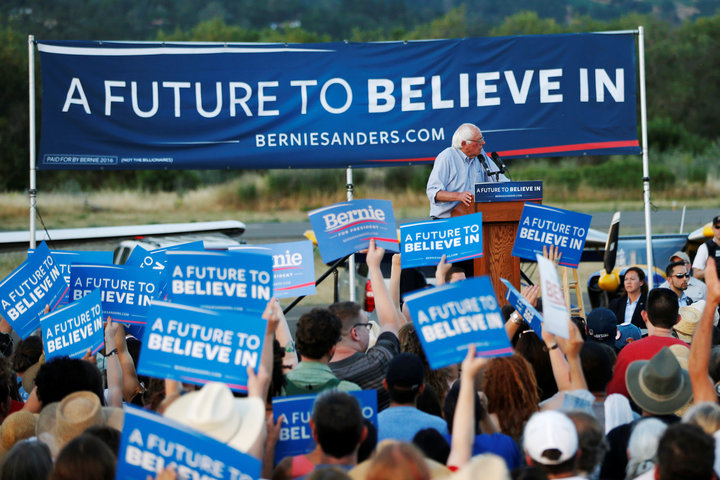
WASHINGTON ― Last June, John Mattes started noticing something coursing like a virus through the Facebook page he helped administer for Bernie Sanders fans in San Diego. People with no apparent ties to California were friending the page and sharing links from unfamiliar sites full of anti-Hillary Clinton propaganda.
The stories they posted weren’t the normal complaints he was used to seeing as the Vermont senator and the former secretary of state fought out the Democratic presidential primary. These stories alleged that Clinton had murdered her political opponents and used body doubles.
Mattes, 66, had been a television reporter and Senate investigator in previous lives. He put his expertise in unmasking fraudsters to work. At first, he suspected that the sites were created by the old Clinton haters from the ‘90s ― what Hillary Clinton had dubbed “the vast right-wing conspiracy.”
But when Mattes started tracking down the sites’ domain registrations, the trail led to Macedonia and Albania. In mid-September, he emailed a few of his private investigator friends with a list of the sites. “Very creepy and i do not think Koch brothers,” he wrote.
Mattes and his friends didn’t know what to make of his findings. He couldn’t get his mind around the possibility that trolls overseas might be trying to sway a bunch of Southern Californians who supported Sanders’ run for president. “I may be a dark cynic and I may have been an investigative reporter for a long time, but this was too dark ― and too unbelievable and most upsetting,” he said. “What was I to do with this?”
By late October, Mattes said he’d traced 40 percent of the domain registrations for the fake news sites he saw popping up on pro-Sanders pages back to Eastern Europe. Others appeared to be based in Panama and the U.S., or were untraceable. He wondered, “Am I the only person that sees all this crap floating through these Bernie pages?”
He wasn’t. Bernie supporters across the country had been noticing dubious websites and posters linked back to Eastern Europe long before Mattes did ― and even before The Washington Post reported in mid-June that Russian government hackers had stolen emails from the Democratic National Committee. They had been warning each other that something weird was going on, posting troll alerts and compiling lists of fake news sites.
There is enough real news to fight over, they thought, without arguing over anti-Hillary conspiracy theories from Macedonia.

Sometimes it was hard to tell who was doing the trolling and for what purposes. Aleta Pearce, 54, who lives in Malibu, California, was an administrator of half a dozen pro-Sanders Facebook groups and a member of many others. In May 2016, she posted a memo to various Facebook groups about the fake news issue, warning of bogus sites.
“The pattern I’m seeing is if a member is repeatedly posting articles that are only from one URL that person is just there to push advertising,” Pearce wrote. “They probably have a sock account with little to no content. They are often from Russia or Macedonia.” (A “sock” or “sock puppet” account uses a false identity to deceive.)
Pearce added, “Please share this with other Bernie groups so we can put an end to this spam bombing that’s filling up our pages and groups. It’s time to chase the mice out of the hen house and send them a message. They don’t know who they are messing with.”
The first tidal wave of spam was mostly anti-Bernie, Pearce recalled, posted by Clinton backers. (David Brock’s Clinton-backing super PAC had likely paid for some portion of those.) But after Clinton became the Democratic nominee in July, Pearce noticed a switch to anti-Hillary messages with links to fake news and to real news with obnoxious pop-up ads.
“Every site publishing those ― you clicked on the article, you would be slammed with ads and strange articles,” Pearce told HuffPost. “It was overwhelming. It was 24/7.”
She kept a list of fake news sites to watch for ― it grew into dozens. There were posts on the Clinton-has-Parkinson’s conspiracy and the Clinton-is-running-a-pedophilia-ring-out-of-a-pizza-shop conspiracy.
On the Sanders campaign, it was Hector Sigala’s job to connect with all the organic Facebook groups. He recalled seeing “a lot of trolls” try to convince people of something “that was obviously fake.”
Many of the interlopers, Sigala said, claimed to be Sanders fans who had decided to vote for GOP nominee Donald Trump or Green Party candidate Jill Stein in the general election and tried to convince others to do likewise. “It made it seem like the community as a whole was supporting that, but that wasn’t the case,” he said.
Sigala thinks most of them were just your average internet trolls. He said he found many were members of 4chan, a gathering place for the alt-right, white nationalists and plain old nihilists from which has sprung all manner of mischief.
The Sanders campaign had begun seeing this particular brand of fake news starting in early 2016. “The first time that we kind of fell for it, for like two minutes, was this link from what seemed to be ABC News,” Sigala said. It turned out to be ABC.com.co, a fake site that has no affiliation with the real news network. It had “reported” that the pope himself had endorsed Sanders.
It came in like a wave, like a tsunami. It was like a flood of misinformation.Bev Cowling, who administered Facebook groups for Sanders supporters
In trying to wade through the flood of fake news, Sanders supporters had some serious trust issues. There was good reason to be skeptical of Clinton and the WikiLeaks dump of DNC emails was real, after all. But a steady diet of stories fabricated out of thin air can also feed into paranoia and flame wars.
Bev Cowling, 64, saw a sudden deluge of requests to join the Sanders Facebook groups she administered from her home in Toney, Alabama. All of a sudden, they were getting 80 to 100 requests to join each day. She and the other administrators couldn’t vet everyone, and the posts started getting bizarre. “It came in like a wave, like a tsunami,” she said. “It was like a flood of misinformation.”
Cowling, a retired postal worker, said some of her Facebook group members were ready to believe the bogus news links. “People were so anti-Hillary that no matter what you said, they were willing to share it and spread it,” she said. “At first I would just laugh about it. I would say, ‘C’mon, this is beyond ridiculous.’ I created a word called ‘ridiculosity.’ I would say, ‘This reeks of ridiculosity.’”
But Cowling got pushback. She was called a “Hillbot” and a Trump supporter. She ended up removing dozens of members who refused to stop pushing conspiracy theories. “I lost quite a few friends,” she said.
Matthew Smollon, a 34-year-old copy editor and page designer based in Knoxville, Tennessee, noticed an influx of posts linking to fake news as early as January 2016. So much of it, Smollon noticed, came from the same accounts. Almost all the sites he traced went back to Veles, Macedonia, which Wired magazine has since dubbed the “Fake News Factory to the World.” There wasn’t a single link he found that went to a pro-Clinton fake news story.
None of the fake stories stood out to Smollon. He described the Facebook groups as “being in a room filled with blasting televisions.” It was hard to pick out the loudest noises. “The ultimate goal of this wasn’t so much misinformation as distraction from valid info,” he concluded.
But Smollon had a hard time convincing other Bernie supporters that they were being played. “No one cared,” Smollon said. “At that point, you were a Hillary shill. It was like an echo chamber of anger.”
Even when pointing out that something like NBCPolitics.org was a fake site ― the real site is NBCNews.com/politics ― he drew criticism. He was eventually removed as a moderator from one of the pro-Sanders Facebook groups. “It’s the closest I’ve been to being gaslit in my life,” he said.
In June, Smollon posted a piece on Medium with the headline, “Dear Bernie Supporters: Stop sharing posts from dumpster fire websites.” He urged his fellow Sanders fans to wake up:
Guys, I sincerely love you. I love your passion. I love your fire. I love all of that. But when 400 people are circle-jerking clickbait links in between wondering how Hillary Clinton is behind the FEMA Earthquake drill that happens on several days with one of them being primary day?
Holy shit.
You are allowing yourselves to be manipulated. Through the practice of taking anything that agrees with your opinion at face value, actively refusing to believe anything but what agrees with your narrative and following that up with blatant disregard for doing two minutes of searching to verify the information: you become the myopic Trump supporter that you so vocally loathe.
Some people “liked” his Medium piece on Facebook and posted it on their walls, he said. Others did not. Smollon later updated his article to say he’d been banned from the group “Bernie Believers” because of it.
“This is a pretty solid case for admins/mods being part of the spam,” he wrote. “Not all of them obviously, but it only takes one person running with an ulterior motive to ensure the whole thing goes to shit.”

In San Diego, Mattes was intrigued by a Facebook user named “Oliver Mitov” whom he saw constantly posting anti-Clinton propaganda.
Mattes first noticed Mitov posting in his Facebook group in September. But when he searched the page’s archives, he found that Mitov had been in the group since late July. He soon realized there wasn’t just one Mitov but four. Three had Sanders as their profile picture. Two had the same single Facebook friend, while a third had no Facebook friends. The fourth appeared to be a middle-aged man with 19 Facebook friends, including that one friend the other Mitovs had in common.
All combined, the four Mitovs had joined more than two dozen pro-Sanders groups around the U.S., including Latinos for Bernie Sanders, Oregon for Bernie Sanders 2016 and Pennsylvania Progressives for Bernie Sanders. Together, those groups had hundreds of thousands of members.
The Mitov posts would have been explosive if they’d been true. In one Aug. 4 post to Mattes’ page, Mitov wrote, “This is a story you won’t see on Fox/CNN or the other Mainstream media!” He then linked to a post claiming falsely that Clinton had “made a small fortune by arming ISIS.” On Sept. 25, he posted on several pro-Sanders pages a link promising game-changing information: “NEW LEAK: Here is Who Ordered Hillary To Leave The 4 Men In Benghazi!” The link went to a fake news site called usapoliticsnow.com.
The aim of Mitov’s activity seemed pretty obvious to Mattes: to depress the number of Sanders supporters who voted for Clinton in November.
“He was a ringer,” Mattes said.
Mattes tried to friend the various Mitovs and message them. None of them responded, he said. Attempts by HuffPost to reach Mitov were similarly unsuccessful.

Keegan Goudiss had a different perspective on the trolling. As head of the digital side of Sanders’ presidential bid, Goudiss launched paid campaigns on social media and around the internet, so he was very familiar with the way that money can drive a meme.
Bots and trolls that spread fake news shouldn’t be ignored, he said, but “it’s like pissing in the ocean. There’s a lot of noise online.” One way to help your message cut through the noise is to spend money with Facebook, Google or an ad targeting platform that spreads links all over the internet, often at the bottom of stories. (Scroll down far enough on this page and you’ll probably see some of them.)
Goudiss recalled one telling example of how this worked: A Clinton ad appeared in the middle of a row of links, clearly paid for by a pro-Clinton group targeting potential donors and voters. To its left was a story making bogus claims about an illegitimate Clinton child. To its right was a piece on presidential mistresses. “There seems to have been a concerted effort to tarnish Hillary and people in her campaign’s reputation using paid placement,” he said.

He can’t prove who was doing that, Goudiss said, but it’s probably worth trying to figure out.
“Was there a Russian entity supporting those websites that popped up?” he said. “That’s important and people deserve to know who influences our democracy.”
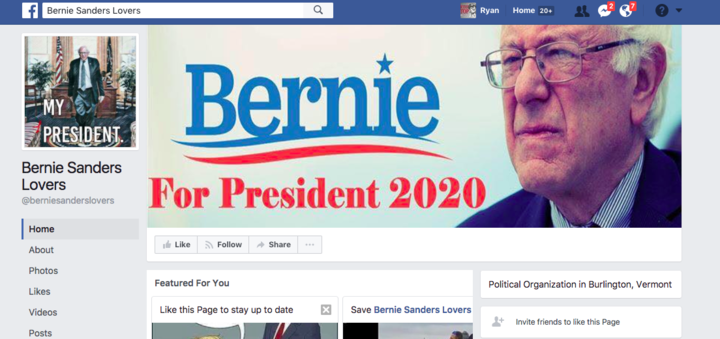
Some level of foreign participation in spreading disinformation about the left was comically apparent. The names of a few suspect Facebook groups reek of poor translation. One group with more than 80,000 members, claiming to be from Burlington, Vermont, is called “Bernie Sanders Lovers” ― the kind of name a non-English speaker might think makes sense, but that sounds wrong to native ears.

Throughout the campaign, the Bernie Sanders Lovers page saw heavy engagement, and nearly every article it shared was from Bients.com, the pieces posted there by one Maximilian Gottlieb. Gottlieb, in turn, pulled articles from other sources, some more and some less reliable.
On Oct. 29, for instance, he put up 11 articles. A few praised Trump or gave Trump’s advisers space to attack Clinton. Others attacked Clinton’s campaign directly: adviser Huma Abedin had ties to radical Islam (false), the DNC email leak was authentic (true), campaign manager Robby Mook had deleted his entire Twitter feed (false).
Since the election, the Bernie Sanders Lovers page has shifted to urging the senator to run for president again in 2020. It no longer shares Bients.com stories. Instead, they all come from ThePredicted.com. Both sites were registered by a person name Hysen Alimi in Albania. (Feel free to check out the sites yourself, but Chrome will warn you your connection is “not secure,” so don’t enter any information there.)

There had been rumblings that the Russians were specifically behind the DNC hack since last June. In early October, the U.S. intelligence community said it was “confident” that President Vladimir Putin’s government had both directed the hack and made sure the emails found their way to WikiLeaks. In January of this year, a more detailed intelligence report concluded that the Russian government had blended covert intelligence operations with overt efforts by, among others, “paid social media users or ‘trolls’” to try to influence the U.S. election.
A separate dossier on Russia’s role, assembled by former MI6 agent Christopher Steele and made public by BuzzFeed, claimed that the DNC leak had been an attempt to “swing supporters of Bernie Sanders away from Hillary Clinton and across to Trump.”
“These voters were perceived as activists and anti-status quo and anti-establishment and in that regard sharing many features with the Trump campaign, including a visceral dislike of Clinton,” Steele wrote.
The intelligence report also said that the DNC hackers seemed to have financial ties to the Internet Research Agency, a Saint Petersburg, Russia, company that has taken state-sponsored trolling to an industrial level. Its likely financier is “a close Putin ally with ties to Russian intelligence,” the report stated.
“Russia’s information war might be thought of as the biggest trolling operation in history,” wrote The New York Times in a 2015 profile of the firm, “and its target is nothing less than the utility of the Internet as a democratic space.”
The “Internet as a democratic space” is the very thing that allowed the energy of the Sanders campaign to snowball into a movement for change. It was also the thing that allowed Oliver Mitov and his ilk to thrive.
Could the fake news tsunami have swung the election? It’s impossible to say for sure, but a YouGov survey recently asked people who voted for Sanders in the primary how they thought other people they knew who backed Sanders ended up voting in the general election. Thirteen percent said all of those folks voted for Clinton, and 48 percent said most of them did. But 20 percent said only some, 9 percent said just a few and 4 percent said none voted for Clinton.
In the survey, only 7 percent said that most or all of the Bernie people they knew wound up helping raise money or otherwise volunteering for Clinton. Fifty-four percent said that applied to just a few or none of the Bernie people they knew. Sanders backers were by far the most energized element of the Democratic coalition during last year’s campaign. Clinton’s inability to motivate them more broadly to back her candidacy undoubtedly hurt.
Asked what they themselves did, 12 percent of those who voted for Sanders said they went on to volunteer or raise money for Clinton. Only 16 percent of those who voted for Clinton in the primary said they also volunteered for her.
Of course, the propaganda didn’t create the chasm dividing left-wing voters. The belief that the DNC favored Clinton was widely held. Fifty-eight percent of all the survey respondents agreed on that. Among Democrats, the number was 55 percent. In the Midwest, which essentially elected Trump president, 67 percent agreed. Even 62 percent of those who voted for Clinton in the primary said that the DNC favored her.
But the legitimate skepticism opened the door to believing the more demented propaganda. And the more the fake news was passed around, the harder the divisions became. Clinton backers would charge Sanders supporters with being obnoxious, sexist “Bernie bros.” Many of those bros may have been trolls, not real Sanders supporters. Tell that to a Clinton backer, however, and you can be accused of dismissing the hostility they faced.
Aidan King set up a popular Reddit page for Sanders beginning in 2013 and went to work for the campaign in January 2016 as Sigala’s deputy. He dealt directly with many of the Facebook groups. After the Democratic convention, he said he noticed a strong shift away from the party in the tone of many of those pages.
“I’ve gone back and forth on it,” King said. “I wouldn’t feel comfortable saying with any authority it’s a coordinated effort by trolls, but also wouldn’t feel confident saying it was exclusively pissed-off Bernie supporters.” 
It might not actually matter if Vladimir Putin or a kid in Macedonia masterminded the flood of fake news. What matters is that it happened ― and it is still happening. People are deliberately seeding misinformation into the left-wing conversation. That’s a real fact. (Trying to measure the size and scope of the operation could make for a useful political science dissertation.)
For a wide swath of Sanders backers, the primary is still far too raw to even start to think about Russia. Mentioning foreign sabotage sounds like you’re throwing up a smokescreen to obscure the Democratic establishment’s own failure. But Mattes has tried to argue that two things can be true at once: Clinton was a terrible candidate and Russia intervened in the U.S. election.
“It’s wildly distressing that we were played,” Mattes said. 

Propaganda wars: 'pro-science' GMO, chemicals boosters funded by climate change deniers

Go to Original
By Stacy Malkan

They promote GMOs, defend toxic chemicals, and attack people who raise concerns about those products as 'anti-science'. But behind the slick 'astroturf' PR fronts lurk some very dubious funders: the same arch-conservative foundations that finance climate science denial. Stacy Malkan exposes the key players in the agribusiness and chemical industry propaganda wars.

The funders behind climate-science denial also bankroll a network of PR operatives who have built careers spinning science to deny the health risks of toxic chemicals in the food we eat and products we use every day.
British writer George Monbiot has a warning for those of us trying to grasp the new political realities in the US and the UK.
"We have no hope of understanding what is coming until we understand how the dark money network operates", he wrote in the Guardian.
Corporate America may have been slow to warm up to Donald Trump, but once Trump secured the nomination, "the big money began to recognize an unprecedented opportunity", Monbiot wrote.
"His incoherence was not a liability, but an opening: his agenda could be shaped. And the dark money network already developed by some American corporations was perfectly positioned to shape it."
This network, or dark money ATM as Mother Jones described it, refers to the vast amount of hard-to-trace money flowing from arch-conservative billionaires, such as Charles and David Koch and allies, and corporations into front groups that promote extreme free-market ideas - for example, fights against public schools, unions, environmental protection, climate change policies and science that threatens corporate profits.
Investigative writers Jane Mayer, Naomi Oreskes, Erik Conway and others have exposed how "the story of dark money and the story of climate change denial are the same story: two sides of the same coin", as US Senator Sheldon Whitehouse described it last year in a speech.
The strategies of the "Koch-led, influence-buying operation" - including propaganda operations that spin science with no regard for the truth - "are probably the major reason we don't have a comprehensive climate bill in Congress", Whitehouse said.
While these strategies have been well-tracked in the climate sphere, less reported is the fact that the funders behind climate-science denial also bankroll a network of PR operatives who have built careers spinning science to deny the health risks of toxic chemicals in the food we eat and products we use every day.
The stakes are high for our nation's health. Rates of childhood cancer are now 50% higher than when the 'war on cancer' began decades ago, and the best weapon is one we are hardly using: policies to limit exposure to cancer-causing chemicals.
"If we want to win the war on cancer, we need to start with the thousand physical and chemical agents evaluated as possible, probable or known human carcinogens by the International Agency for Research on Cancer of the World Health Organization", wrote scientist and author Devra Lee Davis, PhD, MPH, in The Hill.
Reducing known agents of harm has had "less to do with science, and more to do with the power of highly profitable industries that rely on public relations to counteract scientific reports of risks", Davis noted.
Chemical industry propagandists
When products important to the chemical and junk food industries run into trouble with science, a predictable cast of characters and groups appear on the scene, using well-worn media strategies to bail out corporations in need of a PR boost.
Their names and the tactics they use - lengthy adversarial articles, often framed by personal attacks - will be familiar to many scientists, journalists and consumer advocates who have raised concerns about toxic products over the past 15 years.
Public records requests by US Right to Know that have unearthed thousands of documents, along with recent reports by Greenpeace, The Intercept and others, are shining new light on this propaganda network.
Key players include Jon Entine, Trevor Butterworth, Henry I. Miller and groups connected with them: STATS, Center for Media and Public Affairs, Genetic Literacy Project, Sense About Science and the Hoover Institute.
Despite well-documented histories as PR operatives, Entine, Butterworth and Miller are presented as serious science sources on many media platforms, appearing in the Wall Street Journal, New York Times, Los Angeles Times, Newsweek, Philadelphia Enquirer, Harvard Business Review and, most often, Forbes - without disclosure of their funding sources or agenda to deregulate the polluting industries that promote them.
Their articles rank high in Google searches for many of the chemical and junk food industry's top messaging priorities - pushing the narratives that GMOs, pesticides, plastic chemicals, sugar and sugar substitutes are safe, and anyone who says otherwise is 'anti-science'.
In some cases, they are even gaining in influence as they align with establishment institutions such as the Bill & Melinda Gates Foundation, Cornell University and the University of California, Davis.
Yet their funding sources trace back to the same 'ultra free market' ideologues from oil, pharmaceutical and chemical fortunes who are financing climate science denial - Searle Freedom Trust, Scaife Foundations, John Templeton Foundation and others identified as among the largest and most consistent funders of climate change-denial groups, according to a 2013 study by Drexel University sociologist Robert Brulle, PhD.
Those seeking to understand the dark money network's policy goals for dismantling health protections for our food system would do well to keep an eye on these modern propagandists and their messaging.
Jon Entine - Genetic Literacy Project / STATS
Jon Entine, a former journalist, presents himself as an objective authority on science. Yet ample evidence suggests he is a longtime public relations operative with deep ties to chemical companies plagued with questions about health risks.
Over the years, Entine has attacked scientists, professors, funders, lawmakers andjournalists who have raised concerns about fracking, nuclear power, pesticides and industrial chemicals used in baby bottles and children's toys.
A 2012 Mother Jones story by Tom Philpott describes Entine as an "agribusiness apologist", and Greenpeace details his history on their Polluter Watch website.
Entine is now director of the Genetic Literacy Project, a group that promotes genetically engineered foods and pesticides. The site claims to be neutral, but "it's clearly designed to promote a pro-industry position and doesn't try to look neutrally at the issues", said Michael Hansen, PhD, senior scientist at Consumers Union.
"The message is that genetic engineering is good and anybody who criticizes it is a horrible ideologue, but that's just not indicative of where the scientific debate actually is."
Entine claims, for example, that the "scientific consensus on GMO safety is stronger than for global warming" - a claim contradicted by the World Health Organization, which states it is not possible to make general statements about GMO safety, and by hundreds of scientists who have said there is no scientific consensus on GMO safety.
The Genetic Literacy Project also has not been transparent about its connections to Monsanto. As one example, the site published several pro-GMO academic papers that emails later revealed were assigned to professors by a Monsanto executive who provided talking points for the papers and promised to pump them out all over the internet.
Another example: Genetic Literacy Project partners with Academics Review on the Biotechnology Literacy Project, pro-industry conferences that train scientists and journalists on how to "best engage the GMO debate with a skeptical public."
Academics Review, which published a report in 2014 attacking the organic industry, presents itself as an independent group, but emails revealed it was set up with the help of a Monsanto executive who promised to find funding "while keeping Monsanto in the background so as not to harm the credibility of the information." Emails also showed that Academics Review co-founder Bruce Chassy had been receiving undisclosed funds from Monsanto via the University of Illinois Foundation.
So who funds Genetic Literacy Project and Entine?
According to their website, the bulk of funding comes from two foundations - Searle and Templeton - identified in the Drexel study as leading funders of climate-science denial. The site also lists funding from the Winkler Family Foundation and "pass through support for University of California-Davis Biotech Literacy Bootcamp" from the Academics Review Charitable Association.
Previous funding sources also include climate science denial supporters and undisclosed pass-through funding.
The Genetic Literacy Project and Entine previously operated under the umbrella of Statistical Assessment Services (STATS), a group located at George Mason University, where Entine was a fellow at the Center for Health and Risk Communication from 2011-2014.
STATS was funded largely by the Scaife Foundation and Searle Freedom Trust between 2005 and 2014, according to a Greenpeace investigation of STATS funding.
Kimberly Dennis, the president and CEO of Searle Freedom Trust, is also chairman of the board of Donors Trust, the notorious Koch-connected dark money fund whose donors cannot be traced. Under Dennis' leadership, Searle and Donors Trust sent a collective $290,000 to STATS in 2010, Greenpeace reported.
In 2012 and 2013, STATS received loans from its sister organization, the Center for Media and Public Affairs, which received donations during those years from the George Mason University Foundation, which does not disclose funding sources.
Entine has at times tried to distance himself and GLP from these groups; however, tax records show Entine was paid $173,100 by the Center for Media and Public Affairs for the year ending June 30, 2015.
By 2014, emails show, Entine was trying to find a new home for Genetic Literacy Project, and wanted to establish a "more formal relationship" with the University of California, Davis, World Food Center. He became a Senior Fellow at the school's Institute for Food and Agricultural Literacy and now identifies as a former fellow. GLP is now under the umbrella of a group called the Science Literacy Project.
Entine said he would not respond to questions for this story.
Trevor Butterworth - Sense About Science USA / STATS
Trevor Butterworth has been a reliable industry messenger for many years, defending the safety of various risky products important to the chemical and junk food industries, such as phthalates, BPA, vinyl plastic, corn syrup, sugary sodas and artificial sweeteners.
From 2003 to 2014, Butterworth was an editor at STATS, funded largely by Scaife Foundation and Searle Freedom Trust. In 2014, he became the founding director of Sense About Science USA and folded STATS into that group.
A recent exposé by Liza Gross in The Intercept described Sense About Science, its director Tracey Brown, Butterworth, STATS and the founders of those groups as "self-appointed guardians of sound science" who "tip the scales toward industry."
Sense About Science "purports to help the misinformed public sift through alarming claims about health and the environment" but "has a disturbing history of promoting experts who turn out to have ties to regulated industries", Gross wrote.
"When journalists rightly ask who sponsors research into the risks of, say, asbestos, or synthetic chemicals, they'd be well advised to question the evidence Sense About Science presents in these debates as well."
Sense About Science USA posted this response to the piece, and Butterworth said via email he was "disappointed with the Intercept's misleading article, which lumped people and organizations with no connection to Sense About Science USA together." He said his group takes no corporate funding and is legally independent from the UK Sense About Science.
He also said, "I have never been involved in industry messaging campaigns - in any capacity, paid or not."
STATS 'funded by public policy organizations that promote deregulation'
Some journalists have concluded otherwise. Reporters at the Milwaukee Journal Sentinel, The Atlantic and Consumer Reports portrayed Butterworth as a key player in the chemical industry's aggressive PR efforts to defend the chemical BPA.
In 2009, journalists Susanne Rust and Meg Kissinger of the Journal Sentinel described Butterworth as BPA's "most impassioned" defender, and an example of "chemical industry public relations writers" who do not disclose their affiliations.
STATS, they wrote, "claims to be an independent media watchdog" but "is funded by public policy organizations that promote deregulation." Its sister organization, the Center for Media and Public Affairs, "has a history of working for corporations trying to deflect concerns about the safety of their products." Butterworth said his reporting on BPA reflected the evidence at the time from authoritative sources, and STATS posted responses here and here to the critical reporting.
A more recent example of how Butterworth's writings played a key role in corporate lobby efforts to discredit troublesome science can be seen in his work on the controversial artificial sweetener sucralose.
In 2012, Butterworth wrote a Forbes article criticizing a study that raised concerns about the cancer risk of sucralose. He described the researchers, Dr. Morando Soffritti and the Ramazzini Institute, as "something of a joke."
In 2016, a food industry front group featured Butterworth's 2012 article and "something of a joke" critique in a press release attacking a new Soffritti "panic study" that raised concerns about sucralose. Reporters at The Independent, the Daily Mail, The Telegraph and Deseret News picked up Butterworth's quotes discrediting the researchers, and identified him only as a reporter from Forbes.
Similarly, in 2011, Butterworth was a featured expert at the International Sweeteners Association Conference, and quoted in their press release which claimed there is "no evidence of a risk to health" from sucralose, and identified him as a "journalist who regularly contributes to the Financial Times and the Wall Street Journal."
Emails obtained by USRTK show that Coca Cola VP Rhona Applebaum described Butterworth to the leaders of the Global Energy Balance Network - a Coca-Cola front group working to spin the science on obesity - as "our friend" and a journalist who was "ready and able" to work with them. Butterworth said he never worked with that group.
Butterworth is now affiliated with Cornell University as a visiting fellow at the Cornell Alliance for Science, a group launched in 2014 with a Gates Foundation grant to promote GMOs. The Gates-funded group now partners with Sense About Science USA on a workshop to teach young scientists to "Stand Up for Science".
Sense About Science USA also runs public engagement workshops for scientists at such venues as the University of Washington, University of Pittsburg, Carnegie Melon, Rockefeller University, Caltech and University of Massachusetts, Boston.
Henry I. Miller - Hoover Institution
Henry I. Miller, MD, a fellow at the Hoover Institution, is one of the most prolific defenders of genetically engineered foods and fiercest opponents of labeling them. He has penned numerous attacks on the organic industry, including "The Colossal Hoax of Organic Agriculture" (Forbes), "Organic Farming is Not Sustainable" (Wall Street Journal) and "The Dirty Truth About Organic Produce" (Newsweek).
Miller has also written in defense of bee-harming pesticides, plastic chemicals and radiation from nuclear power plants, and has repeatedly argued for the reintroduction of DDT. He did not respond to requests to comment for this story.
Unlike Butterworth and Entine, Miller has a science background and government credentials: he is a medical doctor and was the founding director of the FDA's office of biotechnology.
Like Butterworth and Entine, Miller's funding comes from groups that finance climate science denial - the Hoover Institute's top funder is the Sarah Scaife Foundation, and the group has also taken money from the Searle Freedom Trust, Exxon Mobil, American Chemistry Council, Charles Koch Foundation and Donors Trust.
Like the founders of STATS and Sense About Science, Miller also has ties to the tobacco industry PR campaigns. In a 1994 PR strategy memo for the tobacco company Phillip Morris, Miller was referred to as "a key supporter" of the global campaign to fight tobacco regulations. In 2012, Miller wrote that nicotine "is not particularly bad for you in the amounts delivered by cigarettes or smokeless products."
Miller is also a member of the 'scientific advisory board' of the George C. Marshall Institute, which is famous for its oil and gas industry funded denials of climate change, and a former trustee of the American Council on Science and Health, which "depends heavily on funding from corporations that have a financial stake in the scientific debates it aims to shape", according to Mother Jones.
The 'evil empire' of organic food
Perhaps recognizing that pontificating men aren't the best sources to influence the women who buy food, Miller has recently been sharing bylines with female protégés who have joined his attacks on health advocates and organic farmers.
Examples include a co-authored piece with Kavin Senapathy, co-founder of a group that tries to disrupt speaking events of GMO critics, headlined "Screw the Activists"; and one with Julie Kelly, a cooking instructor whose husband is a lobbyist for the agribusiness giant ADM, describing organic agriculture as an "evil empire."
Recent work by Kelly includes a piece in National Review casting doubt on climate science researchers, and an article in The Hill calling on Congress to defund the International Agency for Research on Cancer, which she accused of "cancer collusion" and "using shoddy science to promote a politically motivated agenda."

As we enter the fifth decade of losing the war on cancer, and as climate instability threatens ecosystems and our food system, it's time to unravel the network of science deniers who claim the mantle of science and expose them for what they are: propagandists who do the dirty work of industry.