Thursday, March 9, 2017

Steve Bannon’s Apocalyptic ‘Unravelling’

Donald Trump’s upbeat slogan is “Make America Great Again,” but his chief strategist Steve Bannon sees apocalyptic days ahead, a harsh winter before society’s renewal, writes ex-British diplomat Alastair Crooke.

Go to Original
By Alastair Crooke

Steve Bannon is accustomed to start many of his talks to activists and Tea Party gatherings in the following way: “At 11 o’clock on 18 September 2008, Hank Paulson and Ben Bernanke told the U.S. President that they had already stove-piped $500 billions of liquidity into the financial system during the previous 24 hours – but needed a further one Trillion dollars, that same day.
Steve Bannon, White House strategist for President Donald Trump. (Photo from YouTube)
“The pair said that if they did not get it immediately, the U.S. financial system would implode within 72 hours; the world’s financial system, within three weeks; and that social unrest and political chaos could ensue within the month.” (In the end, Bannon notes, it was more like $5 trillion that was required, though no one really knows how much, as there has been no accounting for all these trillions).
“We (the U.S.) have”, he continues, “in the wake of the bailouts that ensued, liabilities of $200 trillions, but net assets – including everything – of some $50-60 trillion.” (Recall that Bannon is himself a former Goldman Sachs banker).
“We are upside down; the industrial democracies today have a problem we have never had before; we are over-leveraged (we have to go through a massive de-leveraging); and we have built a welfare state which is completely and totally unsupportable.
“And why this is a crisis … the problem … is that the numbers have become so esoteric that even the guys on Wall Street, at Goldman Sachs, the guys I work with, and the Treasury guys … It’s so tough to get this together … Trillion dollar deficits … etcetera.”
But, Bannon says — in spite of all these esoteric, unimaginable numbers wafting about — the Tea Party women (and it is mainly led by women, he points out) get it. They know a different reality: they know what groceries now cost, they know their kids have $50,000 in college debt, are still living at home, and see no jobs in prospect: “The reason I called the film Generation Zero is because this generation, the guys in their 20s and 30s: We’ve wiped them out.”
And it’s not just Bannon. A decade earlier, in 2000, Donald Trump was writing in a very similar vein in a pamphlet that marked his first toying with the prospect of becoming a Presidential candidate: “My third reason for wanting to speak out is that I see not only incredible prosperity … but also the possibility of economic and social upheaval … Look towards the future, and if you are like me, you will see storm clouds brewing. Big Trouble. I hope I am wrong, but I think we may be facing an economic crash like we’ve never seen before.”
And before the recent presidential election, Donald Trump kept to this same narrative: the stock market was dangerously inflated. In an interview on CNBC, he said, “I hope I’m wrong, but I think we’re in a big, fat, juicy bubble,” adding that conditions were so perilous that the country was headed for a “very massive recession” and that “if you raise interest rates even a little bit, (everything’s) going to come crashing down.”
The Paradox
And here, precisely, is the paradox: Why — if Trump and Bannon view the economy as already over-leveraged, excess-bubbled, and far too fragile to accommodate even a small interest rate rise — has Trump (in Mike Whitney’s words) “promised  … more treats and less rules for Wall Street … tax cuts, massive government spending, and fewer regulations … $1 trillion in fiscal stimulus to rev up consumer spending and beef up corporate profits … to slash corporate tax rates and fatten the bottom line for America’s biggest businesses. And he’s going to gut Dodd-Frank, the ‘onerous’ regulations that were put in place following the 2008 financial implosion, to prevent another economy-decimating cataclysm.”
President Donald Trump delivering his inaugural address on Jan. 20, 2017. (Screen shot from Whitehouse.gov)
Does President Trump see the world differently, now that he is President? Or has he parted company with Bannon’s vision?
Though Bannon is often credited – though most often, by a hostile press, aiming to present Trump (falsely) as the “accidental President” who never really expected to win – as the intellectual force behind President Trump. In fact, Trump’s current main domestic and foreign policies were all presaged, and entirely present, in Trump’s 2000 pamphlet.
In 2000, Bannon was less political, screenwriter Julia Jones, a long-time Bannon collaborator, notes. “But the Sept. 11 attacks,” Ms. Jones says, “changed him” and their Hollywood collaboration did not survive his growing engagement with politics.
Bannon himself pins his political radicalization to his experience of the 2008 Great Financial Crisis. He detested how his Goldman colleagues mocked the Tea Party’s “forgotten” ones. As Ms. Jones sees it, a more reliable key to Bannon’s worldview lies in his military service.
“He has a respect for duty,” she said in early February. “The word he has used a lot is ‘dharma.’” Mr. Bannon found the concept of dharma in the Bhagavad Gita, she recalls. It can describe one’s path in life or one’s place in the universe.
There is no evidence, however, that President Trump either has changed his economic views or that he has diverged in his understanding of the nature of the crisis facing America (and Europe).
Tests Ahead
Both men are very smart. Trump understands business, and Bannon finance. They surely know the headwinds they face: the looming prospect of a wrangle to increase the American $20 trillion “debt ceiling” (which begins to bite on March 15), amid a factious Republican Party, the improbability of the President’s tax or fiscal proposals being enacted quickly, and the likelihood that the Federal Reserve will hike interest rates, “until something breaks.” If they are so smart, what then is going on?
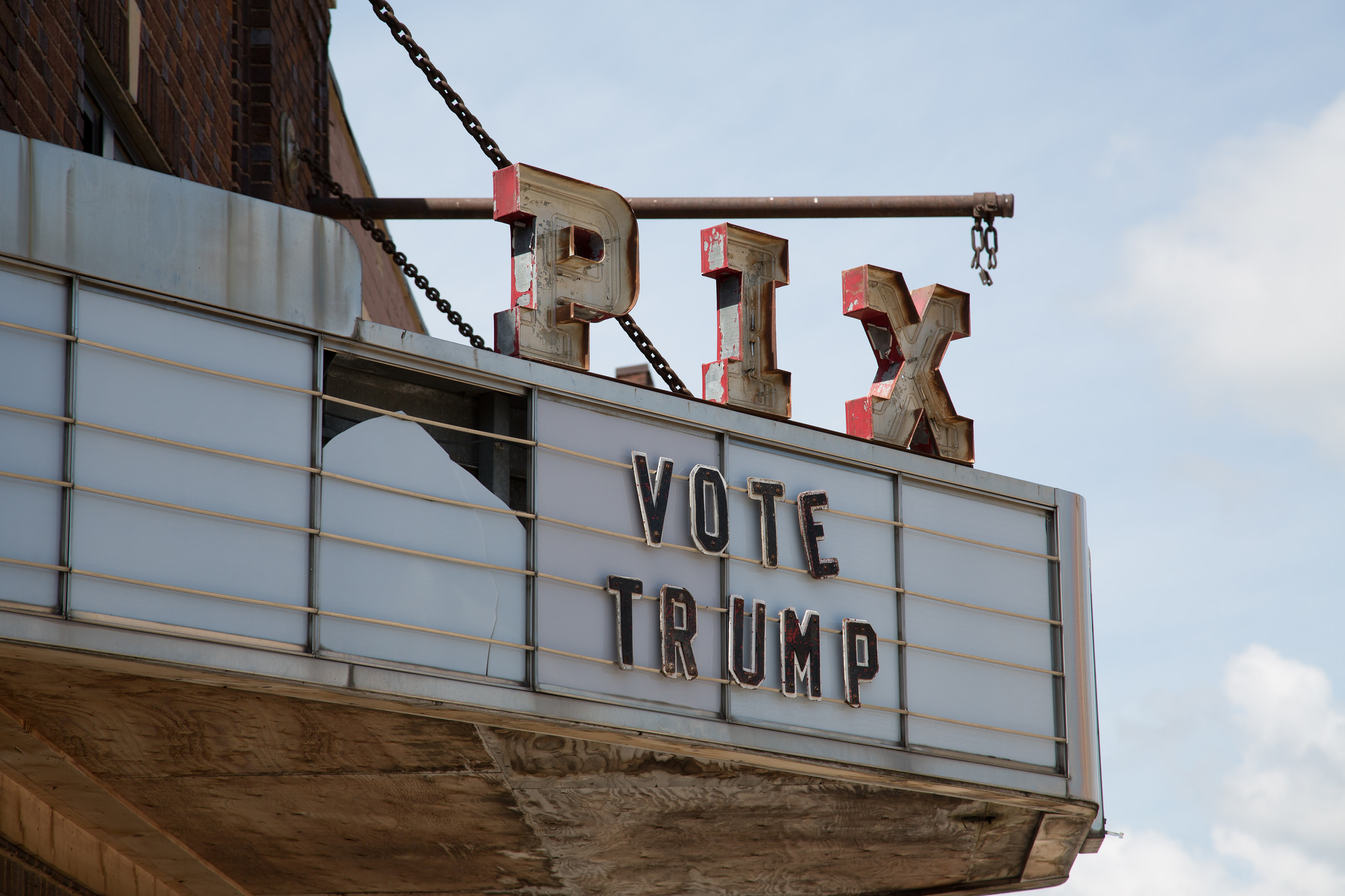
The run-down PIX Theatre sign reads “Vote Trump” on Main Street in Sleepy Eye, Minnesota. July 15, 2016. (Photo by Tony Webster Flickr)
What Bannon has brought to the partnership however, is a clear articulation of the nature of this “crisis” in his Generation Zero film, which explicitly is built around the framework of a book called The Fourth Turning: An American Prophecy, written in 1997 by Neil Howe and William Strauss.
In the words of one of the co-authors, the analysis “rejects the deep premise of modern Western historians that social time is either linear (continuous progress or decline) or chaotic (too complex to reveal any direction). Instead we adopt the insight of nearly all traditional societies: that social time is a recurring cycle in which events become meaningful only to the extent that they are what philosopher Mircea Eliade calls ‘reenactments.’ In cyclical space, once you strip away the extraneous accidents and technology, you are left with only a limited number of social moods, which tend to recur in a fixed order.”
Howe and Strauss write: “The cycle begins with the First Turning, a ‘High’ which comes after a crisis era. In a High, institutions are strong and individualism is weak. Society is confident about where it wants to go collectively, even if many feel stifled by the prevailing conformity.
“The Second Turning is an ‘Awakening,’ when institutions are attacked in the name of higher principles and deeper values. Just when society is hitting its high tide of public progress, people suddenly tire of all the social discipline and want to recapture a sense of personal authenticity.
“The Third Turning is an ‘Unravelling,’ in many ways the opposite of the High. Institutions are weak and distrusted, while individualism is strong and flourishing.
“Finally, the Fourth Turning is a ‘Crisis’ period. This is when our institutional life is reconstructed from the ground up, always in response to a perceived threat to the nation’s very survival. If history does not produce such an urgent threat, Fourth Turning leaders will invariably find one — and may even fabricate one — to mobilize collective action. Civic authority revives, and people and groups begin to pitch in as participants in a larger community. As these Promethean bursts of civic effort reach their resolution, Fourth Turnings refresh and redefine our national identity.” (Emphasis added).
Woodstock Generation
Bannon’s film focuses principally on the causes of the 2008 financial crisis, and on the “ideas” that arose amongst the “Woodstock generation” (the Woodstock musical festival occurred in 1969), that permeated, in one way or another, throughout American and European society.
The Wall Street bull statue by Arturo Di Modica
The narrator calls the Woodstock generation the “Children of Plenty.” It was a point of inflection: a second turning “Awakening”; a discontinuity in culture and values. The older generation (that is, anyone over 30) was viewed as having nothing to say, nor any experience to contribute. It was the elevation of the “pleasure principle” (as a “new” phenomenon, as “their” discovery), over the puritan ethic; It celebrated doing one’s own thing; it was about “Self” and narcissism.
The “Unravelling” followed in the form of government and institutional weakness: the “system” lacked the courage to take difficult decisions. The easy choices invariably were taken: the élites absorbed the self-centered, spoilt-child, ethos of the “me” generation. The 1980s and 1990s become the era of “casino capitalism” and the “Davos man.”
The lavish taxpayer bailouts of the U.S. banks after the Mexican, Russian, Asian and Argentinian defaults and crises washed away the bankers’ costly mistakes. The 2004 Bear Stearns exemption which allowed the big five banks to leverage their lending above 12:1 – and, which quickly extended to become 25:1, 30:1 and even 40:1 – permitted the irresponsible risk-taking and the billions in profit-making. The “Dot Com” bubble was accommodated by monetary policy – and then the massive 2008 bailouts accommodated the banks, yet again.
The “Unravelling” was essentially a cultural failure: a failure of responsibility, of courage to face hard choices – it was, in short, the film suggests, an era of spoilt institutions, compromised politicians and irresponsible Wall Streeters – the incumbent class – indulging themselves, and “abdicating responsibility.”
Now we have entered the “Fourth Turning”: “All the easy choices are back of us.” The “system” still lacks courage. Bannon says this period will be the “nastiest, ugliest in history.” It will be brutal, and “we” (by which he means the Trump Tea Party activists) will be “vilified.” This phase may last 15 – 20 years, he predicts.
Greek Tragedy
The key to this Fourth Turning is “character.” It is about values. What Bannon means by “our crisis” is perhaps best expressed when the narrator says: “the essence of Greek tragedy is that it is not like a traffic accident, where somebody dies [i.e. the great financial crises didn’t just arise by mischance].
President Barack Obama
The Greek sense is that tragedy is where something happens because it has to happen, because of the nature of the participants. Because the people involved, make it happen. And they have no choice to make it happen, because that’s their nature.”
This is the deeper implication of what transpired from Woodstock: the nature of people changed. The “pleasure principle,” the narcissism, had displaced the “higher” values that had made America what it was. The generation that believed that there was “no risk, no mountain they could not climb” brought this crisis upon themselves. They wiped out 200 years of financial responsibility in about 20 years. This, it appears, captures the essence of Bannon’s thinking.
That is where we are, Bannon asserts: Stark winter inevitably follows, after a warm, lazy summer. It becomes a time of testing, of adversity. Each season in nature has its vital function. Fourth turnings are necessary: they a part of the cycle of renewal.
Bannon’s film concludes with author Howe declaring: “history is seasonal and winter is coming,”
And, what is the immediate political message? It is simple, the narrator of Bannon’s film says: “STOP”: stop doing what you were doing. Stop spending like before. Stop taking on spending commitments that cannot be afforded. Stop mortgaging your children’s future with debt. Stop trying to manipulate the banking system. It is a time for tough thinking, for saying “no” to bailouts, for changing the culture, and re-constructing institutional life.
Cultural Legacy
And how do you re-construct civic life? You look to those who still possess a sense of duty and responsibility – who have retained a cultural legacy of values. It is noticeable that when Bannon addresses the activists, almost the first thing he does is to salute the veterans and serving officers, and praise their qualities, their sense of duty.
A sign supporting Donald Trump at a rally at Veterans Memorial Coliseum at the Arizona State Fairgrounds in Phoenix, Arizona. June 18, 2016 (Photo by Gage Skidmore)
It is no surprise then that President Trump wants to increase both the veterans’ and the military’s budget. It is not so much a portent of U.S. military belligerence, but more that he sees them as warriors for the coming “winter” of testing and adversity. Then, and only then does Bannon speak to the “thin blue line” of activists who still have strength of character, a sense of responsibility, of duty. He tells them that the future rests in their hands, alone.
Does this sound like men – Bannon and Trump – who want to ramp up a fresh financial bubble, to indulge the Wall Street casino (in their words)? No? So, what is going on?
They know “the crisis” is coming. Let us recall what Neil Howe wrote in the Washington Post concerning the “Fourth Turning”:
“This is when our institutional life is reconstructed from the ground up, always in response to a perceived threat to the nation’s very survival. If history does not produce such an urgent threat, Fourth Turning leaders will invariably find one — and may even fabricate one — to mobilize collective action. Civic authority revives, and people and groups begin to pitch in as participants in a larger community. As these Promethean bursts of civic effort reach their resolution, Fourth Turnings refresh and redefine our national identity.”
Trump has no need to “fabricate” a financial crisis. It will happen “because it has to happen, because of the nature of the participants (in the current ‘system’). Because the people involved, make it happen. And they have no choice to make it happen, because that’s their nature.”
It is not even President Obama’s or Treasury Secretary Hank Paulson’s fault, per se. They are just who they are.
Trump and Bannon therefore are not likely trying to ignite the “animal spirits” of the players in the financial “casino” (as many in the financial sphere seem to assume). If Bannon’s film and Trump’s articulation of crisis mean anything, it is that their aim is to ignite the “animal spirits” of “the working-class casualties and those forgotten Americans” of the Midwest, Michigan, Indiana, Ohio, Wisconsin and Pennsylvania.
At that point, they hope that the “thin blue line” of activists will “pitch in” with a Promethean burst of civic effort which will reconstruct America’s institutional and economic life.
If this is so, the Trump/Bannon vision both is audacious – and quite an extraordinary gamble …

Was a Trump Server Communicating With Russia?

This spring, a group of computer scientists set out to determine whether hackers were interfering with the Trump campaign. They found something they weren’t expecting.


Go to Original
By 

Read Franklin Foer's follow-up story for new statements from the Trump campaign and Alfa Bank and analysis of the competing theories about the server and its activity.⁠⁠
The greatest miracle of the internet is that it exists—the second greatest is that it persists. Every so often we’re reminded that bad actors wield great skill and have little conscience about the harm they inflict on the world’s digital nervous system. They invent viruses, botnets, and sundry species of malware. There’s good money to be made deflecting these incursions. But a small, tightly knit community of computer scientists who pursue such work—some at cybersecurity firms, some in academia, some with close ties to three-letter federal agencies—is also spurred by a sense of shared idealism and considers itself the benevolent posse that chases off the rogues and rogue states that try to purloin sensitive data and infect the internet with their bugs. “We’re the Union of Concerned Nerds,” in the wry formulation of the Indiana University computer scientist L. Jean Camp.
In late spring, this community of malware hunters placed itself in a high state of alarm. Word arrived that Russian hackers had infiltrated the servers of the Democratic National Committee, an attack persuasively detailed by the respected cybersecurity firm CrowdStrike. The computer scientists posited a logical hypothesis, which they set out to rigorously test: If the Russians were worming their way into the DNC, they might very well be attacking other entities central to the presidential campaign, including Donald Trump’s many servers. “We wanted to help defend both campaigns, because we wanted to preserve the integrity of the election,” says one of the academics, who works at a university that asked him not to speak with reporters because of the sensitive nature of his work.
Hunting for malware requires highly specialized knowledge of the intricacies of the domain name system—the protocol that allows us to type email addresses and website names to initiate communication. DNS enables our words to set in motion a chain of connections between servers, which in turn delivers the results we desire. Before a mail server can deliver a message to another mail server, it has to look up its IP address using the DNS. Computer scientists have built a set of massive DNS databases, which provide fragmentary histories of communications flows, in part to create an archive of malware: a kind of catalog of the tricks bad actors have tried to pull, which often involve masquerading as legitimate actors. These databases can give a useful, though far from comprehensive, snapshot of traffic across the internet. Some of the most trusted DNS specialists—an elite group of malware hunters, who work for private contractors—have access to nearly comprehensive logs of communication between servers. They work in close concert with internet service providers, the networks through which most of us connect to the internet, and the ones that are most vulnerable to massive attacks. To extend the traffic metaphor, these scientists have cameras posted on the internet’s stoplights and overpasses. They are entrusted with something close to a complete record of all the servers of the world connecting with one another.
In late July, one of these scientists—who asked to be referred to as Tea Leaves, a pseudonym that would protect his relationship with the networks and banks that employ him to sift their data—found what looked like malware emanating from Russia. The destination domain had Trump in its name, which of course attracted Tea Leaves’ attention. But his discovery of the data was pure happenstance—a surprising needle in a large haystack of DNS lookups on his screen. “I have an outlier here that connects to Russia in a strange way,” he wrote in his notes. He couldn’t quite figure it out at first. But what he saw was a bank in Moscow that kept irregularly pinging a server registered to the Trump Organization on Fifth Avenue.
More data was needed, so he began carefully keeping logs of the Trump server’s DNS activity. As he collected the logs, he would circulate them in periodic batches to colleagues in the cybersecurity world. Six of them began scrutinizing them for clues.
(I communicated extensively with Tea Leaves and two of his closest collaborators, who also spoke with me on the condition of anonymity, since they work for firms trusted by corporations and law enforcement to analyze sensitive data. They persuasively demonstrated some of their analytical methods to me—and showed me two white papers, which they had circulated so that colleagues could check their analysis. I also spoke with academics who vouched for Tea Leaves’ integrity and his unusual access to information. “This is someone I know well and is very well-known in the networking community,” said Camp. “When they say something about DNS, you believe them. This person has technical authority and access to data.”)
The researchers quickly dismissed their initial fear that the logs represented a malware attack. The communication wasn’t the work of bots. The irregular pattern of server lookups actually resembled the pattern of human conversation—conversations that began during office hours in New York and continued during office hours in Moscow. It dawned on the researchers that this wasn’t an attack, but a sustained relationship between a server registered to the Trump Organization and two servers registered to an entity called Alfa Bank.
The researchers had initially stumbled in their diagnosis because of the odd configuration of Trump’s server. “I’ve never seen a server set up like that,” says Christopher Davis, who runs the cybersecurity firm HYAS InfoSec Inc. and won a FBI Director Award for Excellence for his work tracking down the authors of one of the world’s nastiest botnet attacks. “It looked weird, and it didn’t pass the sniff test.” The server was first registered to Trump’s business in 2009 and was set up to run consumer marketing campaigns. It had a history of sending mass emails on behalf of Trump-branded properties and products. Researchers were ultimately convinced that the server indeed belonged to Trump. (Click here to see the server’s registration record.) But now this capacious server handled a strangely small load of traffic, such a small load that it would be hard for a company to justify the expense and trouble it would take to maintain it. “I get more mail in a day than the server handled,” Davis says.
That wasn’t the only oddity. When the researchers pinged the server, they received error messages. They concluded that the server was set to accept only incoming communication from a very small handful of IP addresses. A small portion of the logs showed communication with a server belonging to Michigan-based Spectrum Health. (The company said in a statement: “Spectrum Health does not have a relationship with Alfa Bank or any of the Trump organizations. We have concluded a rigorous investigation with both our internal IT security specialists and expert cyber security firms. Our experts have conducted a detailed analysis of the alleged internet traffic and did not find any evidence that it included any actual communications (no emails, chat, text, etc.) between Spectrum Health and Alfa Bank or any of the Trump organizations. While we did find a small number of incoming spam marketing emails, they originated from a digital marketing company, Cendyn, advertising Trump Hotels.”)
Spectrum accounted for a relatively trivial portion of the traffic. Eighty-seven percent of the DNS lookups involved the two Alfa Bank servers. “It’s pretty clear that it’s not an open mail server,” Camp told me. “These organizations are communicating in a way designed to block other people out.”
Earlier this month, the group of computer scientists passed the logs to Paul Vixie. In the world of DNS experts, there’s no higher authority. Vixie wrote central strands of the DNS code that makes the internet work. After studying the logs, he concluded, “The parties were communicating in a secretive fashion. The operative word is secretive. This is more akin to what criminal syndicates do if they are putting together a project.” Put differently, the logs suggested that Trump and Alfa had configured something like a digital hotline connecting the two entities, shutting out the rest of the world, and designed to obscure its own existence. Over the summer, the scientists observed the communications trail from a distance.
* * *
While the researchers went about their work, the conventional wisdom about Russian interference in the campaign began to shift. There were reports that the Trump campaign had ordered the Republican Party to rewrite its platform position on Ukraine, maneuvering the GOP toward a policy preferred by Russia, though the Trump campaign denied having a hand in the change. Then Trump announced in an interview with the New York Times his unwillingness to spring to the defense of NATO allies in the face of a Russian invasion. Trump even invited Russian hackers to go hunting for Clinton’s emails, then passed the comment off as a joke. (I wrote about Trump’s relationship with Russia in early July.)
In the face of accusations that he is somehow backed by Putin or in business with Russian investors, Trump has issued categorical statements. “I mean I have nothing to do with Russia,” he told one reporter, a flat denial that he repeated over and over. Of course, it’s possible that these statements are sincere and even correct. The sweeping nature of Trump’s claim, however, prodded the scientists to dig deeper. They were increasingly confident that they were observing data that contradicted Trump’s claims.
In the parlance that has become familiar since the Edward Snowden revelations, the DNS logs reside in the realm of metadata. We can see a trail of transmissions, but we can’t see the actual substance of the communications. And we can’t even say with complete certitude that the servers exchanged email. One scientist, who wasn’t involved in the effort to compile and analyze the logs, ticked off a list of other possibilities: an errant piece of spam caroming between servers, a misdirected email that kept trying to reach its destination, which created the impression of sustained communication. “I’m seeing a preponderance of the evidence, but not a smoking gun,” he said. Richard Clayton, a cybersecurity researcher at Cambridge University who was sent one of the white papers laying out the evidence, acknowledges those objections and the alternative theories but considers them improbable. “I think mail is more likely, because it’s going to a machine running a mail server and [the host] is called mail. Dr. Occam says you should rule out mail before pulling out the more exotic explanations.” After Tea Leaves posted his analysis on Reddit, a security blogger who goes by Krypt3ia expressed initial doubts—but his analysis was tarnished by several incorrect assumptions, and as he examined the matter, his skepticism of Tea Leaves softened somewhat.
I put the question of what kind of activity the logs recorded to the University of California’s Nicholas Weaver, another computer scientist not involved in compiling the logs. “I can't attest to the logs themselves,” he told me, “but assuming they are legitimate they do indicate effectively human-level communication.”
Weaver’s statement raises another uncertainty: Are the logs authentic? Computer scientists are careful about vouching for evidence that emerges from unknown sources—especially since the logs were pasted in a text file, where they could conceivably have been edited. I asked nine computer scientists—some who agreed to speak on the record, some who asked for anonymity—if the DNS logs that Tea Leaves and his collaborators discovered could be forged or manipulated. They considered it nearly impossible. It would be easy enough to fake one or maybe even a dozen records of DNS lookups. But in the aggregate, the logs contained thousands of records, with nuances and patterns that not even the most skilled programmers would be able to recreate on this scale. “The data has got the right kind of fuzz growing on it,” Vixie told me. “It’s the interpacket gap, the spacing between the conversations, the total volume. If you look at those time stamps, they are not simulated. This bears every indication that it was collected from a live link.” I asked him if there was a chance that he was wrong about their authenticity. “This passes the reasonable person test,” he told me. “No reasonable person would come to the conclusion other than the one I’ve come to.” Others were equally emphatic. “It would be really, really hard to fake these,” Davis said. According to Camp, “When the technical community examined the data, the conclusion was pretty obvious.”
It’s possible to impute political motives to the computer scientists, some of whom have criticized Trump on social media. But many of the scientists who talked to me for this story are Republicans. And almost all have strong incentives for steering clear of controversy. Some work at public institutions, where they are vulnerable to political pressure. Others work for firms that rely on government contracts—a relationship that tends to squash positions that could be misinterpreted as outspoken.
* * *
The researchers were seeing patterns in the data—and the Trump Organization’s potential interlocutor was itself suggestive. Alfa Bank emerged in the messy post-Soviet scramble to create a private Russian economy. Its founder was a Ukrainian called Mikhail Fridman. He erected his empire in a frenetic rush—in a matter of years, he rose from operating a window washing company to the purchase of the Bolshevik Biscuit Factory to the co-founding of his bank with some friends from university. Fridman could be charmingly open when describing this era. In 2003, he told the Financial Times, “Of course we benefitted from events in the country over the past 10 years. Of course we understand that the distribution of state property was not very objective. … I don’t want to lie and play this game. To say one can be completely clean and transparent is not realistic.”
To build out the bank, Fridman recruited a skilled economist and shrewd operator called Pyotr Aven. In the early ’90s, Aven worked with Vladimir Putin in the St. Petersburg government—and according to several accounts, helped Putin wiggle out of accusations of corruption that might have derailed his ascent. (Karen Dawisha recounts this history in her book Putin’s Kleptocracy.) Over time, Alfa built one of the world’s most lucrative enterprises. Fridman became the second richest man in Russia, valued by Forbes at $15.3 billion.
Alfa’s oligarchs occupied an unusual position in Putin’s firmament. They were insiders but not in the closest ring of power. “It’s like they were his judo pals,” one former U.S. government official who knows Fridman told me. “They were always worried about where they stood in the pecking order and always feared expropriation.” Fridman and Aven, however, are adept at staying close to power. As the U.S. District Court for the District of Columbia once ruled, in the course of dismissing a libel suit the bankers filed, “Aven and Fridman have assumed an unforeseen level of prominence and influence in the economic and political affairs of their nation.”
Unlike other Russian firms, Alfa has operated smoothly and effortlessly in the West. It has never been slapped with sanctions. Fridman and Aven have cultivated a reputation as beneficent philanthropists. They endowed a prestigious fellowship. The Woodrow Wilson International Center for Scholars, the American-government funded think tank, gave Aven its award for “Corporate Citizenship” in 2015. To protect its interests in Washington, Alfa hired as its lobbyist former Reagan administration official Ed Rogers. Richard Burt, who helped Trump write the speech in which he first laid out his foreign policy, previously served on Alfa’s senior advisory board.* The branding campaign has worked well. During the first Obama term, Fridman and Aven met with officials in the White House on two occasions, according to visitor logs.
Fridman and Aven have significant business interests to promote in the West. One of their holding companies, LetterOne, has vowed to invest as much as $3 billion in U.S. health care. This year, it sank $200 million into Uber. This is, of course, money that might otherwise be invested in Russia. According to a former U.S. official, Putin tolerates this condition because Alfa advances Russian interests. It promotes itself as an avatar of Russian prowess. “It’s our moral duty to become a global player, to prove a Russian can transform into an international businessman,” Fridman told the Financial Times.
* * *
Tea Leaves and his colleagues plotted the data from the logs on a timeline. What it illustrated was suggestive: The conversation between the Trump and Alfa servers appeared to follow the contours of political happenings in the United States. “At election-related moments, the traffic peaked,” according to Camp. There were considerably more DNS lookups, for instance, during the two conventions.
In September, the scientists tried to get the public to pay attention to their data. One of them posted a link to the logs in a Reddit thread. Around the same time, the New York Times’ Eric Lichtblau and Steven Lee Myers began chasing the story.* (They are still pursuing it.) Lichtblau met with a Washington representative of Alfa Bank on Sept. 21, and the bank denied having any connection to Trump. (Lichtblau told me that Times policy prevents him from commenting on his reporting.)
The Times hadn’t yet been in touch with the Trump campaign—Lichtblau spoke with the campaign a week later—but shortly after it reached out to Alfa, the Trump domain name in question seemed to suddenly stop working. When the scientists looked up the host, the DNS server returned a fail message, evidence that it no longer functioned. Or as it is technically diagnosed, it had “SERVFAILed.” (On the timeline above, this is the moment at the end of the chronology when the traffic abruptly spikes, as servers frantically attempt to resend rejected messages.) The computer scientists believe there was one logical conclusion to be drawn: The Trump Organization shut down the server after Alfa was told that the Times might expose the connection. Weaver told me the Trump domain was “very sloppily removed.” Or as another of the researchers put it, it looked like “the knee was hit in Moscow, the leg kicked in New York.”
Four days later, on Sept. 27, the Trump Organization created a new host name, trump1.contact-client.com, which enabled communication to the very same server via a different route. When a new host name is created, the first communication with it is never random. To reach the server after the resetting of the host name, the sender of the first inbound mail has to first learn of the name somehow. It’s simply impossible to randomly reach a renamed server. “That party had to have some kind of outbound message through SMS, phone, or some noninternet channel they used to communicate [the new configuration],” Paul Vixie told me. The first attempt to look up the revised host name came from Alfa Bank. “If this was a public server, we would have seen other traces,” Vixie says. “The only look-ups came from this particular source.”
According to Vixie and others, the new host name may have represented an attempt to establish a new channel of communication. But media inquiries into the nature of Trump’s relationship with Alfa Bank, which suggested that their communications were being monitored, may have deterred the parties from using it. Soon after the New York Times began to ask questions, the traffic between the servers stopped cold.
* * *
Last week, I wrote to Alfa Bank asking if it could explain why its servers attempted to connect with the Trump Organization on such a regular basis. Its Washington representative, Jeffrey Birnbaum of the public relations firm BGR, provided me the following response:
Alfa hired Mandiant, one of the world's foremost cyber security experts, to investigate and it has found nothing to the allegations. I hope the below answers respond clearly to your questions. Neither Alfa Bank nor its principals, including Mikhail Fridman and Petr Aven, have or have had any contact with Mr. Trump or his organizations. Fridman and Aven have never met Mr. Trump nor have they or Alfa Bank had any business dealings with him. Neither Alfa nor its officers have sent Mr. Trump or his organizations any emails, information or money. Alfa Bank does not have and has never had any special or exclusive internet connection with Mr. Trump or his entities. The assertion of a special or private link is patently false.
I asked Birnbaum if he would connect me with Mandiant to elaborate on its findings. He told me:
Mandiant is still doing its deep dive into the Alfa Bank systems. Its leading theory is that Alfa Bank's servers may have been responding with common DNS look ups to spam sent to it by a marketing server. But it doesn't want to speak on the record until it's finished its investigation.
It’s hard to evaluate the findings of an investigation that hasn’t ended. And of course, even the most reputable firm in the world isn’t likely to loudly broadcast an opinion that bites the hand of its client.
I posed the same basic questions to the Trump campaign. Trump spokeswoman Hope Hicks sent me this in response to my questions by email:
The email server, set up for marketing purposes and operated by a third-party, has not been used since 2010.  The current traffic on the server from Alphabank's [sic] IP address is regular DNS server traffic—not email traffic.  To be clear, The Trump Organization is not sending or receiving any communications from this email server. The Trump Organization has no communication or relationship with this entity or any Russian entity.
I asked Hicks to explain what caused the Trump Organization to rename its host after the New York Times called Alfa. I also asked how the Trump Organization arrived at its judgment that there was no email traffic. (Furthermore, there’s no such thing as “regular” DNS server traffic, at least not according to the computer scientists I consulted. The very reason DNS exists is to enable email and other means of communication.) She never provided me with a response.
What the scientists amassed wasn’t a smoking gun. It’s a suggestive body of evidence that doesn’t absolutely preclude alternative explanations. But this evidence arrives in the broader context of the campaign and everything else that has come to light: The efforts of Donald Trump’s former campaign manager to bring Ukraine into Vladimir Putin’s orbit; the other Trump adviser whose communications with senior Russian officials have worried intelligence officials; the Russian hacking of the DNC and John Podesta’s email.
We don’t yet know what this server was for, but it deserves further explanation.

Assange: WikiLeaks Will Give Tech Firms Leaked Docs to Fight CIA 'Cyberweapons'

Companies will get 'some exclusive access...so that the fixes can be developed and pushed out, so people can be secure'

Go to Original
by

WikiLeaks will give technology companies exclusive access to alleged CIA documents to help them repair security flaws that allowed the government to spy on individuals through their smart devices, the organization's founder Julian Assange said Thursday.

"Considering what we think is the best way to proceed and hearing these calls from some of the manufacturers, we have decided to work with them to give them some exclusive access to the additional technical details that we have so that the fixes can be developed and pushed out, so people can be secure," Assange said in a Facebook live address from the Ecuadorian embassy in London, where he has lived in exile since 2012.


WikiLeaks on Tuesday released a trove of documents purporting to show that the CIA exploited security flaws in mobile phones, smart TVs, and other devices that allowed the intelligence agency to listen in on users in their own homes. But the documents did not disclose what those flaws actually were—instead showing user guides, developer manuals, and other communications.

The group said it held back publishing that information to "[avoid] the distribution of 'armed' cyberweapons" until there was a "consensus" on how to dismantle them.
Once they have been disarmed, WikiLeaks would post the code publicly, Assange said.

CIA spokesman Dean Boyd responded to Assange's comments by stating that he was "not exactly a bastion of truth and integrity."

WikiLeaks fired back, "but he literally won the award for just that," referring to the 2010 honor Assange received from the Sam Adams Associates for Integrity in Intelligence, an organization founded by retired CIA officers that recognizes intelligence whistleblowers.

During the press conference, Assange again reiterated the group's claim that the documents show the CIA has lost its grip on its vast surveillance enterprise.
"The Central Intelligence Agency lost control of its entire cyberweapons arsenal," Assange said. "This is an historic act of devastating incompetence to have created such an arsenal and stored it all in one place and not secured it."

'You Have More Support Than You Know': Native Nations Will Rise in DC and Nationwide

"This fight against the Dakota Access pipeline has sparked a powerful global movement," says Dallas Goldtooth

Go to Original
by

An interfaith celebration and prayer service is taking place Thursday evening ahead of Friday's Native Nations Rise march and rally in Washington, D.C.

The service at Washington National Cathedral will include members of the Standing Rock Sioux tribe, the Indigenous Environmental Network (IEN), and tribal nations from across the United States, as well as clergy and lay leaders from the Episcopal Church and various denominations.

Friday's demonstration, meanwhile, is expected to draw thousands. The march will depart from the Army Corps of Engineers office and end with a rally in front of the White House in Lafayette Park. Solidarity events are happening nationwide. As Common Dreams reported, native communities and their allies have been in the nation's capital since Tuesday, participating in lobby days and workshops. 

Veterans for Peace is among the allied groups whose members are traveling to participate in the march and rally, declaring in a statement on Thursday: "We continue to stand in solidarity with the resistance at Standing Rock. As veterans, we see the connections between greed, racism, violence, and environmental destruction in our own communities, and war and militarism abroad."

Also Thursday, tribal representatives met with Sen. Bernie Sanders (I-Vt.), who was a vocal supporter during the fight to stop the Dakota Access pipeline (DAPL)—the battle that sparked Friday's day of action. Despite widespread outcry, President Donald Trump issued an executive order upon taking office advancing construction of the 1,172-mile oil pipeline. Indigenous activists and environmentalists predict further expansion of fossil fuel infrastructure under the oil-soaked Trump administration. 
But they have vowed to fight back.

"You have more support than you know," Sanders reportedly told the group, citing the significant response his social media page receives on posts covering Native American issues. "Your job, my job, is to bring those people together to say to Trump and his corporate friends, he can't do this. But we need to a strategy to do that."
Indigenous Rising Media provided video of the meeting:


"This fight against the Dakota Access pipeline has sparked a powerful global movement calling for Donald Trump, Congress, and the U.S. government as a whole to respect Indigenous nations and people in our right to water, land, sovereignty, and culture," Dallas Goldtooth of IEN said ahead of the demonstration. "Indigenous people are not here to be your sacrifice zone for fossil fuel projects. Water is life—so in attacking our water Donald Trump is attacking our lives, families, and right to self-determination."

DEATH IN AL GHAYIL

Women and Children in Yemeni Village Recall Horror of Trump’s “Highly Successful” SEAL Raid

Go to Original
By 

ON JANUARY 29, 5-year-old Sinan al Ameri was asleep with his mother, his aunt, and 12 other children in a one-room stone hut typical of poor rural villages in the highlands of Yemen. A little after 1 a.m., the women and children awoke to the sound of a gunfight erupting a few hundred feet away. Roughly 30 members of Navy SEAL Team 6 were storming the eastern hillside of the remote settlement.
According to residents of the village of al Ghayil, in Yemen’s al Bayda province, the first to die in the assault was 13-year-old Nasser al Dhahab. The house of his uncle, Sheikh Abdulraouf al Dhahab, and the building behind it, the home of 65-year-old Abdallah al Ameri and his son Mohammed al Ameri, 38, appeared to be the targets of the U.S. forces, who called in air support as they were pinned down in a nearly hourlong firefight.
With the SEALs taking heavy fire on the lower slopes, attack helicopters swept over the hillside hamlet above. In what seemed to be blind panic, the gunships bombarded the entire village, striking more than a dozen buildings, razing stone dwellings where families slept, and wiping out more than 120 goats, sheep, and donkeys.
Three projectiles tore through the straw and timber roof of the home where Sinan slept. Cowering in a corner, Sinan’s mother, 30-year-old Fatim Saleh Mohsen, decided to flee the bombardment. Grabbing her 18-month-old son and ushering her terrified children into the narrow outdoor passageway between the tightly packed dwellings, she headed into the open. Over a week later, Sinan’s aunt Nadr al Ameri wept as she stood in the same room and recalled watching her sister run out the door into the darkness.
Nesma al Ameri, an elderly village matriarch who lost four family members in the raid, described how the attack helicopters began firing down on anything that moved. As she recounted the horror of what happened, Sinan tapped her on the arm. “No, no. The bullets were coming from behind,” the 5-year-old insisted, interrupting to demonstrate how he was shot at and his mother gunned down as they ran for their lives. “From here to here,” Sinan said, putting two fingers to the back of his head and drawing an invisible line to illustrate the direction of the bullet exiting her forehead. His mother fell to the ground next to him, still clutching his baby brother in her arms. Sinan kept running.
His mother’s body was found in the early light of dawn, the front of her head split open. The baby was wounded but alive. Sinan’s mother was one of at least six women killed in the raid, the first counterterrorism operation of the Trump administration, which also left 10 children under the age of 13 dead. “She was hit by the plane. The American plane,” explained Sinan. “She’s in heaven now,” he added with a shy smile, seemingly unaware of the enormity of what he had witnessed or, as yet, the impact of his loss. “Dog Trump,” declared Nesma, turning to the other women in the room for agreement. “Yes, the dog Trump,” they agreed.
According to White House press secretary Sean Spicer, the al Ghayil raid “was a very, very well thought out and executed effort,” planning for which began under the Obama administration back in November 2016. Although Ned Price, former National Security Council spokesperson, and Colin Kahl, the national security adviser under Vice President Biden, challenged Spicer’s account, what is agreed upon is that Trump gave the final green light over dinner at the White House on January 25. According to two people with direct knowledge, the White House did not notify the U.S. ambassador to Yemen in advance of the operation.

The Intercept’s reporting from al Ghayil in the aftermath of the raid and the eyewitness accounts provided by residents, as well as information from current and former military officials, challenge many of the Trump administration’s key claims about the “highly successful” operation, from the description of an assault on a fortified compound — there are no compounds or walled-off houses in the village — to the “large amounts of vital intelligence” the president said were collected.
According to a current U.S. special operations adviser and a former senior special operations officer, it was not intelligence the Pentagon was after but a key member of al Qaeda. The raid was launched in an effort to capture or kill Qassim al Rimi, the leader of al Qaeda in the Arabian Peninsula, according to the special operations adviser, who asked to remain anonymous because details behind the raid are classified.
Villagers interviewed by The Intercept rejected claims that al Rimi was present in al Ghayil, although one resident described seeing an unfamiliar black SUV arriving in the village hours before the raid. Six days after the operation, AQAP media channels released an audio statement from al Rimi, who mocked President Trump and the raid. The White House and the military have denied that the AQAP leader was the target of the mission, insisting the SEALs were sent in to capture electronic devices and material to be used for intelligence gathering. A spokesperson for CENTCOM told The Intercept the military has not yet determined whether al Rimi was in al Ghayil when the SEALs arrived.
Although some details about the mission remain unclear, the account that has emerged suggests the Trump White House is breaking with Obama administration policies that were intended to limit civilian casualties. The change — if permanent — would increase the likelihood of civilian deaths in so-called capture or kill missions like the January 29 raid.

THE JANUARY MISSION was the fourth time U.S. forces have been involved in ground operations in Yemen. While none of those prior raids could be deemed successful — two were failed attempts to free an American hostage, photojournalist Luke Somers — they did not leave the same trail of destruction as the operation in al Ghayil.
The village is part of a cluster of settlements known as Yakla in the Qayfa tribal region of Yemen’s al Bayda province. A basic knowledge of the local political environment, combined with a grasp of the obvious challenges posed by the geographical layout of al Ghayil, would have provided substantial forewarning that this latest raid was a highly precarious undertaking. American military planners should have foreseen that their forces would face not only al Qaeda militants, but also heavy armed resistance from residents of al Ghayil and surrounding villages.
This area of al Bayda has been at war for more than 2 1/2 years, and the Qayfa tribe is renowned for its fighting prowess and a long-standing refusal to yield to the state. After the joint forces of Yemen’s northern Houthi rebels and military loyalists of the country’s former president, Ali Abdullah Saleh, seized control of the capital, Sana, in September 2014, they swiftly moved southeast into al Bayda. Most of the Qayfa tribe, including the men of Yakla, have been fighting the Houthi-Saleh forces ever since. Saudi Arabia joined the fray in March 2015, leading a coalition of nations in a military intervention and aerial bombing campaign, supported by the U.S., to push back the Houthis, who the Saudis view as an Iranian proxy force. In theory, the residents of al Ghayil are on the same side as the United States in a civil war that has left more than 3 million people displaced and brought the country to the edge of famine.
Al Ghayil, just a few miles from Houthi-Saleh-controlled territory, came under Houthi rocket fire more than once in the early weeks of 2017, leaving the area of Yakla on high alert for attacks and residents in constant fear of losing their homes to a Houthi-Saleh incursion. The closest town, Rada — home to the nearest hospital — had been a no-go area for the population of Yakla since it fell under Houthi-Saleh control in October 2014.
When the U.S. Navy SEALs flew into al Ghayil in the early hours of January 29 — a deliberately chosen moonless night — local armed tribesmen assumed the Houthis had arrived to capture their village. After the firefight started, some of the men who ran to defend their families and homes saw colored lasers emanating from the weapons of their opponents, raising suspicions they might be facing Americans.
Shortly after the firefight erupted, Chief Petty Officer William “Ryan” Owens was shot by a bullet that hit just above his armored chest plate and entered his heart, according to the former senior special operations official briefed on the raid. Owens died shortly after he was hit.
Further confusion set in when the attack helicopters joined the assault. Knowing the Houthi-Saleh forces do not have an air force, residents could only assume it was the Saudi-led coalition attacking them from the air. They were not entirely wrong. Troops from the United Arab Emirates — leading players in the coalition’s two-year fight against the Houthis — also took part in the raid and might have been involved in flying the helicopters that fired on civilians. Dozens of UAE Apache gunships are currently stationed in Emirati-run military bases across Yemen.
The UAE government did not respond to multiple requests for comment on its role in the raid or answer queries regarding any casualties among its personnel.
According to the former senior U.S. special operations official and a current military consultant, both of whom were briefed on the raid, the SEALs discovered by the time they arrived in the village that their operation had been compromised. It is still unclear how those on the ground were tipped off, but a current consultant to the Joint Special Operations Command, which oversees SEAL Team 6, said the command is investigating whether UAE forces involved in the raid revealed the details of the mission before the SEALs arrived in al Ghayil. (However, local residents, who are used to hearing the buzz of drones in the remote area, said they noticed the unusual presence of helicopters around 9 p.m. the night before the raid, which raised concern.)
Some men in the surrounding villages grabbed their weapons and ran to help defend their neighbors when they heard the sound of a battle unfolding, according to residents. Mohammed Ali al Taysi, from the nearby village of Husun at Tuyus, dashed to his battered SUV, tearing down a dry riverbed in the dark to reach al Ghayil from the north. But just short of the village, a helicopter flew low overhead, pounding warning shots into the ground on either side of his vehicle. Al Taysi jumped out, firing his rifle toward the Apache before retreating into the night. Other armed men closer to the village descended from the mountainside on foot to support the tribesmen of al Ghayil, who already held the advantage of the high ground on the western side of the village. The SEALs had come in from the low ground to the north, approaching the homes of Abdulraouf al Dhahab and Mohammed al Ameri from the eastern slopes below.
According to those present, the firefight quickly escalated around the al Dhahab house, halting the SEALs’ advance. As the U.S. forces fought from the lower ground and more men descended the mountainside to join the shootout, airstrikes obliterated Mohammed al Ameri’s house on the hill above, killing three of his children, ages 7, 5, and 4, and seemingly destroying any possibility of retrieving laptops, hard drives, or other intelligence material from inside without digging through piles of rubble in the dark.
With one Navy SEAL dead and two others seriously wounded, the special operations forces began to withdraw. But before they departed, according to local witnesses, the MV-22 Osprey used to extract the retreating soldiers crash-landed, forcing another aircraft to land to pull out the operators. Airstrikes then deliberately destroyed the abandoned Osprey.
The gunfight had lasted the better part of an hour. It would be another hour or more before the skies fell silent and the sound of helicopters, aircraft, and drones faded. It was in the dawn light that the mass of bodies was revealed, the missing accounted for, and dead children identified. Smoke swirled into the air from the roofs still burning and the carcass of the smoldering Osprey in the distance.

THIS WAS NOT the first time residents of the remote Yakla area had lost family members to a U.S. attack. In December 2013, a drone strike on a wedding convoy killed 12 civilians. The groom, Abdallah al Ameri, survived that attack. But on January 29, the 65-year-old was killed standing unarmed beside his house as it was bombed. A picture posted online shortly after the raid showed his body lying in the rocky sand with his hand clasped around a blood-soaked head torch.
The aftermath of the raid’s destruction left villagers struggling to understand what the Americans were trying to accomplish. Abdulraouf, whose house appeared to be one of the targets, was no stranger to American attempts to kill him. He was the apparent target of at least three separate airstrikes between 2011 and 2013 in al Bayda province, including one in September 2012 that killed 12 civilians — a pregnant woman and three children were among the dead.
Following the deaths, Abdulraouf called on the families of victims to hire international lawyers to take their cases to court in the United States. Two of Abdulraouf’s brothers were also killed by American drone strikes as the U.S. was drawn into a long-running bloody feud that had split the family of some 18 brothers between those aligned with al Qaeda and those who stood with the state.
Although Abdulelah al Dhahab, a brother who survived the January raid but lost his 12-year-old son, denied Abdulraouf was an al Qaeda member, the bonds between the family and Yemen’s al Qaeda insurgency also extend to marital ties. Al Qaeda propagandist and American citizen Anwar al Awlaki married Abdularouf’s sister. Awlaki’s 8-year-old daughter, Nawar, was in the al Dhahab house the night of the raid. She bled to death after being shot in the neck — the second of Awlaki’s children to be killed by the United States since his own death by an American drone strike in September 2011. His eldest son, 16-year-old Denver-born Abdulrahman, was killed by a U.S. drone two weeks after his father.
Following the onset of civil war in March 2015, Abdulraouf played a key role in leading the self-described “resistance” of local armed militias loyal to the Saudi-led coalition, fighting on the pro-government side of Yemen’s internationally recognized president-in-exile, Abdu Rabbu Mansour Hadi. As a senior Qayfa tribal figure, Abdulraouf was a well-respected resistance leader. The day before the January raid, he was handing out salaries for pro-government fighters after collecting the money from the nearest Saudi coalition base in the neighboring province of Marib.
Although U.S. drone strikes killed a succession of leading AQAP figures in the first six months of 2015, drone, air, and sea-to-land bombings over the preceding 15 years were plagued by poor intelligence and numerous civilian casualties. Survivors of the al Ghayil operation were left to speculate what intelligence led American special operations forces to storm their village “as if they were coming to kill Osama bin Laden,” as one resident noted, puzzling over whether the U.S. thought it was going after the leader of the Islamic State rather than an apparent low-level al Qaeda militant of the same name, Abubakr al Baghdadi, who was killed in the raid. “Or the Americans were tricked into killing Abdulraouf, the leading fighter in Qayfa, to help the Houthis and Saleh,” hypothesized one anti-Houthi tribal fighter.
On at least one occasion in Yemen, the U.S. was deliberately fed false intelligence by the regime of then-President Saleh. In May 2010, it resulted in the erroneous killing of the deputy governor of Marib in a drone strike. As one anonymous American official was later quoted as saying, “We think we got played.”
Though the planning for the Yakla operation began many months ago, Abdulraouf’s house in al Ghayil was built recently. The modern cinder-block walls and PVC windows stood out among the simple stone huts dominating the rest of the village. The tribal leader had been living in a tent on the rocky hillside after being run out of the al Dhahab family homestead in the village of al Manasa by Houthi-Saleh forces in the fall of 2014.
One resident, who asked not to be identified for fear of reprisals, stated that Mohammed al Ameri’s home was used as a guest house by passing al Qaeda militants — aggressive men whom the rest of the villagers avoided. To get to Mohammed’s house, the SEALs had to pass the al Dhahab home, where Abdulraouf, his brother Sultan, and their guests were holding a late-night gathering with another tribal leader, octogenarian Saif Mohammed al Jawfi, who also died in the raid. The witness claimed the meeting in al Dhahab’s house was held to resolve an issue regarding one of Saif’s relatives who had been arrested by militants connected to the guest house, as well as to arrange the distribution of the U.S.-backed Saudi coalition cash payments to anti-Houthi resistance fighters.
Those in the village speculated about the exact target of the January 29 raid. Was the house of Abdulraouf and the tent beside it the objective? Did the U.S. military believe that Qassim al Rimi, the AQAP leader, was inside the house? Or was it the next building on the hillside above, the home of Mohammed al Ameri, the Navy SEALs were aiming for? Others ventured that a woman, Arwa al Baghdadi, might have been the focus.
Arwa al Baghdadi, according to her own social media postings, was imprisoned in 2010 and tortured by authorities in Saudi Arabia after her brother was shot dead by security forces. She was later used as an apparent bargaining chip in the 2015 release of a Saudi diplomat who had been kidnapped by AQAP in Aden three years earlier (Saudi officials say there was no connection). Arwa al Baghdadi, who fled to Yemen after her release from prison, was killed in the raid along with her son Osama, and another brother, Abubakr al Baghdadi. Her pregnant sister-in-law was shot in the stomach. The unborn infant, grazed by the bullet fired into his mother’s stomach, died following an emergency caesarean section at the 26 September hospital, a five-hour drive away in the neighboring province of Marib.
Many of al Ghayil’s residents denied any presence of al Qaeda militants in the village that night. Al Rimi’s statement after the raid offered condolences to the families of those killed, and along with AQAP propaganda channels, listed 14 men among the dead, although al Rimi stopped short of calling them AQAP members. (Eight of those names were not included in the toll of the dead that villagers provided to The Intercept, as they were not known to local residents. Family members disputed claims the remaining six men were members of AQAP.)
In the current context of Yemen’s civil war, AQAP has sought to frame the conflict as a sectarian struggle against Shiite Houthis. In that narrative, AQAP regularly describes all opponents of the Houthis as Sunni “brothers” or “one of us” — part of a long-term strategy to create a more seamless blend with the local population and tribes.

THE ONLY EVIDENCE released so far to back up Sean Spicer’s claim that “the goal of the raid was intelligence gathering, and that’s what we received” was a video posted by U.S. Central Command on February 3. CENTCOM presented the clip as confirmation of the “valuable” material collected during the raid and labeled the video as an “AQAP course to attack the West.” But it was quickly taken down after it was discovered that the footage was 10 years old — pre-dating the existence of AQAP in Yemen — and was readily available online. The U.S. government has yet to produce any further proof of intelligence collected from the raid.
There are other suspect details in the U.S. version of events. In the days after the raid, the Pentagon claimed that the women killed were armed and fought the incoming U.S. special operations forces from “pre-established positions.” Yet all of the witnesses to the attack interviewed by The Intercept in al Ghayil strongly challenged this accusation, citing a culture that views the prospect of women fighting, as Nesma al Ameri put it, as “eib” — shameful and dishonorable — and pointing out the practical implausibility of women clutching babies while also firing rifles. A CENTCOM spokesperson refused to provide any details about female fighters to support its assertion.
However, the names of the dead that villagers gave to The Intercept did not include one woman listed by AQAP media channels. Propagandists and supporters of the militants claimed one unnamed woman “fought them with her own gun,” with an additional claim that Arwa, the former Saudi prisoner, had thrown a grenade killing a U.S. soldier — assertions strongly denied by Abdulelah al Dhahab, who survived the lengthy gunfight around his brother’s home. Sheikh Aziz al Ameri, the head of the al Ameri clan, lost 20 members of his extended family, six of them children, the youngest only 3 months old. “Everyone who tried to run, they killed them,” he said, standing on the hilltop outside his home 11 days later.
In response to The Intercept’s findings, Hina Shamsi, director of the American Civil Liberties Union National Security Project, called for a full investigation into the raid, including the legal basis for the operation, the adequacy of intelligence beforehand, what precautions were taken, and why any precautions failed.
“Each new revelation about this tragic operation is grievous and shocking,” Shamsi said. “Even in recognized armed conflict, there are rules to safeguard against the killings of civilians, and even under the Obama administration’s imperfect lethal force policy, which to the best of our knowledge remains in effect, there are constraints that should have prevented or at least minimized civilian deaths.”
Last week, the White House announced the Pentagon would be carrying out three reviews of the raid, looking into the death of Owens, the loss of the Osprey, and the civilian casualties.
During his first address to Congress on February 28, President Trump noted that Owens died “a warrior and a hero,” leading to a standing ovation for the Navy SEAL’s widow, Carryn Owens. Trump has made no mention of the relatives of the women and children who died that night.
By the time the whirring sound of drones returned to Yakla two days after the operation, the village of al Ghayil was largely deserted. With little reason to stay after their livestock had been eradicated, families fled in fear of further attack and imminent enemy takeover following the death of Abdulraouf al Dhahab, Qayfa’s most eminent adversary of the Houthi-Saleh forces. The majority of the men, women, and children who survived are now indefinitely displaced.
A month later, amid an unprecedented uptick in U.S. military activity in Yemen last week, the helicopters and drones returned to Yakla. Apaches descended on al Ghayil before dawn on March 2, carrying out “indiscriminate shelling,” according to Sheikh Aziz al Ameri, one of the few residents who remained in the village. Later that day, the Pentagon took responsibility for more than 20 airstrikes carried out in the early hours of the morning across three Yemeni provinces, including al Bayda.
Early on March 3, attack helicopters and drones returned yet again. An airstrike, apparently targeting Abduelah, the surviving brother of Abdulraouf al Dhahab, landed just outside the door of his house, killing three of his extended family members from their home village of al Manasa. Late that night, Abdulelah was yet again the apparent target of a drone strike that killed four men traveling with him in a car in Marib province. It is unclear if Abdulelah survived. At least six houses in al Ghayil were damaged the same night by yet more helicopter gunship fire. With the village coming under attack for the third consecutive night on March 5, Sheikh Aziz and his family finally fled; they are now living under trees several miles away. Less than 24 hours later, another drone strike killed two more children, brothers ages 10 and 12.
Pentagon spokesperson Capt. Jeff Davis said in a statement that the strikes targeting AQAP were conducted in partnership with the government of Yemen and were coordinated with President Hadi. Anti-Houthi resistance fighters on the front lines of the civil war, not far from Yakla, were also killed, according to residents of al Bayda. The following day, Davis told reporters that additional strikes were carried out early on Friday, bringing the total to more than 30 strikes in less than 36 hours — exceeding the 32 confirmed U.S. drone strikes in Yemen during all of last year.
Although Davis stated that “U.S. forces will continue to target AQAP militants and facilities in order to disrupt the terrorist organization’s plots, and ultimately to protect American lives,” NBC News reported the strikes were also part of “new directives” to aggressively pursue the Dhahab and Qayfa clans, citing a senior military intelligence source.
While the Yakla raid supposedly took place under presidential policy guidelines set up under the Obama administration — standards repeatedly used to defend the U.S. drone program — further developments last week indicate the Trump administration is no longer abiding by the condition of “near certainty” that civilians will not be killed or injured in operations.
A defense official speaking to the Washington Post stated that the military has been granted temporary authority to regard selected areas of Yemen as “areas of active hostility.” That change, while shortening the approval process for military action, effectively puts the U.S. on a war footing in any area of Yemen designated, but unlikely to be disclosed, by the military, noted Cori Crider, a lawyer at the international human rights organization Reprieve who has represented Yemeni drone strike victims. This authority has a lower bar: Civilian deaths have to be “proportionate” rather than avoided with a “near certainty,” as set out by the previous administration for the use of lethal force “outside areas of active hostilities.”
“This means that all of those much-vaunted ‘standards’ the Obama administration said they were using to minimize civilian casualties in drone strikes in Yemen have been chucked right out the window,” said Crider.
In a press briefing on March 3, Davis told reporters that the legal authority for carrying out the January raid and recent strikes “was delegated by the president through the secretary of defense” to U.S. Central Command. But when contacted by The Intercept, the Pentagon could not clarify whether al Ghayil was still considered to be outside areas of active hostilities during the botched raid.
In al Bayda, the continuing aerial bombardments are perceived by some as helping Saleh and the Houthis — who last month Spicer conflated with Iran and accused of attacking an American Navy vessel off Yemen’s western Red Sea coast. The Houthis had, in fact, hit a Saudi frigate.
Meanwhile, the villagers of al Ghayil are not calling for the usual tribal standard of compensation for the families of victims. Few wanted to be named saying so, but all expressed the same sentiment less than two weeks after the raid: This time, they want revenge, not a payout.
While President Trump continues to hail the mission as a success, quoting Defense Secretary James Mattis in Congress last week that intelligence gathered “will lead to many more victories in the future against our enemy,” in Yakla, the clearest outcome appears to be lengthening the list of America’s adversaries beyond al Qaeda.
Mohammed al Taysi, the tribesman who tried to join the fight in al Ghayil, put it succinctly as we parted company at dusk along the track out of Yakla. “If they come back,” he said, referring to the SEALs, “tell them to bring their caskets. From now we are ready for any fight with the Americans and the dog Trump.”