Saturday, February 18, 2017

New Republican Bill Calls for Israeli-Style Spying on Social Media of All U.S. Visa Applicants

The vaguely-worded legislation would mandate that DHS agents interrogate children as young as 11 years old.

Go to Original
By Sarah Lazare

Freshman Republican Rep. Jim Banks of Indiana introduced legislation on February 16 requiring the Department of Homeland Security to monitor the social media activities of all visa applicants including their Facebook and Twitter accounts. The bill explicitly mandates DHS agents to interrogate children as young as 11 years old.
The legislation is titled the Visa Investigation and Social Media Act of 2017 and is the first bill submitted by the new congressman. The language, which was reviewed by AlterNet, states that no visa applicant will be admitted “unless a background check to determine whether or not the alien is a national security threat or is otherwise ineligible for such visa or admission is completed.”
According to the text of the bill, this background check should include “view of the alien’s publicly available interactions on and posting of material to the Internet (including social media services).” In a press statement, Banks specified that social media subject to such surveillance includes “public tweets, YouTube videos, Facebook photos and posts.”
However, the bill does not state the specific criteria for denying entry to visitors. The vague language underlining Banks' proposal leaves open the possibility that DHS could act based on its own arbitary judgments about social media postings. It also potentially expands the Trump administration's currently frozen travel ban, which scrutinized foreign entrants based on their religion and national background, into the realm of political speech.
The ground rules laid out by Banks requires an in-person interview for visitors as young as 11 years old. For children 10 and younger, “The Secretary may waive such requirement,” the language states. However, it was not clear how an individual would go about attaining such a waiver, indicating that the default would be to interrogate everyone. Banks’ office did not immediately respond to a request for clarification.
The legislation goes on to impose the sweeping and prohibitive requirement that “No document submitted in support of a petition or application for a non-immigrant or immigrant visa may be accepted by a consular officer if such document contains information in a foreign language, unless such document is accompanied by a full English translation.”
Banks' bill outlines a procedure that is remarkably similar to the kind employed by Israel's Shin Bet general security services at Ben Gurion International Airport and other points of entry along Israeli-controlled frontiers. Foreign visitors, particulary those of Arab descent or suspected of pro-Palestinian sympathies, are routinely forced to provide agents with access to their social media and email accounts. In 2013, then-Israeli Attorney General Yehuda Weinstein confirmed the practice and admitted it was used to deny entry to visitors on explicitly political grounds.
Gary Spedding, a British activist with ties to grassroots Palestinian human rights groups like the Holy Land Trust, was denied entry to Israel in 2014 on the basis of his Facebook and Twitter posts. Israeli authorities provided no explanation beyond the vague suggestion that Spedding advocated online against Israel's occupation of the West Bank and Gaza.
Origins under Obama
Ryan Costello, a policy fellow at the National Iranian American Council, told AlterNet, “This is in line with the knee-jerk reaction that Trump has been pushing. This seems more in line with keeping people out by being overly burdensome. I’m certainly concerned about this being used to discriminate against individuals from Muslim-majority countries, and it’s in line with Trump’s proposals to do just that.”
Rachel Levinson-Waldman, senior counsel for the Liberty and National Security Program at the Brennan Center for Justice, told AlterNet that the bill, if passed, would chill speech in the United States as well. “This would have a self-censoring effect,” she said. “If you have a friend or family member who is coming to visit, or you want to collaborate with colleagues, you might think, If I interact with them, my social media will be scrutinized."
The proposed legislation has precedent in Obama-era policies. In the aftermath of the San Bernardino, California mass shooting, both Democrats and Republicans in Congress called for the intensified surveillance of social media accounts belonging to refugees and visa applicants. In response, DHS began expanding its powers to surveil this information, by unrolling a series of pilot programs, one of which “screens the social media accounts of applicants for the so-called fiancé visa,” according to the New York Times.
In December 2016, the U.S. government began requesting that travelers from countries on the visa waiver program provide their social media accounts, including Facebook, Google+, Instagram, LinkedIn and YouTube. While the invitation to “enter information associated with your online presence” is billed as “optional,” critics warned that individuals may feel pressure to hand over personal information, or simply be confused by the already cumbersome process of entering the United States.
In a joint statement released in August 2016, after DHS first proposed the change, civil liberties groups warned that “The scale and scope of this program would lead to a significant expansion of intelligence activity.” They continued, “The risk of discrimination based on analysis of social media content and connections is great and will fall hardest on Arab and Muslim communities, whose usernames, posts, contacts, and social networks will be exposed to intense scrutiny.”
“Our concern at the time, was that it would quickly transform into something much broader,” Levinson-Waldman underscored. “We’re seeing that now.”

Presidential historian predicts Trump’s term will last less than 200 days — the second shortest ever

Go to Original
By Ronald L. Feinman

The news of the forced resignation of National Security Adviser Michael Flynn, due to the scandal that he, as a private citizen, spoke to the Russian ambassador in December after President Barack Obama issued sanctions on Russia for their aggressive behavior, has rocked the Donald Trump Presidency.
Trump, already under fire by many conservatives and Republicans for his “bromance” with Russian President Vladimir Putin, is suspect as to his loyalty to traditional American foreign policy, as a result of him having hired Flynn in the first place. Critics had observed that Flynn seemed unreliable and had poor judgment. Former colleagues darkly joked that there were “Flynn facts,” a reference to his penchant for making up stuff. Flynn had also been criticized for being too close to Putin. At the Republican convention he joined in a chorus of “Lock her up,” a reference to Hillary Clinton.
Many foreign policy professionals are shaking their head at Trump’s inappropriate behavior and language every time he speaks in public, or issues a Twitter comment, and his instability and recklessness. His having a security meeting over the North Korean missile test in public space at dinner in full vision of other guests is a sign of his failure to act responsibly. His abrupt ending of a phone call to the Australian Prime Minister, our loyal ally in four wars in the past hundred years, is alarming. His inconsistent message in his dealings with China, first indicating he accepted the idea of two Chinas, and then backing off under pressure, is disturbing. His inconsistency on the two-state solution in the Middle East is a major problem, as is his seeming lack of respect for Germany’s Chancellor Angela Merkel, and lack of strong support for NATO.
The fact that Vice President Mike Pence played a major role in pushing Flynn out is a sign that Pence is already asserting himself with Trump, and it seems clear that Pence will not stand by and allow our foreign policy to be damaged, or our national security to be endangered. The American people, ultimately, would not expect anything less.
Mike Pence is an establishment Republican, with 12 years in the House of Representatives, where he served in a leadership position as Republican Conference Chairman in his last four years in the House before running for Governor of Indiana. Pence is a no-nonsense, hard-nosed Republican whose strong Christian convictions have shaped his politics, including his stands on women’s issues, gay and lesbian matters, and his refusal to accept the concept of global warming. His stands on these and other issues alienated moderate Republicans in his state. His poll numbers were low when Donald Trump picked him for vice president. Many doubted Pence would have been able to win a second term as governor.
Pence knows how to play “hard ball” and it is clear by his demeanor and body language that he is often uncomfortable with Trump’s freewheeling and careless behavior. An investigation into the Flynn matter will develop, with Speaker of the House Paul Ryan and Senate Majority Leader Mitch McConnell promoting it. Additionally, Senators John Cornyn of Texas, Roy Blunt of Missouri, Lindsey Graham of South Carolina, and John McCain of Arizona all are pushing for hearings. As the FBI investigates this situation further, which would be expected to occur as a normal procedure after such a high level and immediate scandal, the earliest ever in any Presidential term (25 days), there will be calls for Trump to resign or be impeached.
Pence will have the difficult job of defending Trump in public appearances, but can be expected to work behind the scenes to insure that Trump stabilizes his utterances and actions, particularly on foreign policy and national security matters. Pence faces now a situation that has some similarity to Gerald Ford under Richard Nixon during a time of trouble and controversy, and the possibility of future Congressional action against Donald Trump if his mental behavior continues to disturb the top leadership of the Republican Party and the foreign policy establishment.
As this author wrote on January 22 on History News Network, Pence could, even if Trump vehemently opposed it, invoke the 25th Amendment, Section 4 with the approval of a majority of the cabinet, which would make Pence “Acting President.” Some might call it a “palace coup” but Pence could make a convincing case that it is too risky to leave Trump in power. Pence faces a great burden, and whether one agrees with his own agenda on domestic and foreign policy, it seems clear that the Vice President would do what he feels compelled to do if the situation further deteriorates.
One would imagine that if such a scenario occurred, that Donald Trump would resign, as Richard Nixon did in 1974 after the House Judiciary Committee approved his impeachment. But with an unhinged person such as Trump, who can say what would happen in such a circumstance?
In any case, it seems likely that Donald Trump will be leaving the Presidency at some point, likely between the 31 days of William Henry Harrison in 1841 (dying of pneumonia) and the 199 days of James A. Garfield in 1881 (dying of an assassin’s bullet after 79 days of terrible suffering and medical malpractice). At the most, it certainly seems likely, even if dragged out, that Trump will not last 16 months and 5 days, as occurred with Zachary Taylor in 1850 (dying of a digestive ailment). The Pence Presidency seems inevitable.

The Deep State Targets Trump

Go to Original
By Patrick J. Buchanan

When Gen. Michael Flynn was forced to resign as national security adviser, Bill Kristol purred his satisfaction, “If it comes to it, prefer the deep state to the Trump state.”

To Kristol, the permanent regime, not the elected president and his government, is the real defender and rightful repository of our liberties.

Yet it was this regime, the deep state, that carried out what Eli Lake of Bloomberg calls “The Political Assassination of Michael Flynn.”

And what were Flynn’s offenses?

In December, when Barack Obama expelled 35 Russian diplomats, Flynn spoke to the Russian ambassador. He apparently counseled the envoy not to overreact, saying a new team would be in place in a few weeks and would review U.S.-Russian relations.
“That’s neither illegal nor improper,” writes Lake.

Vladimir Putin swiftly declared that there would be no reciprocal expulsions and U.S. diplomats and their families would be welcome at the Kremlin’s Christmas and New Year’s parties.
Diplomatic crisis averted. “Great move … (by V. Putin),” tweeted 
Trump, “I always knew he was very smart.”

But apparently, this did not sit well with the deep state.

For when Vice President Pence told a TV show that Flynn told him that sanctions did not come up in conversation with the Russian ambassador, a transcript of Flynn’s call was produced from recordings by intelligence agencies, and its contents leaked to The Washington Post.

After seeing the transcript, the White House concluded that Flynn had misled Pence, mutual trust was gone, and Flynn must go.

Like a good soldier, Flynn took the bullet.
The real crime here, however, is not that the incoming national security adviser spoke with a Russian diplomat seeking guidance on the future president’s thinking. The real crime is the criminal conspiracy inside the deep state to transcribe the private conversation of a U.S. citizen and leak it to press collaborators to destroy a political career.

“This is what police states do,” writes Lake.

But the deep state is after larger game than General Flynn. It is out to bring down President Trump and abort any move to effect the sort of rapprochement with Russia that Ronald Reagan achieved.
For the deep state is deeply committed to Cold War II.

Hence, suddenly, we read reports of a Russian spy ship off the Connecticut, Delaware and Virginia coasts, of Russian jets buzzing a U.S. warship in the Black Sea, and Russian violations of Reagan’s INF treaty outlawing intermediate-range missiles in Europe.

Purpose: Stampede the White House into abandoning any idea of a detente with Russia. And it appears to be working. At a White House briefing Tuesday, Sean Spicer said, “President Trump has made it very clear that he expects the Russian government to … return Crimea.”

Is the White House serious?

Putin could no more survive returning Crimea to Ukraine than Bibi Netanyahu could survive giving East Jerusalem back to Jordan.
How does the deep state go about its work? We have seen a classic example with Flynn. The intelligence and investigative arms of the regime dig up dirt, and then move it to their Fourth Estate collaborators, who enjoy First Amendment immunity to get it out.

For violating their oaths and breaking the law, bureaucratic saboteurs are hailed as “whistleblowers” while the journalists who receive the fruits of their felonies put in for Pulitzers.
Now if Russians hacked into the DNC and John Podesta’s computer during the campaign, and, more seriously, if Trump aides colluded in any such scheme, it should be investigated.

But we should not stop there. Those in the FBI, Justice Department and intelligence agencies who were complicit in a conspiracy to leak the contents of Flynn’s private conversations in order to bring down the national security adviser should be exposed and prosecuted.

An independent counsel should be appointed by the attorney general and a grand jury impaneled to investigate what Trump himself rightly calls “criminal” misconduct in the security agencies.
As for interfering in elections, how clean are our hands?

Our own CIA has a storied history of interfering in elections. In the late ’40s, we shoveled cash into France and Italy after World War II to defeat the Communists who had been part of the wartime resistance to the Nazis and Fascists.

And we succeeded. But we continued these practices after the Cold War ended. In this century, our National Endowment for Democracy, which dates to the Reagan era, has backed “color revolutions” and “regime change” in nations across what Russia regards as her “near abroad.”

NED’s continued existence appears a contradiction of Trump’s inaugural declaration: “We do not seek to impose our way of life on anyone.”

The president and GOP should get out front here. Let Congress investigate Russia meddling in our election. And let a special prosecutor run down, root out, expose and indict those in the investigative and intel agencies who used their custody of America’s secrets, in collusion with press collaborators, to take down Trump appointees who are on their enemies lists.

Then put NED down.

Friday, February 17, 2017

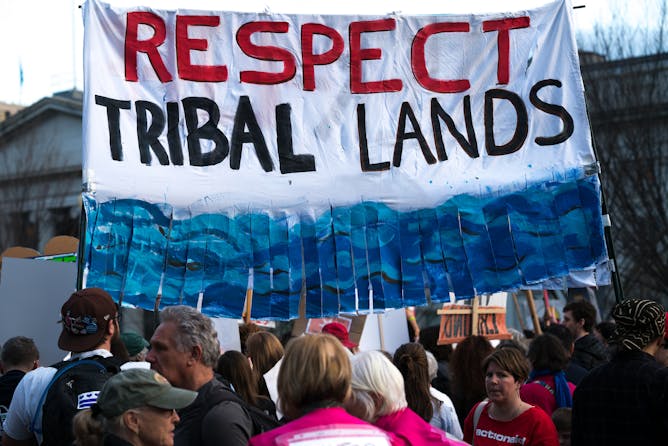
How Will Native Tribes Fight the Dakota Access Pipeline in Court?


Go to Original
By 

On Feb. 8 the U.S. Army Corps of Engineers reversed course and issued an easement allowing the installation of the Dakota Access Pipeline under Lake Oahe in North Dakota. That decision followed a presidential memorandum indicating that construction and operation of the pipeline would be in the “national interest,” and set the stage for a final showdown over the pipeline’s fate.
In response, two Indian tribes, the Standing Rock and Cheyenne River Sioux, filed new motions to halt the pipeline’s construction and operation. After an initial hearing on those motions, the federal judge on the case allowed construction to proceed but will be considering the tribes’ claims before oil will pass through the pipeline under Lake Oahe. That means, unlike the voices of thousands who joined the Standing Rock Sioux tribe in protest against the pipeline, the next chapter of this fight will be argued by a few lawyers in the pin drop silence of a federal courtroom.
Although the details of those arguments will be complex, as a legal scholar focused on Native American law I see the case addressing an essential question at the heart of our legal system: namely, how does federal law and judicial process protect the fundamental values and structure of the Constitution?
The central issues in the case are now whether the U.S. Army Corps of Engineers’ approval of the pipeline and easement illegally interferes with the tribes’ religious beliefs and whether the corps adequately considered the tribes’ water and other treaty rights before issuing that approval.

Religious Freedom Restoration Act

According to the Cheyenne River Sioux tribe, oil running through the pipeline would represent the fulfillment of a generations-old prophesy, passed down through the oral traditions of tribal members, that warned of a Black Snake coming to defile the sacred waters necessary to maintain the tribes’ ceremonies. Beyond the environmental concerns often at the center of the pipeline protests, the tribe’s motion for an injunction squarely defines final authorization of the pipeline by the corps as an existential threat: destruction of the tribes’ religion and way of life.
One of the key legal questions in the North Dakota Access Pipeline case whether federal interests can supersede religious freedoms of native groups.vpickering/flickrCC BY-ND
The Constitution’s First Amendment guarantees the exercise of religion free from governmental interference. But the Supreme Court, in Lyng v. Northwest Indian Cemetery Protection Association, in 1988 upheld the Forest Service’s approval of a road across an area on federal land sacred to local tribes even while recognizing the road could have devastating effects on their religion.
Then in 1993, Congress enacted the Religious Freedom Restoration Act (RFRA), which requires that the government demonstrate a compelling interest and use the least restrictive means to achieve that interest if its actions will substantially burden religious practice.
In other words, even if approving the Dakota Access Pipeline served a compelling governmental interest, RFRA may require the U.S. Army Corps of Engineers to show that the pipeline easement under Lake Oahe would have the least impact on tribal religion. That approach would be consistent with the Supreme Court’s broad application of RFRA in a 2014 case not involving tribal interests or federal lands and may pose a significant challenge to the corps, which considered but rejected a different route that did not pose the same threat to the tribes.
Both the corps and company behind the Dakota Access Pipeline argue that the risk of spill from the pipeline is minimal and that the tribes failed to raise these religious concerns in a timely manner. In addition, the U.S. Army Corps of Engineers contends that, consistent with the Lyng case, governmental action on federal land should not be restricted because of religious concerns raised by local tribes.
Thus, resolution of the case will turn upon whether the court recognizes the legitimacy of the tribal religious concerns and broadly applies RFRA or, instead, chooses to prioritize federal authority over federal land to the detriment of those concerns. The parties will argue whether the religious freedom issues support an injunction on Feb. 27.

Arbitrary or capricious decisions?

In addition to their religious concerns, the Sioux tribes challenge the corps’ decisions based on the rights they reserved in treaties made with the federal government in 1851 and 1868.
The Constitution recognizes treaties as the “supreme law of the land” and, according to a 2016 analysis done by the solicitor of the U.S. Department of the Interior, both the Standing Rock and Cheyenne River Sioux retain treaty-reserved water, hunting and fishing rights in Lake Oahe.
The pipeline company has argued that the risks to the water supply are minimal and that the tribes didn’t raise religious concerns earlier in the approval process. diversey/flickrCC BY-NC-SA
Before reversing course in February, the U.S. Army Corps of Engineers refused to issue the easement last year in order to further understand and analyze those treaty rights.
Importantly, federal law generally allows courts to set aside arbitrary or capricious agency decisions. In a Feb. 14 filing, the Standing Rock Sioux tribe asks the court to review the corps’ about-face under that standard and argues that the federal trust responsibility, recognized by the Supreme Court since the early 1800s, demands more than just a cursory review of tribal treaty rights.
The parties will be briefing the treaty rights issues into March, but the judge is keeping a close eye on Dakota Access’ progress in the meantime.
The ultimate fate of the pipeline will turn on how the courts recognize the rights asserted by the Sioux tribes, rights rooted in the Constitution’s values and structure – precisely the type of rights our rule of law and federal courts are meant to protect.

PABLO ESCOBAR’S SON REVEALS HIS DAD “WORKED FOR THE CIA SELLING COCAINE” — MEDIA SILENT

Go to Original
By Claire Bernish

Juan Pablo Escobar Henao, son of notorious Medellín cartel drug kingpin, Pablo Escobar, now says his father “worked for the CIA.”
In a new book, “Pablo Escobar In Fraganti,” Escobar, who lives under the pseudonym, Juan Sebastián Marroquín, explains his “father worked for the CIA selling cocaine to finance the fight against Communism in Central America.”
“The drug business is very different than what we dreamed,” he continues. “What the CIA was doing was buying the controls to get the drug into their country and getting a wonderful deal.”
“He did not make the money alone,” Marroquín elaborated in an interview, “but with US agencies that allowed him access to this money. He had direct relations with the CIA.”
Notably, Marroquín added, “the person who sold the most drugs to the CIA was Pablo Escobar.”
Where his first book primarily covered Escobar, the man as a father, Marroquín’s second — which has just been released in Argentina — delves into the kingpin’s “international ties of corruption in which my father had an active participation, among them with the American CIA,” he said in a recent interview.
Those government associates “were practically his partners,” which allowed Escobar to defy the law, and gave him nearly the same power as a government.
Predictably, this information is conveniently absent from media headlines in America.
If the CIA trafficking cocaine into the United States sounds like some tin foil conspiracy theory, think again. Their alleged role in the drug trade was exposed in 1996 in an explosive investigative series “Dark Alliance” by Gary Webb for the San Jose Mercury News. The investigation, headed up by Webb revealed ties between the CIA, Nicaraguan contras and the crack cocaine trade ravaging African-American communities.
The investigation provoked massive protests and congressional hearings, as well as overt backlash from the mainstream media to discredit Webb’s reporting. However, decades later, officials would come forward to back Webb’s original investigation up.
Then-senator John Kerry even released a detailed report claiming that not only was there “considerable evidence” linking the Contra effort to trafficking of drugs and weapons — but that the U.S. government knew about it.
El Patron, as Escobar came to be known, amassed more wealth than almost any drug dealer in history — at one point raking in around $420 million a week in revenue — and reportedly supplied about 80 percent of the world’s cocaine. Escobar landed on Forbes’ list of international billionaires for seven straight years, and — though the nature of the business makes acquiring solid numbers impossible — his estimated worth was around $30 billion.
Escobar and the Medellín cartel smuggled 15 tons of cocaine into the U.S. — every day — and left a trail of thousands of dead bodies to do so.
“It was a nine-hundred-mile run from the north coast of Colombia and was simply wide-open,” journalist Ioan Grillo wrote in the book, “El Narco: Inside Mexico’s Criminal Insurgency.” “The Colombians and their American counterparts would airdrop loads of blow out to sea, from where it would be rushed ashore in speedboats, or even fly it right onto the Florida mainland and let it crash down in the countryside.”
If what Marroquín reveals in the new book is, indeed, true, it would mean the CIA played a major role in ensuring Americans had access to boundless quantities of cocaine — while the U.S. government sanctimoniously railed against drugs to promote the drug war.
In fact, as Marroquín keenly observes, drug prohibition makes for the best pro-drug propaganda — the nature of something being illegal naturally gives it greater appeal.
That prohibition guaranteed Escobar’s bloody reign would be all the more violent. Marroquín now believes “his path of healing is reconciliation with the relatives of those whom his father ordered to kill.”
While Escobar certainly used violence, or ordered others to use violence, to effectively foment and maintain power, he wasn’t without a charitable bone in his body. As Business Insider notes“He was nicknamed ‘Robin Hood’ after handing out cash to the poor, building housing for the homeless, constructing 70 community soccer fields, and building a zoo.”
El Patron met his fate in 1993 — by gunshot as he attempted to flee after his house was surrounded. However, the circumstances surrounding his death are still being debated today. Marroquín insists his father committed suicide rather than be shot or captured by police forces sent to hunt him down; while others believe Escobar was absolutely slain by police.
Either way, Escobar’s accumulation of wealth could be viewed as incidental to the role he played for the CIA and the war on drugs — a massive hypocrisy serving to keep people hooked on a substance deemed illegal by the State, so the State can then reap the profits generated by courts, prisons, and police work ‘necessary’ to ‘fight’ the ‘war on drugs.’
“My father was a cog in a big business of universal drug trafficking,” Marroquín explains, and when he no longer served a purpose for those using him that way, killers were sent to do away with the problem — the problem so many had a hand in creating.
Marroquín, who only revealed himself as Escobar’s son in 2009, says he’s had to forgive members of his family for their involvement in the drug business and betrayal of his father — but notes that forgiveness doesn’t mean forgetting what happened.
But he has measured perspective about the man who brutally ruled the cocaine industry.
“Pablo Escobar is by no means a role model,” he asserts.
“I admire Pablo, my father, who educated me. Not Escobar, the mafioso.”
Marroquín noted drug lords like his father might appear to have everything as their status and name garner attention, but these material gains, in actuality, take control in the end.
“The more power my father had, the poorer he lived.”

Washington may have finally found bipartisan consensus with Congressional Cannabis Caucus

Bipartisan House lawmakers launch pro-marijuana club


A bipartisan group of federal lawmakers launched the Congressional Cannabis Caucus with a press conference at the U.S. Capitol on Thursday afternoon.
Members of the Cannabis Caucus see marijuana reform as an important issue and will make a bipartisan effort to pass bills. While the group didn’t lay out specific legislative objectives, lawmakers said that there is a need to square federal law — which prohibits marijuana use — with the growing number of state laws that allow for medical and recreational use.
“The prohibition of cannabis has been a failure and Americans across our nation are demanding a more sensible approach,” said Oregon Democrat Rep. Earl Blumenauer.
Blumenauer is one of the Caucus’s founding members, along with California Republican Dana Rohrabacher, Colorado Democrat Jared Polis and Alaska Republican Don Young. All four representatives hail from states where recreational marijuana use is legal. Blumenauer said it’s important the federal government doesn’t prevent the continuation of research into its medicinal use.
“Following the November election, federal laws are now out of step with 44 states. The time is now to come together and bring the federal government in line with the will of the American people,” he said.
Rohrabacher echoed Blumenauer’s sentiments, adding that he has personally benefited from medical marijuana.
“About a hundred days ago I had an operation on my arm here, it was real heavy arthritis. As a surfer I actually wore away all the cartilage in both of my arms. It was really painful,” he told reporters. “They gave me this candle and the candle was infused with cannabis and yeah, I put it on my arm and guess what—the pain went away for a couple hours and I got sleep for the first time in weeks after that.”
Marijuana is legal, in some form or another, in 28 states. Various polls show that a majority of Americans support legalizing marijuana in some form and the marijuana industry brought in $6.7 billion in legal sales in the U.S. last year. Now that an additional eight states — including California — voted to legalize recreational use of marijuana last November, that figure is expected to grow.
But President Donald Trump’s Attorney General Jeff Sessions has raised concerns about the drug and said previously that “good people don’t smoke marijuana.” It remains to be seen whether Sessions will roll back Obama-era policies that have allowed pot businesses to flourish in states where it is legal.
“Many of us have expressed concerns about the new attorney general,” Rep. Polis said. “We’re also cautiously hopeful that President Trump will maintain a commitment he made on the campaign trail where he said it would be a state issue.”
Earlier this month, Rohrabacher introduced a measure called the Respect State Marijuana Laws Act of 2017, which would prohibit the Justice Department from using federal funds to target cannabis operations that comply with local laws. Under President Barack Obama, the Justice Department declined to interfere with states that had legalized marijuana, even though federal law defines it as an illegal drug.
But at the federal level, marijuana policy remains essentially unchanged from the early 1970s.
“Until (the underlying federal law is addressed), the industry exists really at the discretion of the president and the attorney general, and it’s a dangerous place to be,” Polis said, adding that, “we need to make the case directly to Trump.”
In a joint statement, several of the marijuana industry’s top leading lobbying groups and associations — including NORML, the Marijuana Policy Project and the Drug Policy Alliance, among others — issued a joint statement on Thursday commending the lawmakers leading the charge on cannabis policy.
“The establishment of a Cannabis Caucus will allow members from both parties, who represent diverse constituencies from around the country, to join together for the purpose of advancing sensible cannabis policy reform,” the statement read.
“The formation of this caucus is a testament to how far our country has come on the issue of cannabis policy,” the groups added. “There is a growing consensus that cannabis prohibition has failed, and it is time for a more sensible approach.”
The new Cannabis Caucus will be among more than 200 different issue-related groups that have attracted members from both sides of the aisle in the House. They range from the serious, such as the Bipartisan Taskforce for Combating Anti-Semitism to the Rugby Caucus.

Santa Monica, Calif., Dumps Wells Fargo Over DAPL Funding

Go to Original
By Emma Niles

Santa Monica, Calif., has joined a growing list of cities that have enacted progressive local policies, often at odds with President Trump’s positions.
On Wednesday, the Santa Monica City Council voted to sever ties with Wells Fargo because the financial services company helps fund the controversial Dakota Access pipeline.
The Santa Monica Lookout reported:
Council members heard from nearly three-dozen speakers, including several who sang and played drums in an “honor song,” during the session that did not begin until the final minutes of Tuesday night due to the meeting’s lengthy agenda.
Many of the speakers had been to the much-publicized protests in North Dakota, where they objected to the project because they say it stretches onto sacred native land and creates water and other environmental safety issues.
“Santa Monica is taking a stand against Wells Fargo because they have repeatedly used deceptive business practices,” Councilmember Tony Vazquez said.
He continued, “Their investment in the Dakota Access Pipeline is the latest egregious action. It’s our hope that other cities will divest their funds so together we can have a collective and powerful impact.”
According to local news site Santa Monica Next, the council voted 5-0 to support the divestiture measure, although two council members were not present for the vote.
Santa Monica joined cities such as Seattle and Davis, Calif., which also have voted to pull investments from Wells Fargo due to its ties to the North Dakota oil pipeline.
In addition, Santa Monica has passed local measures on a wide range of progressive issues in the face of Trump administration moves. For instance, one day after the divestiture vote, the Santa Monica City Council approved drafting legislation to protect residents from having to give sensitive information to employers and landlords.
The Santa Monica Lookout explained:
After hearing from numerous public speakers who said they lived in fear under the Donald Trump presidency, the Santa Monica City Council passed a measure calling for staff to draft an ordinance that would prohibit employers and landlords, among others, from collecting information on people’s immigration status, religion and sexual identity. …
The action comes after President Trump signed an executive order last month that would have halted travel from seven countries with mostly Muslim populations designated by the Obama Administration as “areas of concern” because of terrorist activity.
“What we have here [from the federal government] is overt discrimination against people based on religion,” council member Kevin McKeown stated at the hearing.
Other local governments around the country are responding to President Trump’s policies in a outspoken manner as well. Los Angeles City Council members recently took similar steps to protect minorities and immigrants, with council member Paul Krekorian declaring, “It’s important for the city to get ahead of this and say, ‘We’re not going to stand for this.’ ”
It’s unclear how the Trump administration will respond to these actions in progressive cities, but community leaders say people are looking to their local governments for extra protection in a worrisome time.
“[W]e have a great deal of fear in the community,” noted Santa Monica City Council member McKeown during Thursday’s meeting.

Donald Trump considers mobilising 100,000 National Guard troops to round up undocumented immigrants

If carried out, states would have final say on whether or not troops are actually deployed

Go to Original
By Feliks Garcia

Donald Trump's administration is considering mobilising as many as 100,000 National Guard troops to round up undocumented immigrants, it has been reported.

The Associated Press obtained a draft memo that calls for the unprecedented militarisation of the US immigration enforcement. But if implemented, governors in 11 states included in the draft memo would have final say on whether troops are actually deployed.
The draft memo, written by Department of Homeland Security Secretary John Kelly, includes four states that border Mexico – Texas, New Mexico, Arizona, and California – but extends to seven contiguous states  – Louisiana, Arkansas, Oklahoma, Colorado, Utah, Nevada, and Oregon. 
States like California would be unlikely to comply with the Trump administration should it actually call for the deployment of National Guard troops for immigration enforcement.
Last month, the President signed two executive orders pertaining to the southern border with Mexico. The first directed the construction of a wall in the region, despite the existence of some 700 miles of barrier already in place. The second boosted the number of Border Patrol agents and immigration enforcement officers who carry out raids and deportations. 
White House Press Secretary Sean Spicer denied the report as "100 per cent false" on Twitter, but could not say that the subject was never a topic of discussion within the administration.
"I don't know what could potentially be out there, but I know that there is no effort to do what is potentially suggested," he said. "It is not a White House document."
The acting press secretary for the DHS also denied the report, saying: "The Department is not considering mobilising the National Guard."
But it remains unclear whether the White House will carry out this order as reported, as the administration has become notorious for attempting to discredit news stories that cast a unfavourable light on the President, writing them off as "fake".
Mr Trump launched his campaign with particular focus on immigrants from Mexico, criminalising them with broad brushstrokes. In his now infamous June 2015 campaign announcement, he referred to Mexican immigrants as rapists and drug traffickers, solidified with his vow to build a wall along the already-militarised southern border. 
In the first month of Mr Trump's administration, immigration enforcement officers carried out the first large-scale enforcement of Mr Trump's executive order to take action against undocumented people in the US.
Raids took place last week in and around New York, Los Angeles, North Carolina, South Carolina, Atlanta and Chicago, immigration officials confirmed – with more than a third of those detained in the Los Angeles area being deported to Mexico. 
Democratic Texas Rep Joaquin Castro condemned the draft and called it "disturbing". 
"I'm hoping that it's not true, but you get five different answers on controversial issues depending on who you ask [in the Trump administration]," he said during a conference call with reporters. "So it's hard to know when Sean Spicer's denial is actual policy. 
"The President needs to address this; the President needs to be clear about his intentions and whether he intends to use the National Guard as immigration agents."
Mr Castro explained that, following a meeting with ICE, it was hard to "not conclude that Donald Trump has started his mass deportation plan". In the meeting ICE officials referred to the President's executive order to crack down on undocumented immigrants and acknowledged that it was a much broader mandate than President Barack Obama's.
"They seemed determined to go after as many people as possible because of the language of the executive order," he said. "And the ICE director was very clear that they were going to follow that message."
Immigrants who face the threat of removal have the right to due process. A mass deportation operation would likely still require full removal proceedings, leading to mass incarceration and increase the likelihood of erroneous detentions. Mr Trump's actions could lead to an increase in immigration detention populations from about 45,000 daily to three million.
Christian Ramirez, the director of the Southern Border Communities Coalition and human rights director for Alliance San Diego, expressed concern about the panic that will stem from this report, as well as the fear that Mr Trump has already generated in immigrant communities along the US-Mexico border. 
"Any talk about deploying military personnel to our communities is not only of great concern to border residents who have been living under the boot of border militarisation for generations, but it should be of great concern to our democracy," he told The Independent.
"Having military personnel enforce civilian laws runs counter to basic principles of democratic societies and we should be concerned with the notion of this being contemplated by this administration."
Still, Mr Ramirez explained immigrant communities along the border were already heavily policed by the Border Patrol, the largest law enforcement agency in the country.
Mr Trump's enforcement efforts are made possible by infrastructure that has already been fortified by previous administrations. The Obama administration was fiercely criticised by immigrant rights groups for its part in ramping up immigration enforcement in the US.
Under Obama, ICE carried out some 2.5 million deportations between 2009 and 2015. 
"When it comes to the actual enforcement, we had gross cases of human rights violations along the southern border under Obama," Mr Ramirez said. 
"I think what is clear is that President Trump inherited a massive deportation machine and has control of the largest law enforcement agency in the country, which Congress granted these absolute powers to look the other way when it comes to protecting our Constitutional rights.
"What is clearly different is that, unlike the previous administration, the Trump administration has been using a whole lot of hate speech and hyperbolic rhetoric when referring to the border region, immigrants, and refugees – and language has a real impact on communities."