Sunday, May 14, 2017

If You Still Use Windows XP, Prepare For the Worst

Go to Original
By 


AS A VICIOUS new strain of ransomware swept the UK’s National Health Service yesterday, shutting off services at hospitals and clinics throughout the region, experts cautioned that the best protection was to download a patch Microsoft had issued in March. The only problem? A reported 90 percent of NHS systems run Windows XP, an operating system Microsoft first introduced in 2001, and hasn’t supported since 2014.
NHS has disputed the 90 percent figure—though not that a significant portion of its systems run Windows XP—and was only one example of the tens of thousands of impacted computers across nearly 100 countries yesterday. But its meltdown illustrates the deeper problems inherent in Windows XP’s prevalence three years after its official demise.
Experts rightly that the best protection against the so-called WannaCry ransomware was to patch everything, as soon as possible. But for Windows XP and other expired operating systems, the patches weren’t there in the first place. With very few exceptions—including an emergency patch after the first wave of WannaCry infections, and expensive, specialized service contracts—Microsoft no longer provides any security support for the OS. A computer running XP today is a castle with no moat, portcullis raised, doors flung open, greeting the ravaging hoards with wine spritzers and jam.
And it’s only going to get worse.

Expiration Date

Hackers have targeted XP for years. Its lack of defenses and persistent popularity make it a popular target. And it really does have a foothold; according to analytics company StatCounter, 5.26 percent of Windows PCs run XP still, while a similar analysis from Net Applications puts the total at just over 7 percent of all personal computers. No matter whose numbers you use, that amounts to tens of millions of devices, and that’s before you count the absurd percentage of ATMs and other non-traditional systems stuck in the past.
The natural question, given the absurd level of risk that comes with running Windows XP in 2017, is why on earth would anyone stick with it, much less millions of people and companies with so much to lose.
The problem stems in part from Windows XP’s initial popularity. “It was one of the first Microsoft operating systems people latched onto,” says Peter Tsai, IT analyst at Spiceworks, a network for IT professionals. Not only was it one of the first stable Windows versions, the five-year gap between Windows XP and its unpopular successor, Windows Vista, resulted in an uncommonly large install base.
You can guess what happened from there; you’ve probably experienced yourself. Business-wide operating system updates take time and money, the kind that fall low on the priority list of a strapped CEO. “A lot of smaller companies subscribe to the theory, probably wrongly now, that if it’s not broken then don’t fix it,” says Tsai. “Especially companies that aren’t prioritizing IT.” Which appears to be most of them; a recent Spiceworks survey found than more than half of businesses worldwide have at least one machine running Windows XP.
Many companies have a more practical excuse than just lethargy; they may rely on specialized legacy software that simply won’t work with newer Windows releases. That may include institutions like NHS, where the process of testing new or updated versions of critical software could disrupt patient care.
But if nothing else, WannaCry makes clear that whatever time and money and disruption companies might think they’re saving by sticking with Windows XP is an illusion. If anything, in recent weeks the threats have only escalated.

New Tools

Last month, a group of hackers calling themselves Shadow Brokers released a set of purported NSA hacking tools on the internet. They included a previously undisclosed Microsoft vulnerability that targeted older versions of Windows. And it’s that exploit that WannaCry uses to wreak havoc.
This means a few things, none of them encouraging. First, that WannaCry is not a one-off event. There’s a whole suite of NSA tools now available to bad guys, whose interests may range from ransomware to targeted surveillance to building botnet armies and anything in between. Second, since those tools didn’t target Windows 10, any PC not running the latest Microsoft operating system finds itself at much greater risk than it did a month ago. Microsoft confirmed, in fact, that WannaCry didn’t target Windows 10 at all.
By making a rare exception to its hands-off policy toward Windows XP, and issuing a patch that protects older systems (though doesn’t help PCs already infected), Microsoft undoubtedly helped slow the WannaCry spread. But that kind of selective, responsive patching won’t help the first wave of victims of the next big XP vulnerability. It also may give some XP laggards the impression that Microsoft will bail them out in the future, of which there’s no guarantee.
“It can give users a false sense of security, and does not motivate them to upgrade to systems whose security architecture is superior and can be improved on,” says Jérôme Segura, lead malware intelligence analyst at Malwarebytes.
Especially when so many active risks plague XP daily that don’t rise to the level of WannaCry, but can still do harm. “If for some reason they are running Internet Explorer [on XP],” says Segura, “it would only take a few minutes of browsing the net before getting infected via malvertising or a compromised site.”
Maybe, then, the silver lining in WannaCry comes from alerting companies large and small of just how debilitating Windows XP can be. “A decade or two decades ago, most of these malware variants were pretty benign,” says Tsai. “Viruses were just a nuisance, instead of something that could impact the bottom line. But now with ransomware, where they’re encrypting or deleting your critical data, I think that the higher-ups who make decisions are starting to take note.”
If so, hopefully sooner than later. If you don’t want hackers taking shots at you, start by removing the bullseye.

Hundreds Gather at Trump Golf Course and Spell It Out: 'Resist!'

Local Indivisible group targets country club owned by the president to deliver message

Go to Original


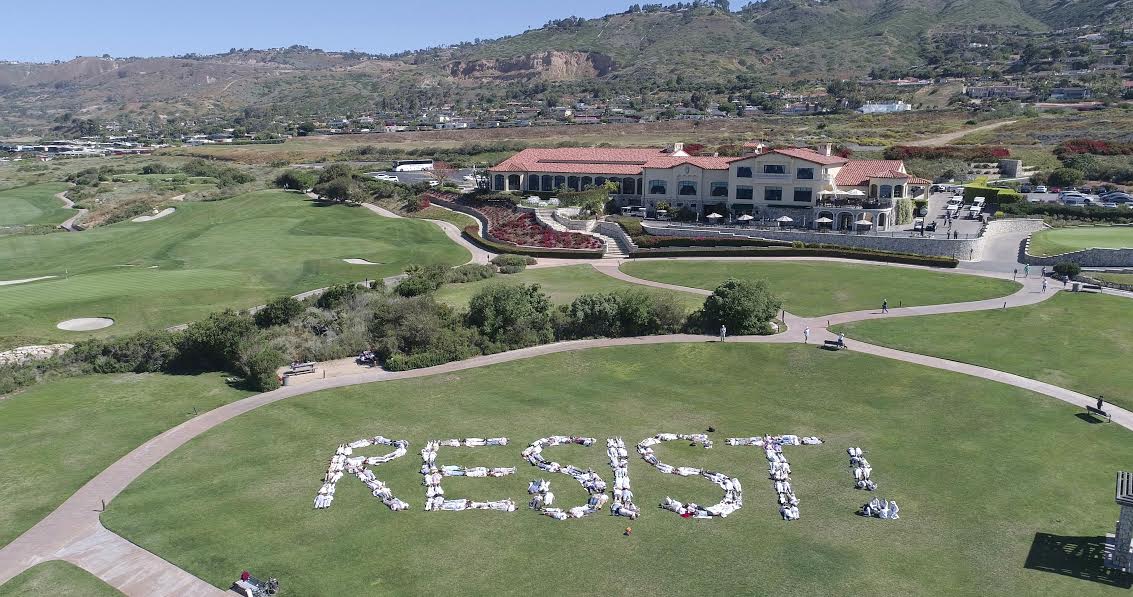
With the national anti-Trump resistance movement continuing its fight against the White House and Republican agendas on all fronts, 200 members of a local Indivisible group in California on Saturday took their message to the  Trump National Golf Course in the town of Rancho Palos Verdes and aimed it at the sky: Resist!

With bodies folded against one another on a green near the course's clubhouse, the aerial shots are not likely to be included in the country club's brochure anytime soon.

Peter Warren, a member of Indivisible San Pedro, explained to local news channel CBS2that the protest was calling for a special prosecutor to begin an independent probe into whether there was Russian influence on the 2016 presidential election and if there was collusion of any kind with the Trump campaign or people affiliated with it.

200 members of Indivisible San Pedro form the word RESIST! Sat. at Trump National Golf Course, Rancho Palos Verdes, CA.

Thousands of local Indivisible groups have popped up around the country since Trump took over the White House in January. Spawned by former legislative aides in Washington, D.C. who wrote the "Indivisible Guide" and posted it online, the groups have formed one of the main arteries for grassroots resistance against both Trump and the Republican lawmakers who now control both the House of Representatives and the Senate.

As The Hill noted, the San Pedro group's Facebook describes them as "a group of concerned citizens that realize the Trump administration's agenda will take America backwards, and must be stopped."

Turkish-American relations at crossroads

Go to Original
By M.K. BHADRAKUMAR

When President Donald Trump receives President Recep Erdogan on Tuesday at the White House, his legendary deal-making prowess will be on trial.
Trump has not been in a tearing hurry to receive Erdogan. During the first 100 days of his presidency, Trump received the leaders of Israel, Egypt, Saudi Arabia, UAE, Jordan (twice), Iraq and Palestine. Yet, none of them belongs to a NATO member country and or is a crucial “swing” state in Trump’s messianic war against the ISIS, as Turkey is.
Could it be Erdogan’s dalliance with the ISIS in the past that put a dampened Trump’s enthusiasm for this “strongman”? But then, Saudi Arabia too was promoting al-Qaeda groups in Syria.
Or, was it Erdogan’s growing friendship with Russian President Vladimir Putin that discouraged Trump? But then, Trump greeted Egypt’s President Abdel Fattah el-Sisi in the White House as an old ally.
Clearly, the only good reason could be that Trump deliberately decided that there is a time for everything – even for meeting Erdogan. Trump thoughtfully let the Turkish referendum on constitutional reform run its course first. Trump now has the answer.
Erdogan extracted a ‘yes’ vote in the referendum alright, and is set to concentrate executive power in his hands, but, paradoxically, he is a wounded man, having lost the referendum vote in all major cities, especially Istanbul, which has been his citadel in living memory. Erdogan barely scraped through.
On the other hand, an invigorated German-French axis following the magnificent election victory of Emmanuel Macron means that a consolidated EU pressure is building on Erdogan to curb his authoritarian drift. Erdogan knows that a rupture of Turkey’s ties to the West would have grave economic and political consequences.
Meanwhile, if Erdogan had calculated that he could play off the US and Russia, that is also not to be. Trump simply outflanked him by opening a line to Putin regarding Syria before he met Erdogan.
Erdogan has been naïve. The Kremlin won’t risk annoying Trump. Détente with the US is an overriding concern for Russia.
All things taken into account, therefore, Trump did the right thing to meet Erdogan in the fullness of time. Trump’s decision to sign the executive order allowing the Pentagon to transfer heavy weapons to the Kurdish militia right on the eve of Erdogan’s visit underscores it.
Trump is looking for a quick victory in Raqqa. The liberation of Raqqa will be prime time news in America. Who’d pay attention anymore to “a showboat” like James Comey when the pictures are beamed from Raqqa into the living rooms in America?
The Pentagon commanders estimate that the Kurdish militia with US air support will liberate Raqqa successfully and swiftly. Indeed, latest reports suggest that the Kurdish militia has reached within two kilometers of Raqqa city limits.
Simply put, Erdogan who was hoping to dissuade Trump from aligning with the Kurds will now have to discuss concerns over post-liberation Raqqa. The ground beneath Erdogan’s feet has dramatically shifted.
He still can resort to strategic defiance by resorting to air strikes against the Kurdish militia, similar to the attacks staged by Turkish Air Force on April 25 on the town of Sinjar (Iraqi Kurdistan) and on targets in the Karachok Mountains (north-eastern Syria).
However, the US and Russian deployments to the Kurdish cantons in northern Syrian show that both Washington and Moscow have factored in such a possibility and have a tacit understanding that only their physical presence might act as a deterrent against Erdogan’s adventurism.
This opens up a tantalizing prospect – US and Russia having an unwritten division of labor to “tame” Erdogan. The Russian diplomacy has shown masterly skill in shepherding Turkish policies away from covert backing for extremist groups towards new directions that help to end the fighting in Syria. The Russia-US cooperation in Syria drastically curbs Erdogan’s elbow room.
What are Erdogan’s options? Trump has put him out of business since the US is no longer using Turkish proxies to push the ‘regime change’ agenda in Syria. The US’ retrenchment affects Saudi and Qatari policies, too.
Will Erdogan retaliate by shutting down Incirlik air base? Such a possibility exists but is unlikely. At any rate, Washington is focused on the liberation of Raqqa, and access to Incirlik is a secondary issue at the moment.
Besides, Erdogan will be wary of provoking Trump. Apart from the discord over the extradition of Islamist preacher Fetullah Gulen, US is keeping under detention the top executive of Halkbank Mehmet Hakan Attila whom it implicates in the sensational criminal case (which is also linked to Erdogan’s immediate family members) regarding abuse of the US financial system to conduct fraudulent transactions on behalf of Iranian entities.
The bottom line is that Erdogan is running out of options and may be coming under compulsion, finally, to (re)open his own channels to the Kurdish groups. Indeed, Turkey got along well with the leadership of Iraqi Kurdistan and a similar deal can be worked out with Syrian Kurds.
Being the consummate pragmatist that he is, Erdogan may well decide to pick up the threads of the peace process with Kurds from where he summarily left them in 2015 due to compulsions over forthcoming electoral battles culminating in the March referendum to transform Turkey into a presidential system.
Significantly, Erdogan has reacted with extraordinary restraint to the Pentagon move to arm Kurds in Syria. He is brooding over his options. Trump can encourage him to seek a deal with Kurds. It may not be the mother of all deals, but a historic deal nonetheless, which will go a long way to stabilizing Syria and the Middle East.

Donald Trump could be impeached over firing of James Comey, says professor who called election

'This is more serious than Watergate'

Go to Original
By Andrew Buncombe


professor of history who predicted Donald Trump would win the race to the White House, has claimed the firing of James Comey as FBI Director is sufficient to see the President impeached.
Allan Lichtman, who has correctly guessed the outcome of every presidential election since 1984, claimed Mr Trump’s firing of Mr Comey was “more serious than Watergate”.
“He arguably could be impeached now,” Mr Lichtman toldNewsweek. “Arguably he’s already obstructed justice and already violated the emoluments clause [regarding receiving gifts from foreign governments]. I’m not saying we should impeach him now, I’m calling for an impeachment investigation.”
Mr Lichtman may have reason for making such claims; he is promoting his latest book, The Case for Impeachment
“We see credible reporting that he may well be guilty of obstructing justice in the FBI investigation, first by demanding loyalty to him personally from the man investigating him,” he said. 
“That’s pretty blatant obstruction of justice. And then by firing director Comey and then in effect lying initially, or having his team lie in his direction, about the reasons for the firing.”
In the aftermath of last week’s firing of Mr Comey, the White House scrambled to provide an explanation for Mr Trump’s actions. Officials sought to protect the President from accusations by Democrats and others, that he had fired him because he was heading the investigation into the possible collusion between the Trump campaign and Russia’s alleged efforts to influence the presidential election.
White House spokespersons claimed he had been fired because of the way he handled the investigation into Hillary Clinton’s use of a private email server. The administration cited memos from Attorney General Jeff Sessions and Deputy Attorney General Rod Rosenstein, which recommended getting rid of him.
Yet it rapidly became clear, those memos had been hastily provided to provide cover for Mr Trump, who had decided last week to get rid of Mr Comey, Indeed, the President admitted as much himself in an interview with NBC News. 
“When I decided to just do it, I said to myself, I said ‘You know, this Russia thing with Trump and Russia is a made-up story, it’s an excuse by the Democrats for having lost an election that they should’ve won’,” he said.

He called Mr Comey a “showboat” and a “grandstander”.
“Regardless of recommendation, I was going to fire Comey,” Mr Trump said.
Mr Trump also claimed Mr Comey assured him on three separate occasions, including once over dinner and on another occasion over a phone call, that he was not personally under investigation.
It has been reported that Mr Trump sought repeated oaths of loyalty from Mr Comey, despite the fact that his role is supposed to be independent and non-partisan. The White House has denied such demands were made.
Sources close to Mr Comey have denied the President’s version of events.
Only two presidents have been impeached by the House of Representatives – Andrew Johnson and Bill Clinton. No president has seen their impeachment approved by the Senate. For Mr Trump to be impeached, Republicans in the House would have to decide to turn on him. Alternatively, if the Republicans lost control of the house in the 2018 midterms, Democrats could lead such a move.

Trump Released This Letter to Prove He Has No Russian Ties. We Annotated It.

The document raises more questions than it answers.


Go to Original
By 

The White House on Friday released a one-page letter from Trump's private tax attorney, Sheri Dillon, that was intended to debunk the notion that President Trump has any Russian business dealings or sources of income. Dillon is the same lawyer who vowed at a January 11 press conference that Trump would meaningfully separate himself from the Trump Organization—something that never happened. No surprise: Dillon's new letter is hardly worth the paper it's printed on, raising as many questions about Trump's business activities as it answers.
So, we marked up the letter with some questions and observations of our own.

Trump Is Audaciously Trying to Privatize Native American Land

Trump has had a very spotty past with Native America tribes.

Go to Original
By Michael Hayne


Each and every day, we the people are forced to endure something profoundly horrific being committed by Trump. And since Republicans only concern is maintaining their tenuous grip on power, they could care less what damage their president does tho their constituents. We've already seen scientific, environmental, and social groups get slaughtered by this one sociopaths desire to do everything to enrich himself and his amoral wall street pals. Now it seems it's Native American Tribes' turn.
Trump began mobilizing to pursue the privatization of Indian lands back in October of last year with the formation of his 27 member Native American Affairs Coalition. The Coalition is chaired by so-called Cherokee Rep. Markwayne Mullin. Much like termination policy that took place more than 60 years ago, the Coalition feels that impoverished tribes are overwhelmed by federal regulations that impede self-reliance and prosperity. Therefore, all tribal lands should be privatized so that American Indians can pursue development projects that lift them out of poverty.

Featured image via CounterCurrentNews
 
The map above shows the amount of Naive American land being controlled by the federal government, which will be endangered by Trump's "America First" energy policy that seeks to give industry a free pass to drill on many of these lands.
According to Trump's America First energy policy:
Sound energy policy begins with the recognition that we have vast untapped domestic energy reserves right here in America. The Trump Administration will embrace the shale oil and gas revolution to bring jobs and prosperity to millions of Americans. We must take advantage of the estimated $50 trillion in untapped shale, oil, and natural gas reserves, especially those on federal lands that the American people own.
Making matters worse, Trump picked Montana Rep. Ryan Zinke for Secretary of the Interior, the very agency overseeing the Borough of Indian Affairs. Much like every amoral pick Trump has chosen to run major governmental departments, Zinke is notorious for being a deceptive con man. For example, Scientific American rates Zinke as a “mixed bag” with a very anti-environment, pro-industry voting record. So it's as likely that he will be an asset to Native American affairs as HHS Secretary Tom Price is for sick Americans.
Trump has had a very spotty past with Native America tribes. 
In 1993, Donald Trump testified before a House subcommittee that the mafia was running rampant on Native American gaming casinos. Here, he bickers with members of Congress about taxes, the FBI and if certain tribes "look Indian."
In short, we're seeing yet another example of Trump trampling on the rights of Native Americans.

Debt Collector Abuse Is Raging in the Trump Era

Donald Trump's policies will make things worse for American consumers saddled with debt.

Go to Original
By Alex Henderson


If there is any business sector in the United States that surpasses health insurance companies and megabanks when it comes to being corrupt, immoral and unscrupulous, it is debt collection agencies. Debt collectors are not exempt from federal governance; the Fair Debt Collection Practices Act of 1977 contains a long list of rules outlining what they legally can and cannot do. But FDCPA violations are rampant, and judging from the abundance of complaints the Federal Trade Commission and the Consumer Financial Protection Bureau have been receiving, the debt collection industry is showing no signs of cleaning up its act.
The CFPB reported receiving almost 7200 debt collector-related complaints in December 2016, an 11% increase from December 2015. The federal agency has been taking consumer complaints since 2011, and the category that has received the most complaints by far is debt collection. As of Dec. 1, 2016, the CFPB had handled approximately 285,000 debt collection-related complaints along the way. Common complaints included consumers being pursued for debts they no longer owed or never owed in the first place.
The FTC was fairly aggressive about bringing unscrupulous debt collectors to justice during the Barack Obama era; between 2010 and early 2015, the FTC filed lawsuits against 180 debt collectors and banned 63 of them from continuing operations. The FTC even publishes, on its website, a long list of debt collectors it has banned. But debt collection is big business; the Norfolk, Virginia-based Portfolio Recovery Associates, for example, reported total revenues of $881 million in 2014. Agencies typically purchase debts for pennies on the dollar, which can yield a sizable return on their investment if they collect. The potential of a huge ROI inspires many debt collection agencies to be as ruthless as possible, and there are countless examples of the industry’s corruption in recent years.
In 2013, the FTC fined the Plano, Texas-based collector Expert Global Solutions $3.2 million for numerous FDCPA violations, including “(calling) persons repeatedly or continuously with the intent to annoy, harass or abuse.” That same year, the FTC shut down Goldman Schwartz, another Texas-based debt collector, for making harassing phone calls, pretending to be attorneys and other FDCPA violations. And in 2014, the Memphis-based Regional Adjustment Bureau agreed to pay a $1.5 million civil penalty for offenses that included harassing phone calls and making unauthorized withdrawals from consumers’ bank accounts. 
That same year, the Southern California-based Asset Capital and Management Group settled charges with the FTC that included harassing consumers and pretending to be process servers; Asset agreed to pay approximately $4 million to consumers it had extorted money from. And in 2015, the FTC shut down Vantage Point Services, another Buffalo-based debt collection company, for making threatening phone calls and pretending to be with a district attorney’s office.  
Debt collectors are notorious for going after the wrong people. One of the most egregious examples occurred when Portfolio Recovery Associates mistook Missouri resident Maria Guadalupe Mejia for someone else, hounded her relentlessly and took her to court for a $1000 credit card debt that wasn’t even hers. In 2015, a jury ordered Portfolio to pay Mejia almost $83 million in punitive damages, in addition to having to pay $250,000 for violating the FDCPA. But even though the company was clearly in the wrong, Portfolio spokesperson Michael McKeon had the audacity to call the verdict “outlandish.” Not surprisingly, the CFPB has cited Portfolio as one of the collection agencies it has received the most complaints about. 
According to Gina Chialla, an attorney with the law firm that represented Mejia, one of the things that made Portfolio look so bad in that case was its failure to comply with the rules of discovery, the process in which all attorneys on a case share evidence. Portfolio’s contempt for the FDCPA was so blatant it wouldn’t even take an honest look at the evidence in the case.
Although $83 million is a lot of money, Portfolio got off easy in 2015. Ideally, the company should have been shut down, which has happened to many debt collection agencies in recent years. 
For debt collectors, the financial crash of September 2008, which brought on the worst economic downturn in the U.S. since the Great Depression of the 1930s, was a golden opportunity to cash in on widespread suffering. In 2012, Marketdata Enterprises reported that the collections industry had grown by 3.9% in 2011. And with consumers having a harder time paying their debts, Marketdata reported, more collectors were resorting to illegal or abusive tactics. Not surprisingly, the most common complaints the FTC received in 2010 and 2011 were debt collector-related—and that remains true today.
In the U.S., medical debt continues to be the most common type of debt, even with the number of Americans lacking health insurance having reached an all-time low thanks to the protections of the Affordable Care Act of 2010, aka Obamacare. A study conducted by the CFPB in 2014 and 2015 found that 59% of Americans contacted by debt collectors said it was for medical debt. In April of this year, the U.S. PIRG Education Fund released the report “Medical Debt Malpractice,” which reviewed 17,701 medical debt collection complaints the CFPB had received and found that “nearly two-thirds (63%) of complaints about medical debt collection assert either that the debt was never owed in the first place, it was already paid or discharged in bankruptcy, or it was not verified as the consumer’s debt.”
The report, according to PIRG, also found that “many complaints document inappropriate and aggressive tactics, including frequent or repeated calls, calls harassing friends and family, threats of legal action, or the use of abusive language.” And if the GOP's American Health Care Act (AHCA), aka Trumpcare—which Republicans in the House of Representatives narrowly passed on May 4—leads to 24 million Americans losing their health insurance as the Congressional Budget Office predicted, medical debt will become even more pandemic.  
Given all the abuses in the collections industry, it is important for Americans to know as much as possible about the FDCPA, which has been federal law for 40 years and is quite clear about what third-party debt collectors are and aren’t allowed to do. Using abusive, insulting, racist, defamatory or threatening language is strictly forbidden, as is pretending to be an attorney or law enforcement officer.  
One of the most common complaints about debt collectors is their insistence on calling people 20 or 30 times a day, but the FDCPA states that if someone sends a debt collector a letter asking them to cease communications, they must do so immediately. Under the FDCPA, debt collectors are not allowed to call before 8am or after 9pm unless the consumer has made arrangements to speak at another time. According to a CFPB survey, however, three out of four consumers said debt collectors ignored their requests to stop calling, which is illegal under FDCPA rules.
The FDCPA allows debt collectors to contact third parties such as neighbors or co-workers to obtain information about a debtor’s whereabouts, but they aren’t permitted to discuss the specifics of a debt with them. And of course, debt collectors are not allowed to pursue someone for a debt that isn’t even theirs, as Portfolio Recovery Associates did with Maria Guadalupe Mejia.  
Consumers who are being abused or harassed by a debt collector should send letters of complaint to the FTC and the CFPB and contact an attorney who specializes in consumer protection. Kimmel and Silverman, which has offices in Pennsylvania, New York State, New Jersey and Connecticut, is among the many law firms that specializes in combating abusive debt collectors. Another firm that has been active in the area of consumer protection is Slough, Connealy, Irwin & Madden, which represented Mejia in her case against Portfolio Associates. 
Mejia’s attorneys fought Portfolio in civil court, but in other cases, abusive debt collectors have faced criminal charges. In 2015, the Buffalo-based Four Star Resolution was slapped with an FTC lawsuit and charges from the U.S. attorney’s office in Manhattan for, among other things, pretending to be law enforcement officers and repeatedly threatening and harassing people they were trying to extort money from. Co-owners Travell Thomas and Maurice Sessum, along with 12 employees, pled guilty to conspiracy to commit wire fraud, and on April 20, Joon H. Kim, acting U.S. attorney for the southern district of New York, announced that Thomas had been sentenced to eight years and four months in federal prison and ordered to forfeit $31 million. Others in the company received federal prison sentences as well.
According to Kim, “Travell Thomas was the mastermind behind the largest criminal debt collection scheme ever charged. Using abusive and outrageous threats to take advantage of vulnerable Americans, Thomas and his co-conspirators defrauded victims out of $31 million—and Thomas made a small fortune for himself. Thomas will now serve a significant term in federal prison. This office is committed to prosecuting those who prey and abuse everyday consumers.”
Certainly, legitimate debt collection has its place in the U.S. economy. Businesses need to receive money that is owed to them in order to operate in the black and pay their employees. And when in-house debt collectors do their jobs in a respectful, careful fashion and obey the FDCPA, it is good for business. But third-party collectors violate the FDCPA so often and so blatantly that they are a drain on the economy. While the industry’s trade association, ACA International, will claim it opposes FDCPA violations, the reality is that ACA International is an apologist for an abusive, corrupt, out-of-control industry. ACA’s disingenuous attacks on the CFPB bear that out. To hear ACA International CEO Pat Morris tell it, the CFPB has unfairly maligned third-party debt collectors. But if Morris were truly concerned about collection abuses, he would welcome the scrutiny and want the CFPB to be as aggressive as possible in policing the industry. 
Debt collectors thrive on financial misery, and there is likely to be plenty of that in the Donald Trump era. With Republicans trying to rob millions of Americans of health insurance, weaken the Dodd-Frank Wall Street Reform and Consumer Protection Act of 2010, ease the Obama administration’s restrictions on student loan debt collection and undermine or even abolish the CFPB, the debt collections industry may very well become even more abusive in the years ahead.