Wednesday, March 15, 2017

Unsealed Court Documents Suggest Collusion Between Monsanto, EPA to Pollute Science

Go to Original
By Farron Cousins


Agrichemical giant Monsanto is currently facing lawsuits from people who claim that exposure to the company’s blockbuster product Roundup has caused cancer, specifically non-Hodgkin’s lymphoma and other cancers of the blood. The active ingredient in Roundup, glyphosate, is the suspected culprit. Roundup is the most widely used herbicide on the planet right now.
As part of this ongoing litigation, Judge Vince Chhabria has unsealed some of the documents that have been filed with the court. These documents appear to show that Monsanto had numerous contacts with regulators at the Environmental Protection Agency (EPA) during the time that the agency was supposed to be investigating the link between Roundup and certain cancers.
The New York Times provides the following summary of the exchanges revealed in the unsealed documents:
“The court documents included Monsanto’s internal emails and email traffic between the company and federal regulators. The records suggested that Monsanto had ghostwritten research that was later attributed to academics and indicated that a senior official at the Environmental Protection Agency had worked to quash a review of Roundup’s main ingredient, glyphosate, that was to have been conducted by the United States Department of Health and Human Services.
The documents also revealed that there was some disagreement within the E.P.A. over its own safety assessment …
In one email unsealed Tuesday, William F. Heydens, a Monsanto executive, told other company officials that they could ghostwrite research on glyphosate by hiring academics to put their names on papers that were actually written by Monsanto. 'We would be keeping the cost down by us doing the writing and they would just edit & sign their names so to speak,' Mr. Heydens wrote, citing a previous instance in which he said the company had done this.”
These documents could help shine some light on issues that had remained a relative mystery up to this point.
For example, why did the EPA determine in 1985 that glyphosate should be classified as a group C carcinogen — possibly cancer-causing in humans but lacking sufficient studies of humans and animals — only to reverse that decision six years later? Did it have anything to do with Monsanto’s influence over the agency, or did new studies emerge that cast doubt on previous conclusions? The latter seems less likely considering the fact that the bulk of independent research has reached the same conclusions about the existence of a probable link between Roundup’s glyphosate and cancers.
Another question that these documents could finally answer is why the EPA has been constantly at odds with the majority of the scientific community over the potential dangers of glyphosate. If, in fact, Monsanto was submitting ghostwritten research to the agency, which then failed to do its own testing, that might explain why the EPA has never found a link (beyond the original determination in the 1980s).
The answers to those questions may appear during the ongoing trials against Monsanto and as more documents are released from the trial.
But here are some things that we do know about the company’s activities that could have played a role in the government downplaying the link between Roundup and cancer: According to Open Secrets, Monsanto has spent more than $57 million since 2008 lobbying the federal government, the majority of which was spent on issues relating to agriculture and the food industry, issues that directly relate back to their blockbuster herbicide.
We also know that the International Agency for Research on Cancer (IARC) in 2015 classified glyphosate as “probably carcinogenic to humans,” though the European Food Safety Authority disagreed with its conclusion. The IARC is a World Health Organization cancer agency that is not the subject of lobbying, which lessens its likelihood of being corrupted by special interests.
The IARC decision on glyphosate was reached after careful review of independent studies conducted on the safety of glyphosate. Here are some of the health effects in either humans or animals that independent researchers have linked in some way to Roundup or glyphosate exposure, as reported by EcoWatch.com:
     ADHD
    Alzheimer’s disease
    Anencephaly (birth defect)
    Autism
    Birth Defects
    Brain Cancer
    Breast Cancer
    Cancer
    Celiac Disease
    Gluten Intolerance
    Colitis
    Depression
    Diabetes
    Heart Disease
    Hypothyroidism
    Inflammatory Bowel Disease
    Liver Disease
    ALS
    Multiple Sclerosis
    Non-Hodgkin Lymphoma
    Parkinson’s Disease
    Infertility
    Respiratory Illnesses
The wide range of potential health effects — and researchers' calls for additional study of them — points to the many unknowns and possible risks regarding the safety of glyphosate, which in the U.S. the EPA is responsible for assessing. As more information comes to light about Monsanto's interactions with its regulators, how well the agency has been assessing these risks will likely surface as well.

Trump Designating the Muslim Brotherhood as Terrorists Would Be a Massive Victory for Extremists

Go to Original
By 


DONALD TRUMP’S ADVISERS are said to be arguing over whether to list the Muslim Brotherhood (MB) as a terrorist organization.
The Brotherhood is a broad social and political movement that advocates for democratization and Islamic law. It has long renounced violence, providing a moderate alternative to violent Islamist movements and Arab autocrats — and is seen by both of those groups as an enemy.
It has generally been the view of the United States that it is best to bring the Brotherhood into the political process rather than isolate and alienate it.
But for years, far-right anti-Muslim activists in the United States — including top White House adviser Steve Bannon — have promoted conspiracy theories claiming that the Brotherhood is controlling mainstream American Muslim organizations ranging from the Council on American-Islamic Relations (CAIR) to Muslim Student Association chapters as a part of a scheme for an Islamist takeover of America. In 2007, Bannon authored a film script that imagined an America where Muslims had taken over the country through cultural subversion. In the outline for that film, he dubbed the Muslim Brotherhood “the foundation of modern terrorism.”
Extremists on both sides have long sought to exploit divisions between East and West. ISIS, for instance, condemns what it calls the “grayzone” of coexistence that allows Muslims to live and thrive in Western societies. This Muslim extremist strategy has as symbiotic relationship with the far-right in the West, which also seek to make their societies unwelcome to Muslims.
Listing the Muslim Brotherhood as a terrorist organization and spreading wild interpretations about its reach into American-Muslim life could, in the view of Muslim-American activists, lead to an unprecedented crackdown against Muslim-American nonprofits and civic organizations, as well as other steps towards criminalizing simply being Muslim in America.
Ryan Ahari, a policy analyst at the Muslim Public Affairs Committee, worries that it would give fodder to the government to suppress Muslim American civic life. “What would happen is if you designate the MB as a terrorist organization, you’re going to have to figure out which organizations at home at do you think are operating domestically in conjunction with the Muslim Brotherhood,” he warned. “You’re going to order the FBI to raid their offices. You’re going to delegitimize us. You’re going to remove our credibility.”
Ibrahim Hooper, a spokesperson for CAIR, emphasized to The Intercept that there has never been any actual legal link between mainstream Muslim-American organizations and the Brotherhood. To Hooper, the campaign to list the MB is about intimidating American-Muslims.
“The only reason for this call to ban the Muslim Brotherhood is to target American-Muslim civil rights and advocacy organizations,” Hooper said. “They don’t really give a rip about what’s happening overseas. It’s a two-step vehicle for targeting American-Muslims. First, you get this designation. Then you bring up the fact that for years Islamophobes have been falsely linking every mainstream American-Muslim leader and organization to the Muslim Brotherhood. Then you say, ‘There, Go get ’em!'”
One of the president’s top aides, terrorism adviser Sebastian Gorka, has a history of associating American-Muslims with the Brotherhood. When several Muslim-American organizations, including CAIR, sponsored a prayer at the National Cathedral in Washington, D.C., in 2014, Gorka sensationally penned an article titled “Muslim Brotherhood Overruns National Cathedral in DC.” In that piece, he lamented that the Episcopal Church, which runs the National Cathedral, failed to understand “the finer points of jihadist doctrine, one of which is that if a place of worship is used by Muslims for their prayers, that territory subsequently becomes part of Dar al Islam, sacred muslim land. Forever.”
There are signs that those in the Trump administration who want a hostile posture towards the MB are winning. On Tuesday, Defense Secretary Jim Mattis — one of the more moderate members of the administration — withdrew his nomination of former diplomat Anne W. Patterson as his deputy at the Pentagon. The Washington Post reports that officials in the White House objected to Patterson due to her previous role as the U.S. ambassador to Egypt during the brief time that the Brotherhood ruled the government there. Two Republican senators who have also been highly critical of the MB, Arkansas’s Tom Cotton and Texas’s Ted Cruz, also reportedly pressured the administration to oppose her.
If Trump declares the MB to be terrorists, it would be an affirmation of the extremist claims that Muslim political engagement with the United States is fruitless and the only way to deal with the U.S. government is through violence.
Just ask Abu Muhammad al-Maqdisi, one of the most influential Salafist scholars in the Muslim world. The Salafi movement advocates for an ultra-right wing form of Islam, and Maqdisi served as a one-time personal spiritual mentor for Abu Musab al-Zarqawi, the infamous al Qaeda terrorist who waged sectarian warfare in Iraq.
Eventually, Maqdisi became a critic of some terrorist organizations like ISIS, but he continues to preach an intolerant form of Islam that seeks conflict with liberalism.
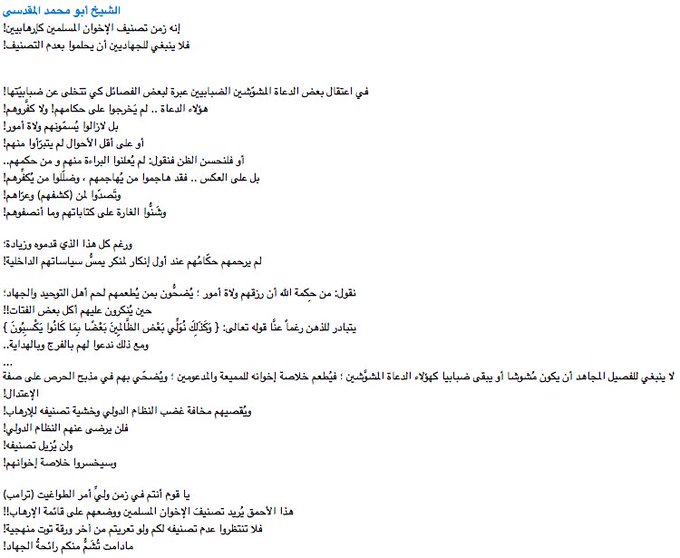
In a February 24 missive written on the messaging app Telegram, Maqdisi invoked Trump’s possible move as evidence that political engagement with western governments is pointless, as Muslims will just end up being called terrorists anyway.
“All Jihadis should not dream of no classification!” he wrote. Using poetic language common in Arabic writing, he wrote of Trump: “Oh people you are now at a time of a guardian of all tyrants.” He also encouraged his followers to pursue their extremism, pointing to the treatment of the Muslim Brotherhood as an example of how they will be suppressed even if they embrace moderation and political engagement with the West. “That stupid [person] wants to label the Muslim Brotherhood on the terrorist list!! So don’t wait for him to un-label you even if [you lost everything]! As long as you smell like the scent of jihad [the idea of jihad is not gone]!”
Cole Bunzel, a PhD student at Princeton who studies Islamist movements, posted it to Twitter:

Bunzel explained how he read the letter: “Basically he just says that the jihadis (his term) ought to hope that the Brotherhood is designated, noting that Trump wishes to do this,” Bunzel told The Intercept in an email. “His purpose in saying this though is not to exonerate the MB (which he hates) but to criticize those elements of the Syrian armed opposition he sees as drifting in the direction of the MB by trying to show the West good will — e.g., attending talks in Astana.”
The peace talks held in Astana, Kazakhstan, have brought together major players in the Syrian civil war, including opposition groups and the Syrian, Russian and Turkish governments. But some Syrian opposition groups are boycotting the talks, believing them to be pointless.
“So he says at the end that if Trump designates the MB don’t think you’ll escape the same fate,” Bunzel concluded.

Naval Exercises Add Trillions of Pieces of Plastic Debris to Oceans

Go to Original
By Dahr Jamail


For the next two decades, the US Navy will inject hundreds of thousands of pounds of flares and billions of metal-coated glass fibers into ocean waters off the coasts of Washington and Oregon.
When the last two decades are added in, the Navy will have left behind more than half a million pounds of flares and trillions of microfibers of chaff (a radar countermeasure dropped by aircraft) by the year 2037.
Additionally, as Truthout previously reported, upcoming naval exercises will inject 20,000 tons of heavy metals and explosives into the seas.
These shocking numbers are due to a widespread domestic military expansion, which entails a dramatic uptick in the number of naval training exercises conducted each year.
When one looks more closely at what it means for that much toxic material to be added to the oceans, the news becomes even more disconcerting.
No Significant Impact?
The Navy claims its ramped-up activity will have no significant impacts.
However, Karen Sullivan, a retired endangered species biologist who cofounded the West Coast Action Alliance, which acts as a watchdog of naval activities in the Pacific Northwest, disagrees with that claim.
"When have they ever claimed there would be significant impacts?" Sullivan asked, in an interview with Truthout.
The Navy makes no-impact claims on a regular basis, but conducts its own research to back up the claims.
"The data they produce never fails to back up their 'no significant impact' claims," Sullivan explained. "To wit: The mission statement of the Navy's 'Living Marine Resources (LMR) Program,' a taxpayer-funded government research program run by the Navy, is to ' ... improve the best available science regarding the potential impacts to marine species from Navy activities ... while preserving core Navy readiness capabilities.' Which translates to, let's not get too carried away with conclusions we don't like."
There are 22 ongoing research projects taking place at LMR, and some are genuinely collaborative scientific efforts. But others are not.
For instance, the lead scientist for a study on the effects of explosions on marine species works for the Space and Naval Warfare Systems Center, a Navy-owned division that, according to the Navy, "will be the Nation's Technical Leader for Integrated Information Warfare Solutions." The lead scientist for another study, on beaked whales, works for the Naval Undersea Warfare Center -- as do eight of the 11 other authors.
"This fox-in-henhouse science is not new," Sullivan explained. "Take flares, for example. Among other things, they contain hexavalent chromium, which is highly carcinogenic when ingested or inhaled in small quantities."
However, when confronted with this fact, the Navy persistently quotes an Air Force study from 1997, which concluded that it is safe to fire 8.2 billion flares containing 2.4 billion grams of hexavalent chromium over a 1.6 million acre area of land, without significantly increasing the risk of cancer. That conclusion is based on a human being living 70 years and not being exposed to any other type of carcinogens besides chromium.
Another example of the Navy's deceptive research practices relates to chaff. Chaff fibers are about the thickness of a human hair and range in length from a third of an inch to about three inches. The armed services now use a lot of it worldwide for peacetime training. Most people are aware of what fiberglass does to human skin: The tiny fibers can irritate and make you itch for days. They can irritate the eyes, cause contact dermatitis, and if inhaled, can cause breathing difficulties.
"Chaff fibers are larger than fiberglass, but are not without risk, especially considering the huge volumes that the Navy is dropping from the sky," Sullivan said. "Considering that chaff is labeled by the Navy as an 'ingestion stressor,' and considering the length of time chaff has been in use, and the fact that until 1987, chaff strands were made of solid aluminum coated with strips of lead to increase flutter, and considering the amount released (43.7 tons of it in one year over one 2.7 million acre range alone), the public has a right to be concerned."
Once deployed, chaff fibers can remain suspended in the air for 10 or more hours, raising concerns about air quality, safety from unintended interference with FAA or other radar systems, risks to other aircraft engines, impacts to grazing livestock, and impacts on birds and bats. Seabirds have been known to swallow plastic canister parts and land birds have been observed building nests with chaff. The amount of time chaff remains airborne depends on the combination of local weather conditions and the altitude of deployment.
However, the Navy itself appears unperturbed about chaff. "Predictably, the military has downplayed public concerns for decades," Sullivan said.
Despite the Navy's near-silence on the topic, chaff still occasionally makes it into public conversations. For example, TV weather people have mentioned it, as it tends to show up on their radar when explaining weather systems. In one case in 2010, a former US marine described chaff and called out the military for using it -- and covering up its use -- on air. Another example can even be viewed on Fox News. Once a chaff cloud drifted across the state of Florida, and was so big on the TV weather radar that the entire center of the state was blotted out.
More Impacts
In the late 1990s the Air Force, Navy and Marines dropped an average of 2.5 million bundles of chaff per year, each bundle weighing six to seven ounces and containing plastic parts, on 53 ranges in the United States, including offshore waters of the Pacific Northwest. Which means that, at the time, the yearly average of chaff dropped on US soil and in coastal waters was 547 tons. If this number stayed steady, we would have seen at least 11,000 tons of chaff dropped over the last 20 years. However, advocates say that number may well be much higher.
Moreover, according to the Navy, the use of chaff in the Pacific Northwest will increase from the current 2,900 "events" per year to 5,000 events. The maximum number of chaff canisters that the Navy says it would drop in one place is 360, or about 160 pounds of chaff containing 5.3 billion fibers. Thus, it is challenging to figure out how the military came up with its "worst-case scenario for environmental concentration" estimate for all that chaff dropped in one place: only 0.02 fibers per square meter. That figure assumes the chaff plume spreads out evenly over 200 square miles, and it does not count multiple chaff events that occur in one location (in this case, within the Pacific Northwest naval training region). Multiply those 360 canisters by 5,000 events and, at a minimum, the Navy is injecting 26.5 trillion chaff fibers -- or 400 tons of chaff -- per year into the environment. The chaff is being dropped quite near the shoreline -- sometimes as close as 12 miles off Washington's coast.
"Does chaff drift inshore to more sensitive habitats?" asked Sullivan. "Absolutely. What are the chemical and physical impacts of chaff on soil functioning? What are the implications to human and wildlife health, from so much aerial deposition? What happens if the water body where chaff lands is not the ocean, but an enclosed inland lake, where concentrations of metals build up?"
When it comes to how different sea life will be impacted by the Navy's exercises, the devil is in the details.
The Navy's own so-called environmental impact statement (EIS) claims the potential for impacts from military-expended materials like flares and chaff to sea turtles are low, in part because there are so very few sea turtles.
Yet, the EIS adds, "If a leatherback sea turtle were to incidentally ingest and swallow a projectile or solid metal high-explosive fragment, it could disrupt its feeding behavior or digestive processes."
The Navy concludes that its activities won't cause a "population-level" effect, meaning it won't lead to extinction for leatherback sea turtles, but it admits: " ... sublethal effects from ingestion of military expended materials other than munitions used in testing activities may cause short-term or long-term disturbance to an individual turtle."
The Military's Contradicting Statements
When it comes to flares, what can we make of the Navy's assessment of environmental impact? The aforementioned 20-year-old Air Force report often cited by the Navy says that when a burning flare cools, its toxic combustible materials condense from a vapor state to solid particles. Unfortunately, because information was not available about the actual size of these particles or the way they condensed, the Air Force found it "hard to speculate" as to whether breathable particles were produced at all.
The report did say that over time, emissions from all these flares would not cause the Environmental Protection Agency to classify our air as failing to meet air quality standards, and it acknowledged the lack of scientific research on the impacts of flare materials on soil and water.
"Most of the documents reviewed came to the conclusion that no impacts would occur but did not support their findings with empirical data," it said (emphasis added). And because flare dud rates were unknown, the authors assumed a low total of 20 duds per year.
The Navy does not keep records of when and where it releases multiple chaff cartridges. This lack of recordkeeping allows them to conclude that marine mammal exposures are "difficult to calculate."
As Truthout has previously reported, the Navy also fails to keep track of where it fired depleted uranium rounds into the ocean over the course of decades, making it impossible to calculate exactly how much depleted uranium remains in the waters off the Washington coast. It was only possible to estimate the total amount (34 tons, at the minimum), by adding up figures found in multiple Navy documents.
Contradictions abound throughout the Navy's assessments of what it is dropping into our oceans. On the subject of chaff, the Navy has claimed that chaff will have "no significant impact" on marine life, yet in its Northwest Training and Testing EIS, it states, "Some marine animal species within the Study Area could be exposed to chaff through direct body contact, inhalation, and ingestion. Chemical alteration of water and sediment from decomposing chaff fibers is not expected to occur. Based on the dispersion characteristics of chaff, it is likely that marine animals would occasionally come in direct contact with chaff fibers while either at the water's surface or while submerged...."
Again citing the Air Force report, the Navy's final word on chaff's impact on marine mammals is dismissive -- yet simultaneously admits significant impact.
"Because of the flexibility and softness of chaff, external contact would not be expected to impact most wildlife (U.S. Air Force 1997) and the fibers would quickly wash off shortly after contact," the Navy report reads. "Given the properties of chaff, skin irritation is not expected to be a problem (U.S. Air Force 1997). The potential exists for marine animals to inhale chaff fibers if they are at the surface while chaff is airborne. Arfsten et al. (2002), Hullar et al. (1999), and U.S. Air Force (1997) reviewed the potential impacts of chaff inhalation on humans, livestock, and other animals and concluded that the fibers are too large to be inhaled into the lungs. The fibers were predicted to be deposited in the nose, mouth, or trachea and either swallowed or expelled."
More Naval Obfuscation
In the Navy's 2015 Northwest Training and Testing EIS, it quotes several studies, saying, "contamination of the marine environment by munitions constituents is not well documented."
The Navy has consistently made this claim in an attempt to show that its actions are not harmful to the environment, but it does so simply by claiming the impacts are "not well documented."

"That statement actually means that it has neither looked for nor measured its impacts on the environment," Sullivan said. "The need for more data does not mean it is scientifically sound to assume there has been no damage."
In its 2015 EIS, the Navy states, "Long-term exposure to pollutants poses potential risks to the health of marine mammals, although for the most part, the impacts are just starting to be understood." Yet later, it delineates impacts, including " ... organ anomalies and impaired reproduction and immune function." There are multiple other examples of such doublespeak within the Navy's own documents.
Lastly, if more data is needed in order to understand the impacts of the Navy's exercises on wildlife and marine life, the prudent course to take would be to not conduct exercises until the requisite data is available -- if the data show there is truly no significant impact to the environment.
A Global Perspective
When we consider the debris that US military is dropping off our own shores, we must also acknowledge the massive amounts of contamination our military has wrought abroad. Mozhgan Savabieasfahani, an environmental toxicologist and winner of the 2015 Rachel Carson prize for her research on depleted uranium (DU) and heavy metal contamination, told Truthout that the global implications of US military exercises are staggering.
"Since 2001, the United States has accelerated its war contamination of the planet," she told Truthout. "The US has spent over $3 trillion on the decimation of Iraq and Afghanistan. The number of bombs and bullets dropped on those nations alone is staggering, let alone the contamination caused by their naval exercises around the world."
As early as 2005, it was reported that US forces were using 1.8 billion rounds of small-arms ammunition per year.
"That means that approximately a quarter of a million US bullets were being expended to kill every single US war victim in the Middle East," Savabieasfahani said. "In 2015 alone, the United States dropped over 23,000 bombs on the Middle East, according to the Council on Foreign Relations."
Now, in addition to the toxic debris the US military has left strewn across large swaths of the Middle East, the Navy is planning to add to global contamination by injecting unfathomable amounts of toxic contaminants into the seas surrounding the US.
When taken together, the amount of environmental damage the US military is causing around the planet on an annual basis is nearly impossible to comprehend.

Syria war: 'Worst man-made disaster since World War II'


On sixth war anniversary, Syria headed towards 'perverted version' of what has been happening in Iraq or Afghanistan.


Go to Original
By 


Six years to the day since protesters poured into the streets of Daraa, Damascus and Aleppo in a "day of rage" against the rule of President Bashar al-Assad, Syria's uprising turned global war is far from over.
Six years of violence have killed close to half a million people, according to the Syrian Centre for Policy Research, displaced half of the country's prewar population, allowed the Islamic State in Iraq and the Levant (ISIL, also known as ISIS) to seize huge swaths of territory, and created the worst humanitarian crisis in recent memory.
International diplomatic efforts have repeatedly failed to bring the protracted conflict closer to an end and the growing role of outside actors has changed the nature and trajectory of the war.
The UN estimates the war has pushed close to five million people to flee the country, many of whom have risked their lives seeking sanctuary in Europe. Hundreds of thousands of others exist precariously in tents and tin shelters in Syria's neighbouring countries.
An entire generation of Syrian children has either been pushed out of school or forced to cope with interrupted curriculums, makeshift classrooms, or unqualified teachers. According to UNICEF, 2016 was the worst year yet for Syrian children. Nearly three million children - the UN estimated amount of Syrians born since the crisis began - know nothing but war.
The country's healthcare system, particularly in places like Aleppo, is decimated. More than four-fifths of the country live in poverty.
Basic infrastructure, such as the electricity grid, water lines and roads, is in shambles. As of 2015, 83 percent of Syria's electric grid was out of service, according to a coalition of 130 non-governmental organisations. 
On Monday, in an address to the UN Human Rights Council, UN human rights chief Zeid Ra'ad al-Hussein described the war in Syria as "the worst man-made disaster since World War II".
Zeid added that his office had been refused access to the country and that no international human rights observers had been admitted to places where "very probably tens of thousands of people are currently held. They are places of torture".
Any form of solution is basically out of the hands of Syrians.
Samer Abboud, Arcadia University
"Indeed, the entire conflict, this immense tidal wave of bloodshed and atrocity, began with torture," he said, citing as an example the torture of a group of children by security officials over anti-government graffiti in the southern city of Daraa six years ago. "Today, in a sense, the entire country has become a torture chamber, a place of savage horror and absolute injustice," he said.
UN investigators have accused the government of "extermination" in its jails and detention centres.
Global watchdog Amnesty International said in a report last August that an estimated 17,700 people had died from torture or harsh conditions while in government custody since the beginning of the conflict. The Syrian Observatory for Human Rights (SOHR) put the number at 60,000.
Many others have been executed, and far more have simply disappeared. Thousands more have died in prisons run by rebel groups and hardliners like ISIL and groups affiliated with al-Qaeda.
Intervention by regional and global players into what started as an uprising of the people against a repressive government has transformed the conflict into a proxy war as international efforts repeatedly stall.
Russia's October 2015 military intervention helped prop-up a gutted Syrian army and, with the assistance of thousands of Iranian-backed fighters, has helped put Damascus firmly back in control on the battlefield.
The Russian-backed push on the battlefield culminated in the government takeover of rebel-held east Aleppo late last year, dealing the opposition its biggest defeat of the conflict.
As pro-government forces steadily captured rebel territory over the past year, a series of "local truces" in areas crippled by years of government siege saw the transfer of thousands of fighters and civilians to Idlib, the last opposition-held province in the north. The UN has said the deals amount to forced displacement and are thus war crimes. 
Earlier this week, increased bombing in the government-besieged district of al-Waer in Homs, the city's last rebel-held bastion, pushed rebels and their families to sign on to a similar evacuation deal.
Recently renewed diplomatic efforts to bring an end to war have all but stalled, as a nationwide ceasefire agreed upon by Russia and Turkey at the end of last year falls apart.

Since the start of the year, aid deliveries have slowed to a trickle for hundreds of thousands living under siege, according to a recent report by Physicians for Human Rights. Heavy fighting has increased in recent weeks in strategic areas near Damascus, as government forces push to slice off territories from the last rebel-held stronghold close to the capital. 
Rebels boycotted a third round of Russian-led talks in Kazakh capital of Astana, ostensibly aimed at consolidating the shaky truce, over continued violence. And although Astana talks succeeded in paving the way for a fifth round of UN-led intra-Syrian talks late last year, little was agreed upon other than a basic format for future negotiations.
The internationalisation of the war in Syria has left it beholden to outside interests, according to associate professor of international studies at Arcadia University Samer Abboud. "Any form of solution is basically out of the hands of Syrians," he told Al Jazeera.
"Ultimately, what's on offer is some kind of containment of the violence, but no effort to really eliminate it," he said. "But talk about a revolution or a political transition … it’s beyond that now."
Key rebel backers like Turkey and the United States have narrowed their agendas in Syria over the past year, as government gains on the battlefield erase the prospect of regime change and domestic priorities take precedent. 
Ankara, whose troops now occupy a large section of territory in Syria's northeast, has given up on removing Assad in favour of preventing an armed Kurdish autonomous region on its border. 
The US, who ,along with Turkey and the Gulf states, was central to facilitating the armament of what started as a peaceful uprising, has remained a political voyeur since Donald Trump's administration came to power.
Instead, it has remained hyper-focused on making shortsighted, tactical gains against ISIL.
Just last week, the Pentagon deployed another 500 marines to Syria and spoke of the possibility of a long-term US presence in the country.
Infighting and a lack of international support have left rebel forces increasingly dependent on groups with hardline religious agendas. And as the government, Turkey and the US, along with their respective allied forces, race to push ISIL out of its self-declared capital in Raqqa, the international agenda in Syria is shifting the narrative of the conflict. 
"Syria is headed towards some sort of perverted version of what has been happening in Iraq or Afghanistan… where reconstruction efforts will be forced to exist alongside low levels of violence," said Abboud.
"The war economy is entrenched … and outside players are reserving their right to do exactly what they want in Syria under the appearance of international consensus."