Friday, February 24, 2017

An Actual False-Flag Operation at CPAC

Meet the protesters who tricked conference attendees into waving Russian flags.

Go to Original
By 

Two men made trouble—and stirred up a social-media frenzy—on the third day of the Conservative Political Action Conference by conducting a literal false-flag operation.

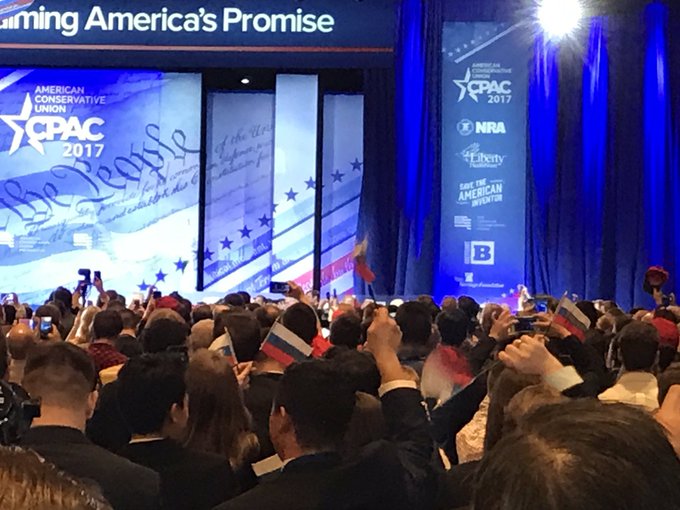
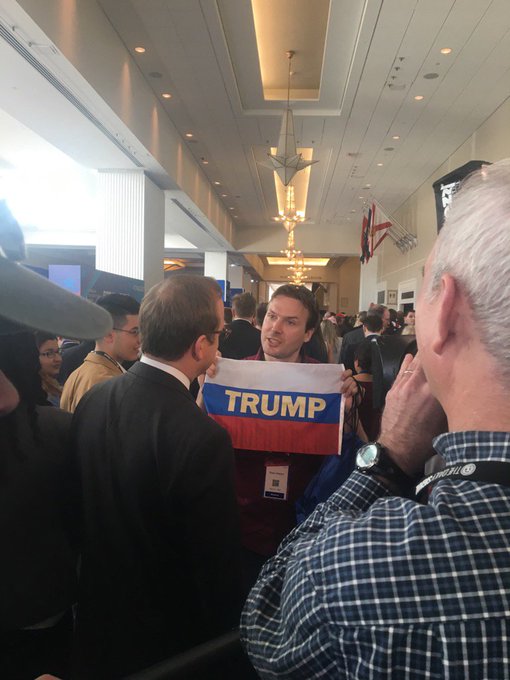
Jason Charter, 22, and Ryan Clayton, 36, passed out roughly 1,000 red, white, and blue flags, each bearing a gold-emblazoned “TRUMP” in the center, to an auditorium full of attendees waiting for President Trump to address the conference. Audience members waved the pennants—and took pictures with them—until CPAC staffers realized the trick: They were Russian flags.
The stunt made waves on social media, as journalists covering CPAC noticed the scramble to confiscate the insignia.
No joke, someone has been handing out Russian flags that say  on them. And people are waving them.

A section of people in the back of  waving Russian flags -- a staffer just came and demanded they all be handed over.


 Clayton himself was photographed outside, holding up a larger version of the flag:
“Most people didn’t realize it was a Russian flag, or they didn’t care,” Charter told me in a phone interview. He and Clayton had purchased tickets to CPAC for the day the president was scheduled to speak, and managed to disperse the flags with surprising ease among the crowd.
But the two wouldn’t call it a “false-flag” operation. “It’s true-flag operation,” Clayton told me over the phone, in a thick, mock Russian accent. “It show how Trump and Russia are so connected, they like peas in pod!” The CPAC stunt comes after a report from February 14 suggesting that Trump aides were in contact with Russian intelligence officials in the year before the U.S. presidential election. Trump himself has also praised Russian President Vladimir Putin on a number of occasions.
After the flag trick, Clayton was escorted from the premises, but Charter wasn’t booted until he stood up during Trump’s official remarks to accuse him of being a “fascist” and “Putin’s puppet.”
“And, I was banned from CPAC,” Charter said, sounding pleased. “I think there are multiple ways you can resist against Trump, and I think this is one way that’s extremely effective,” Charter said. In other words, he said, “It’s fun to have a joke sometimes in a very serious situation.”
The two are members of Americans Take Action, a self-proclaimed “resistance organization” whose website features a petition to impeach Trump and lists three priorities: restoring free and fair elections, creating a purpose-driven economy, and maintaining an open internet.
The group is relatively new, but it’s already been busy. In late January, Clayton, the organization’s president, and Charter infiltrated and attempted to film a private event held by James O’Keefe, a conservative provocateur and the leader of Project Veritas, Charter told me. The group also attempted to disrupt Trump’s inauguration by shouting lines from the Constitution during his inaugural address.
Its choice of O’Keefe as a target is a reminder that groups on both sides of the political spectrum frequently stage stunts like these in an effort to attract media coverage for their agendas, as Charter and Clayton successfully did on Friday.
“We will continue doing these actions until Trump is impeached,” an unrepentant Charter said.
“Remember,” Clayton added, still committed to the fake accent, “In Trump’s America, flag wave you!”

Trump asks NASA to explore putting crew on rocket's debut flight

Go to Original
By Irene Klotz

The Trump administration has directed NASA to study whether it is feasible to fly astronauts on the debut flight of the agency’s heavy-lift rocket, a mission currently planned to be unmanned and targeted to launch in late 2018, officials said on Friday.
The study marks President Donald Trump's first step in shaping a vision for the National Aeronautics and Space Administration.
Under former President Barack Obama, the U.S. space agency was working on the heavy-lift Space Launch System rocket and Orion deep-space capsule with the aim of sending astronauts to rendezvous with an asteroid in the mid-2020s, followed by a human expedition to Mars in the 2030s.
The request for the study from the new Republican president’s administration tweaks that plan by exploring whether to add a crew to an earlier test flight and perhaps setting the stage for a human return to the moon.
NASA officials said they do not feel compelled to fly the test mission with crew aboard, Bill Gerstenmaier, NASA’s head of human space flight, told reporters on a conference call.
“There’s not pressure to go do this,” Gerstenmaier said. "I find it encouraging that we were asked to go do this feasibility study."
The study is expected to take about a month. Engineers are assessing hardware changes, schedule delays, additional costs and increased risks of flying a two-member crew on the first flight of the Space Launch System rocket, which is about four times bigger and more powerful than any current U.S. booster.
A NASA safety oversight panel on Thursday cautioned that the agency should have compelling reasons for adding crew to justify the extra cost, risk to human life and schedule delays.
“If the benefits warrant assumption of additional risk, we expect NASA to clearly and openly articulate their decision-processing rationale,” Patricia Sanders, head of the Aerospace Safety Advisory Panel, said at a meeting at the Kennedy Space Center in Florida.

If approved, the astronauts would fly aboard an Orion capsule, under development by Lockheed Martin Corp, and swing around the moon during an eight- to nine-day mission, similar to what the Apollo 8 crew accomplished in 1968.
Gerstenmaier said adding crew to the mission would not be worthwhile if it forced the flight to be delayed more than about a year.
The rocket’s second flight, which is to include crew, is targeted for August 2021. The study will explore what would be gained technically by having a crew aboard sooner.

Florida man pleads guilty in attempted hacking of Clinton Foundation

Go to Original
By Nate Raymond and Nathan Layne

A Florida man pleaded guilty in a case stemming from an attempted hacking of the Clinton Foundation on Thursday, months after he was sentenced to 42 years in prison in the wake of child pornography discovered on his computers during the probe.
Timothy Sedlak, 43, pleaded guilty in federal court in Manhattan to attempting to access protected computers without authorization. Prosecutors accused him of trying to gain access to an unnamed New York-based charitable organization's network.
"I knew that what I was doing was wrong," Sedlak said in court.
Neither prosecutors nor Sedlak named the organization from which he tried to get access to emails.
In a court filing obtained by Reuters that summarized a U.S. Secret Service interview in 2015 with Sedlak, an agent said he was questioned about notes they found referencing former Democratic presidential candidate Hillary Clinton and her daughter, Chelsea Clinton.
Sedlak, who called himself a private investigator, told the agents he was researching whether charities were unintentionally providing funding to Islamic militant groups, and said the Clintons "came up in his research," the filing said.
The filing's description of the Clintons matched prosecutors' descriptions of two previously unnamed individuals who were said to be executives at the charity and an "individual who has been publicly affiliated" with it.
Chelsea Clinton is the vice chair of the foundation, which was started by her father, former U.S. President Bill Clinton. Its full name is the Bill, Hillary & Chelsea Clinton Foundation.
The filing was downloaded by Reuters on Feb. 3. It was later replaced by a redacted version removing the Clintons' names.
Clinton Foundation representatives did not respond to requests for comment.
The investigation into Sedlak, of Ocoee, Florida, predated probes into cyber attacks on Democrats during the 2016 presidential election.
U.S. intelligence agencies in January released an assessment indicating that Russian President Vladimir Putin had ordered cyber attacks to help Republican Donald Trump's electoral chances by discrediting Clinton.
Sedlak launched about 390,000 unsuccessful attempts to gain unauthorized access to the charitable organization's computer network, according to prosecutors.
Following his arrest in 2015, authorities discovered files on his computers containing child pornography, including images depicting Sedlak sexually abusing a toddler, prosecutors said.

Sedlak was separately charged in Florida, where a federal jury in Orlando in May found him guilty of charges he produced and possessed child pornography. He was sentenced in August to 42 years in prison.

Kansas shooting raises safety concerns for foreigners in US: 'Do we belong here?'

FBI investigation into whether the shooting of two Indian men was a hate crime also raised questions about the White House’s rhetoric around immigration

Go to Original

The FBI is investigating whether the shooting of two Indian men at a bar in Kansas could be a hate crime, amid reports that the gunman harassed the victimsbefore opening fire on Wednesday night.

Adam W Purinton was charged with murder for allegedly shooting Srinivas Kuchibhotla, 32, and his friend Alok Madasani, 32, at the Austins Bar & Grill in Olathe, Kansas. Kuchibhotla died in the hospital from his injuries, and Madasani has been released from the hospital.

At least one witness told the Kansas City Star that the gunman yelled “go back to your country” before opening fire.
In India, citizens raised concerns about the safety of foreigners in the US. It also raised questions about the White House’s rhetoric around immigration, which has promoted Donald Trump’s “America First” position on allowing people into the country.
White House press secretary, Sean Spicer, said the death in Kansas was tragic but that it would be absurd to link the action to Trump’s rhetoric, according to Reuters. He also said it was too early to determine the motive.
But for Kuchibhotla’s wife, Sunayana Dumala, the incident raised questions about whether immigrants are valued in the US. Dumala said at a press conference on Friday that she wanted an answer to just one question: “Do we belong here?”
Dumala said she wondered before if her family should stay in the country because of its high rates of gun violence but her husband told her “good things happen in America”.
More than $413,000 has been raised on the crowdfunding website GoFundMe to help Sunayana pay for funeral expenses and other costs.
Any action on charging the incident as a hate crime would have to come from the federal government because Kansas does not have a hate crime statute, said Johnson County district attorney Stephen M Howe.
Purinton was charged with first-degree murder and two counts of attempted first-degree murder on Thursday. He is set to appear in court on Monday. Authorities declined to provide additional details about the incident.
Johnson County court records show Purinton had faced a drunken-driving charge in 1999, which was dismissed, and received a speeding ticket in 2008.
Purinton’s next-door neighbor, Beverly Morris, told the Kansas City Star he was “usually pretty inebriated”, while other neighbors remembered a reclusive, sometimes emotional man who would occasionally help neighbors with gardening tasks.
He worked with the Federal Aviation Administration until 2000, according to an agency spokesperson.
Police apprehended Purinton at an Applebee’s about 80 miles away in Clinton, Missouri, after being tipped off by a bartender at the restaurant, who said Purinton told them he had been involved in the shooting.
Another man, 24-year-old Ian Grillot, was wounded in the hand and chest after trying to stop the shooter, he said.
Loaded: 0%
Progress: 0%
Mute
Pinterest
 Kansas bar shooting victim tells how he tried to tackle gunman
“I got behind him and he turned around and fired a round at me,” he said, in a video from his hospital bed.
“I was just doing what anyone should have done for another human being. It’s not about where he’s from, we’re all humans.”
The other two victims both worked at the aviation division of the tech company, Garmin.
Garmin said it was “devastated by the senseless tragedy that took the life of one of our associates and friends” and injured another. “Srinivas was a valued member of our engineering team and will be greatly missed,” the company said in a statement.
Another former employer, Rockwell Collins, an avionics and information technology systems company, spoke highly of the deceased engineer.
“I couldn’t say anything slightly bad about Srinivas,” his former manager at the firm, Rod Larson, told the Kansas City Star. “He was well-liked by anybody. He was excellent in all categories. He was a low-maintenance employee and did whatever was asked of him”.
The shooting has sparked widespread concern among Indian parents who have children living in the US. One parent, Sreemala, from Kuchibhotla’s home state of Telangana, told NewsMinute: “My daughter is working in the US. I have made it mandatory for her to call me twice a day after the recent incidents happening in US.
“Last week, she forgot to call me at night and her phone was unreachable. I cannot explain my situation in words. I couldn’t sleep the whole night. After Trump, it has become worse. Earlier, there used to be frequent robbery on the streets, but now they are shooting our children. How we are supposed to stay calm?”
In India, newspapers and television reports covered the Kansas shooting extensively, with editorials raising concerns about the safety of Indians in the US, and headlines labelling Grillot a hero.
The US embassy in Delhi also condemned the shooting. “The United States is a nation of immigrants and welcomes people from across the world to visit, work, study and live,” the US chargé d’affaires, MaryKay Carlson, said in a statement.
“US authorities will investigate thoroughly and prosecute the case, though we recognise that justice is small consolation to families in grief.”

Law Enforcement Using Facebook and Apple to Data-Mine Accounts of Trump Protest Arrestees

Data surveillance targets people hit with trumped-up felony riot charges.

Go to Original
By Sarah Lazare

Law enforcement is compelling Apple and Facebook to hand over the personal information of users who were mass arrested at protests against the inauguration of Donald Trump in Washington, D.C., AlterNet has confirmed. The tech giants appear to be complying with the data-mining requests, amid mounting concerns over the heavy-handed crackdown against the more than 200 people detained on January 20, among them journalists, legal observers and medics.
“This is part of an increasing trend of law enforcement attempting to turn the internet, instead of technology for freedom, into technology for control,” Evan Greer, the campaign director for Fight for the Future, told AlterNet. “This trend started long before Trump and seems to be escalating and growing in scale now."
More than 200 of those picked up in the sweep at the anti-fascist, anti-capitalist bloc have been hit with felony riot charges, which carry penalties of up to ten years in prison and a $25,000 fine. Because the arrests took place in Washington, D.C., the cases are being prosecuted by the U.S. Attorney’s Office for the District of Columbia, which is directly accountable to the Department of Justice, now overseen by the notorious white supremacist Jeff Sessions.
Mark Goldstone, a National Lawyers Guild-affiliated attorney who is representing numerous defendants in the case, told AlterNet that “several” of his clients have been contacted by Facebook and Apple and informed that their personal information has been requested by law enforcement.
AlterNet viewed a “customer notice” email sent on February 14 by Apple to one of the defendants, who requested anonymity due to the ongoing charges. “On 2017-01-27, Apple Inc. ('Apple') received a legal request from United States Attorney's Office requesting information regarding your Apple account,” the message states.
The communication states that “Apple will be producing the requested data in a timely manner as required by the legal process.”
The individual who received the notice told AlterNet, “My phone wasn't present at the time of arrest and wasn't taken.” That individual does not know whether the data has been handed over to prosecutors.
“I wasn’t surprised by it, but it was also very unsettling and made me feel very vulnerable and exposed,” the individual said. “That some federal grunt could be looking through old texts, personal stuff and selfies. This is exposing and gross and creepy.”
Goldstone emphasized, “It’s an outrageous overreach by the government to try to data-mine personal property that wasn’t even seized at the demonstration. This will be fought vigorously.”
AlterNet also viewed a statement sent from Facebook on February 3 to an anonymous defendant. “We have received legal process from law enforcement seeking information about your Facebook account,” states the email, sent from the company’s records office.
“If we do not receive a copy of documentation that you have filed in court challenging this legal process within ten (10) days, we will respond to the requesting agency with information about the requested Facebook account,” the letter continues. “We may need to respond to this legal request within less than ten (10) days if we have a reasonable belief that we are legally required to do so.”
Stephanie Lacambra, a criminal defense staff attorney for the Electronic Frontier Foundation, told AlterNet that, in addition to Facebook and Apple, Google has also been sent requests for information by law enforcement. None of the companies responded to a request for an interview.
‘What is the government doing with the data?’
It is not immediately clear what information law enforcement has requested and under what legal justification.
“The most invasive form of surveillance is a warrant. A judge could authorize police to look through every byte of data on someone's Facebook account,” Michael Price, counsel for the Liberty and National Security Program at the Brennan Center for Justice, told AlterNet. “A 2703(d) court order allows police to get metadata about communications, and that could possibly include location information about when communications took place and when a phone was connected to cell tower. A national security letter allows police to get that information but does not require a court order.”
According to Lacambra, law enforcement could be accessing “surface information like user names, the registration information that was collected and the metadata on the last time of login and duration of service.” Or, they could be searching “information stored in Apple iCloud, contacts, the content of emails, any number of photos that are stored there.”
“I don't know the scope of information,” she said, “because I don’t know what legal instrument was used.”
Goldstone, the defense attorney, said he was not informed of what legal justification law enforcement invoked to seize the information. “No one has said or sent anything to me,” he explained.
The Metropolitan Police Department and the U.S. Attorney's Office for the District of Columbia both refused to comment, citing the pending investigation.
According to Price, “As a general matter, it is not uncommon for law enforcement to seek information from a third-party service provider like Apple or Facebook. It happens all the time."
"One of my biggest concerns," he said, "is that police will attempt to use electronic surveillance to get information about the people who were at the protest, in order to compile a list of the people who were present. Is that information going to be mined and used for other purposes? What is the government doing with the data? Are they going to store it? Are they going to send it to an intelligence analyst?”
Lacambra said the investigation raises disturbing questions. “Why is the Department of Justice trying to intrude into the digital lives of people exercising their rights to protest?” she asked. “Is this to intimidate, silence or threaten people for exercising their constitutional rights? When you arrest 230 people, some of whom are medics and legal observers, and try to systematically get to the content of their digital life, that is troubling."
The anti-capitalist, anti-fascist bloc was part of a day of disruptive protests across Washington, D.C., and the world, to interrupt business as usual and register opposition to the rise of Donald Trump, whose cabinet has aggressively delivered on his white supremacist campaign pledges. Since Trump took the White House, millions have taken to the streets, flocked to airports and mobilized to defend their neighborhoods and communities against a multi-pronged assault.
‘People should be paying close attention’
Some of the arrestees were already suspicious that police had searched their phones, which were seized by police. Those phones are still being held as evidence, according to legal support volunteers.
AlterNet spoke with a journalist who was arrested on January 20 and requested anonymity. He sent AlterNet a screenshot of his Google account, which shows that while he was detained and his phone was in police custody, there was activity on his account. AlterNet confirmed that the login occurred while the phone was in police custody by viewing a property receipt issued to the journalist by the MPD. The journalist says his phone is password protected.
This mysterious account activity is similar to activity on the account of an unidentified medic, reported by George Joseph of CityLab. As in the case of the journalist, the medic spotted activity on his account while the phone was in police custody. Joseph notes that a screenshot of the activity “suggests that police began mining information from the captured cellphones almost immediately after the arrests.”
Goldstone, who has defended protesters in Washington, D.C., for more than 30 years, underscored that he has “never seen phones seized at protests, let alone phones that were not part of a protest."
He also said that he has “never seen a felony riot charge in Washington, D.C., let alone more than 200 of them.” According to news reports, 214 people have been indicted for these charges so far, indicating that the prosecution plans to move forward with the bulk of the charges.
“We’re in a dangerous new world,” he declared.
Those arrested in the sweep already reported heavy violence at the hands of the MPD, which is overseen by Chief Peter Newsham, who has a troubling history of kettling and mass arresting people in the proximity of protests.
On January 20, Washington, D.C.-based lawyer Jeffrey Light filed a class action lawsuit on behalf of those detained charging that “Without warning and without any dispersal order, the police officers kettled all of the plaintiffs.” The lawsuit states, “Defendants John Doe MPD Officers and/or John Doe Park Police Officers deployed a large amount of chemical irritants against the plaintiffs, as well as struck multiple plaintiffs with their batons, and deployed flash-bang grenades.”
The anonymous journalist told AlterNet that, while covering the protests, he was sprayed in the face with what he believes was OC gas. “Two flash-bang grenades fell within three or four feet of me. I had tinnitus in my ears for a couple of minutes. I yelled out for a medic, and by the time I could see, we were completely kettled. I was incapacitated. I had a press badge and tried to tell them I was press."
AlterNet spoke with one anonymous arrestee who said that, at the police academy where arrestees were taken for processing, he received a “two-knuckle-deep cavity search.” He noted, “I didn’t see any reason for it.”
According to Greer, the police crackdown is “unquestionably an attempt to silence dissent, frighten people and keep them off of the streets. But I wouldn’t call it new. Anyone who has been involved in activist movements for more than a few years has seen this before.”
In recent weeks, Republican lawmakers across the country have introduced state-level bills aimed at criminalizing protests. One piece of proposed legislation in Washington state calls for certain acts of civil disobedience to be classified as “economic terrorism.” North Dakota lawmakers introduced a bill that would make it lawful for motorists to hit and kill protesters staging acts of civil disobedience obstructing highways, as long as the cause is “negligence.” The legislation, which failed earlier this month, is clearly aimed at Indigenous resistance at Standing Rock, as well as the Black Lives Matter movement, which has staged acts of civil disobedience across the country.
Meanwhile, police departments have long been building up their capacity for surveillance. A 10-month investigation by CityLabs.com, a project of The Atlantic, revealed earlier this month that “major police departments around the country are spending millions on cellphone spy tools that can be used to build up massive surveillance databases—with few rules about what happens to the data they capture.” According to the investigation, most of the major police departments in the United States have either cell phone interception devices and/or “cell phone extraction devices, used to crack open locked phones that are in police possession and scoop out all sorts of private communications and content.”
In light of this climate, the fact that tech giants like Google, Apple and Facebook store large amounts of personal data is sparking concerns.
"Tech companies are building business models based on collecting large amounts of personal information and then failing to protect that information from the government and others who attempt to access it,” said Greer, who attended the January 20 protests in Washington, D.C. “People should be paying close attention and be concerned.”